
Vamos Amigos! Come with us to Mexico! Part 4 of our Travel Blog.
Updated: Mar 22

So far we have written extensively about our adventures in Mexico. Unfortunately, shortly before the end of our trip, there is, once again, no more space on the blog. Therefore, we have set up a new part 4 of our travel blog.
Here you can read and see photos of Loreto and the remaining days of our adventure in Baja California Sur and in Mexico City. Enjoy!

Looking back
After three months of travelling through Mexico, it’s time to reflect. We’ve written about the places, the adventures, and the people — but what did we really take away? And what kind of tourists were we?
Tourism in Mexico, as elsewhere, is a double-edged sword. On one hand, it brings clear benefits: jobs, support for small businesses, and the preservation of culture, traditions and historic sites. Many livelihoods depend on visitors.
But there’s another side — harder to ignore.
Baja California, for example, left us with mixed feelings. It offered stunning landscapes, beautiful beaches and a sense of freedom — but also moments of discomfort. Away from charming towns like Loreto, the desert reveals stark poverty. What struck us most was the contrast: huge motorhomes and oversized pickup trucks travelling along Highway 1, overnighting on the beaches, whilst next to them, local families camp in simple tents or inside their work vans.
Many visitors come from the US and Canada, drawn by sunshine, space and lower costs. But the divide between wealthy visitors and local communities feels very real — and raises questions about sustainability. At times, Baja even felt less “Mexican” than the mainland, with English often the default language in tourist areas. It makes you wonder how locals feel about this— welcoming or quietly resentful?
We noticed similar patterns elsewhere. In cities like Mexico City and Oaxaca, tourism is transforming neighbourhoods. Rents are rising, short-term rentals and Airbnbs are increasing, forcing locals out of city centres. When we returned to Oaxaca after nine years, it felt busier, more crowded, and at times overwhelming. Cultural traditions seemed increasingly shaped for visitors rather than lived from within. North Americans often fly down to Oaxaca for a long weekend of partying.
Mass tourism also brings environmental strain. We experienced water shortages ourselves — locals going without, while tourist accommodation remained supplied and swimming pools filled. And culturally, there is tension too. Events like Día de los Muertos, once an intimate family ritual, are now major attractions, sometimes reduced to photo opportunities for visitors who don’t fully understand their meaning and just want to upload photos to Facebook or Instagram.
All of this raises an important question: where do you draw the line between appreciation and intrusion?
We tried to travel thoughtfully — supporting local businesses, speaking Spanish, and respecting boundaries. There were things we chose not to do, such as visiting cemeteries during Día de los Muertos. Some moments feel too personal to observe, and too obtrusive.
Perhaps that’s the key: to travel with curiosity, humility and respect.
Mexico is an extraordinary country — rich in culture, warmth and creativity. The challenge, here as elsewhere, is finding a balance where tourism supports communities without overwhelming them. We don’t want to be the cause of “Gringos go home” spray-painted on the walls.
Our travels in Mexico gave us incredible memories, a fondness for the people and respect for their culture and environment.
Lisa and Dave
8. Last Phase: Mexico City: 8th until 12th March 2026

Lisa:
8th March 2026
The drive from Los Barriles to Los Cabos was quick, and so was the handover of our campervan to Julian of Vanbaja. There was no damage, no scratches; we were happy with it. It had suited us perfectly for our travels through Baja California. We very much appreciated Julian’s remote support when something went wrong. A great service. Julian kindly drove us to the airport, where we said goodbye and wished him all the best for his campervan rental business.
From our experience of handing back our camper in Sidney, Australia, we had expected a long wait for the handover formalities and had therefore booked a later flight back to Mexico City in the afternoon. As it turned out, we arrived at the airport far too early with plenty of time to kill. First, we sat outside on a bench in the warm sun and finished our leftovers from our previous evening: Jumbo prawns, fish and veg - cold but still delicious. Afterwards, we moved inside to the waiting area and spent some time writing on our blog. Eventually, our flight was called, and once again we were reminded that our chosen airline, Volaris, is the Mexican equivalent of Ryanair: cheap, cheerful and with very little legroom. Poor Dave had to sit sideways, but fortunately, it was only a 1 1/2 hour flight.
By the time we arrived in Mexico City, it was already dark. The taxi driver informed us that, due to demonstrations in the city centre, he might not be able to drop us directly in front of the hotel but would get us as close as possible. He explained that it was International Women’s Day and claimed that the women marching on the street were very violent, warning us to be careful. I chose not to pursue the conversation further.
However, when we reached the centre, there were no demonstrations and no roads blocked. We drove straight through, and he dropped us directly outside our hotel. The only sign of any potential unrest was the presence of numerous police vans filled with armed officers stationed on street corners, their lights flashing. The shutters of the shops were down, but there was no sign of violent protesters. Later, when we went out for dinner, we even found some of them in our restaurant, El Quatro 20, enjoying a meal and drinks with friends - perfectly peaceful. The supposed “violence” seemed entirely exaggerated.

At the hotel, however, we faced some disappointment. The first-floor room with a balcony overlooking the square, which we had booked and paid for five weeks ago, was not available due to a problem with the water pipes. We were offered instead, a dark room with a view to a side street. Strangely, our friends, Beverley and Terry, who had stayed at the same hotel a few weeks ago before returning to London, had the same problem and had also been given another room. We asked the staff to find us an alternative and, in the meantime, we headed out for dinner.
When we returned, there was still no other room available. We spoke to the manager, who explained that the hotel was fully booked and that we might be able to change rooms in two days, or perhaps even tomorrow. How frustrating! After our wild camping experience in Baja, we had hoped to end our time in Mexico on a high note, in a lovely hotel room. However, changing rooms for the final night would have been far too disruptive. Instead, we asked for some form of compensation - perhaps a bottle of their best red wine? Agreed! We accepted the room, and in the end, it turned out to be rather nice.
The Hotel Domingo Santo describes itself as a boutique hotel - very modern and stylish, in a historic building, with indirect lighting throughout that can be dimmed. The reality, however, was a little more complicated. The light switches were temperamental and required patience. Dave’s bedside lamp seemed to have a mind of its own, constantly cycling through its three brightness settings. In the end, he had to remove the bulb to get some sleep. The toilet and shower area had glass walls, which looked stylish but offered very little privacy. The lighting in there was so dim that you could barely see. The door to our room did not lock, so we could only hope that no one would wander in uninvited. That said, the room itself was pleasant enough - with a small balcony overlooking a side street. Once the motorbikes and lorries had stopped passing through, it was relatively quiet.
9th March 2026
We slept very well and, reassuringly, nobody had broken into our room overnight. Breakfast was served on the roof terrace overlooking the square, a lovely setting. They didn’t have black tea, but thanks to Beverley’s generous supply of Twinings tea bags from London, I now travel prepared, bring my own tea bag, and simply ask for hot water. Problem solved. The food was excellent, although the waiter - clearly a stand-in - seemed rather stressed. He spoke very little English, which did not help matters, especially with the demanding Indian couple from Texas at the next table, who appeared determined to make his life as difficult as possible. We felt quite sorry for him.

After breakfast, we hurried to the National Palace, hoping to finally get tickets to photograph the Diego Rivera murals. After Christmas, tickets had sold out daily by 10 am, and we were told March would be quieter when fewer tourists were in town. Unfortunately, the palace was now closed for refurbishment until the end of April. Typical! Very disappointing, but nothing to be done.
So, we improvised and spent the morning in the historic centre before setting off in the afternoon on a “dummy run” to Frida Kahlo’s house in Coyoacán. We had managed to secure tickets weeks in advance for tomorrow at 11.15 am and were determined not to miss our slot. On a previous visit, we’d seen a couple turned away for arriving just 20 minutes late - lesson learned.
The journey wasn’t straightforward. We took the metro, changed at Ermita Station, and then had to find the right bus. This proved trickier than expected, with several people confidently sending us in the completely wrong direction. Eventually, an older man approached Dave, who was a little dismissive at first. The man then spoke to me and gave clear, accurate directions, even describing the colour of the bus and correctly guessing our destination. He also asked me to tell Dave not to be afraid of him. Fair enough. We explained our frustration, and he laughed knowingly before heading off.
We found the bus, paid 15 Mexican pesos (£0.64; 0.74 Euros) for both of us, and 17 minutes later were dropped right outside Frida Kahlo’s famous blue house. Success! We now know exactly where to go and how long it will take; there are no excuses for being late tomorrow. Job done. We celebrated with tea, coffee and an almond croissant at a nearby cafe.
The return journey, however, was less relaxed. The metro at 5 pm was packed with commuters. When we reached our stop, Allende, we couldn't get off because people were already pushing their way in. We shouted and pushed (politely, at first) to get out. I just about managed to squeeze through, but Dave was stuck. A large man shoved him, and he shoved back; others joined in - it was escalating quickly. For a moment, it looked like things might turn ugly. Then, somehow, Dave broke free just as the doors were closing. The train pulled away behind him. That was a close one.
On the way back to the hotel, we came across the damaged head of the Angel of Independence on display in the courtyard of the Historic Archives. The original statue on the Plaza de Independencia had fallen from its column during the 1957 earthquake, shattering on impact. While the statue was later restored, the original head could not be repaired and is now exhibited as a reminder of the event - known locally as “el sismo del Angel’ (the Angel's earthquake).

We still had one unresolved issue: our terracotta jaguar. Five weeks earlier, we had bought it at the Saturday Bazar. Jaguars symbolise strength and protection in Mexico, and we were keen to bring this one home. The seller, Rodrigo, had promised to deliver it to our hotel - but it hadn’t arrived. Nor could we reach him despite multiple calls and messages. By now, we were getting concerned. We mentioned it to our hotel manager (now our friend), and he immediately took charge. He called Rodrigo and got through straight away (of course), politely but firmly asking when the jagar would be delivered. After much apologising, Rodrigo promised it would arrive that afternoon or evening. We would see.
Reassured, we headed for dinner at the well-known Café de Tacuba. The historic interior, with its ornate paintings and gold-framed pictures, felt almost church-like. The food was good, and the staff were dressed in traditional attire - the waitresses resembling nurses in their white aprons and headpieces. A live band played throughout the evening; they were good, apart from one singer who struggled rather heroically with the high notes.

It was an enjoyable experience, but overall it felt like an overpriced tourist spot. We both preferred El Quatro 20 from the night before - livelier, simpler, better food and half the price. An easy choice for our final evening.
Back at the hotel, relief at last - our jaguar had arrived. We took him upstairs, and the next day, we would buy bubble wrap to protect him for the journey home. He was smaller than we had remembered him. Fortunately, he fitted neatly into Dave’s day rucksack, and we did not need to buy an extra bag for him.
10th March 2026
Today was the day when we returned to Frida Kahlo’s house. We had visited nine years ago and were keen to experience it again. Determined not to be late, we set off early, far too early, as it turned out, and spent quite some time queuing. Still, better early than missing our slot.
The queue was well organised; every 15 minutes, a group of people was allowed in, keeping the house and garden pleasantly uncrowded. As before, it felt less like visiting a museum and more like stepping into her home - her private world. The house and garden are full of her personality and artistic spirit.


Downstairs and in the garden, there were displays from her extensive art collection, along with black-and-white photographs of Frida with Diego Rivera, friends, and family - offering a very personal glimpse into her life.

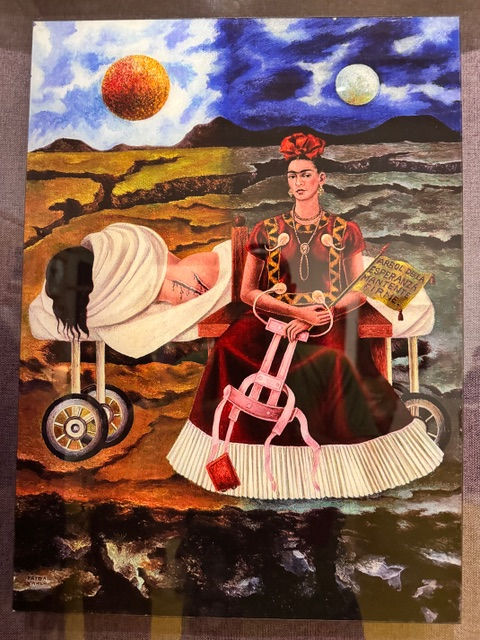
For me, the highlights were upstairs: her studio with the easel, brushes, and paints; her wheelchair placed in front of it; and her bedroom, where a mirror is fixed to the ceiling. Her father had installed it after her terrible accident, when she was confined to bed for over a year. Unable to move, she began painting herself - and the rest is history.


Frida’s paintings are displayed throughout the house. One that particularly stayed with me was a still life of watermelons. Painted years earlier, she added the words: “Viva la Vida!” (Long live life!) shortly before her death. Just days later, she passed away. It felt both powerful and poignant.

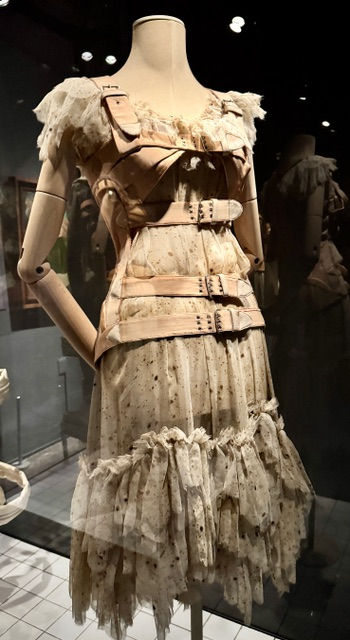
Throughout the house and garden, there are handwritten notes and letters from Frida Kahlo or Diego Rivera. In one of the smaller buildings, her corsets, crutches, dresses, and jewellery are exhibited; in another, a documentary with photographs and diary excerpts gives further insight into her life. In the courtyard, visitors can relax with a cup of coffee or even join drawing classes. There is so much to take in.
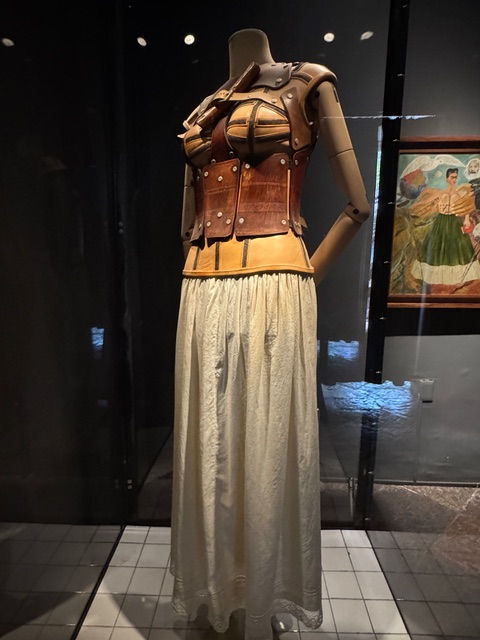
After about two and a half hours, we left - tired but deeply moved. The whole experience feels intimate and emotional, almost like a pilgrimage. People of all ages from all over the world come here, drawn by her life, her resilience, and her art. It’s absolutely worth the visit.

Much has been written about Frida Kahlo, and films have been made about her life. Here are some links for those who want to read some more background information.
Here is a link to her biography:

We recovered at a nearby café with cappuccinos, tea, and an almond croissant, scrolling through our photos before heading back. This time, the metro journey was refreshingly calm - mid-afternoon and far less crowded.
For our final evening in Mexico, we returned to our favourite restaurant, El Quatro 20. With a Bohemia dark beer in hand, Dave enjoyed a delicious octopus dish, while I had flautas (fried tortilla rolls filled with chicken). I would have happily shared more of Dave’s octopus as it was excellent, but he liked them so much and wasn’t feeling particularly generous. A real shame.

11th March 2026
On our last morning, we packed our bags and headed to the Torre Latinoamericana, a 44-storey, 182-metre-high landmark in the historic centre, opposite the Palacio de Bellas Artes. Its 360-degree observation deck on the 42nd floor promised the perfect farewell view.
The tower is an engineering marvel — the first skyscraper built in a highly seismic zone — and has survived several major earthquakes, including the devastating 1985 Mexico City earthquake. Photos in the small museum show the tower standing intact, surrounded by completely destroyed buildings — quite a sight.

After a few hazy days, the weather finally cleared just in time for our departure. The views were spectacular, stretching across this vast and impressive city — a fitting way to say goodbye.


We decided to end our journey where it had begun: at a rooftop restaurant overlooking the Zócalo, with views of the cathedral and the National Palace. With a cold drink in hand, we took it all in one last time.
Then reality intervened. A message from Aeroméxico warned us of a taxi strike targeting airport access, particularly Mexico City International Airport Terminal 2, where our flight would depart. The hotel advised us to leave early and arranged a trusted taxi.
On the way, the driver received updates over the radio — instructions to stay calm and respectful amid the disruption. Terminal 2 was indeed blocked, but he dropped us at Terminal 1 instead, from where we could take the connecting train. Problem solved.
We arrived far too early — but better safe than sorry. Ongoing construction work ahead of the upcoming World Cup made things chaotic: no lifts, no escalators, just endless stairs. Thankfully, helpful staff came to the rescue and carried my suitcase (Dave, less fortunate, managed his alone — sorry, Dave!).
Eventually, we reached Terminal 2, only to find we were still too early to check in. We collapsed into some seats, connected to the Wi-Fi, and passed the time working on the blog.
One lingering worry remained: our extra bag — containing the carefully wrapped jaguar — wasn’t technically allowed. At check-in, no one noticed. At security, an officer began unwrapping it, and I feared for its survival. Thinking quickly, I showed him a photo of the jaguar. He laughed and waved us through. Crisis averted.
Boarding came with more waiting — and more quiet anxiety about the extra luggage. But again, no issues. In fact, a friendly stewardess even helped us stow the jaguar safely in the overhead locker between our rucksacks.
The flight itself was mostly uneventful — for me, at least. Dave’s seat had to be replaced (apparently a casualty of the previous passenger), so he stood waiting while a clean one was found. His entertainment screen then refused to cooperate, repeatedly freezing mid-film — not his lucky day.
I, meanwhile, watched a long documentary about Frida Kahlo and spent much of the flight worrying about turbulence and the fate of our jaguar. Sleep was minimal.
We landed an hour early, around 2 pm. All our concerns about customs turned out to be unnecessary — no questions, no checks, we just walked straight through.
And now, our little jaguar sits safely in our living room, a daily reminder of an extraordinary journey through Mexico.

———

Dave:
8th March 2026
We landed in Mexico City airport Terminal 1 at 19:00, 10 minutes early. A MX$500 (£21.00) 25-minute taxi ride brought us to Hotel Domingo Santo, our home for the next three nights. Our driver managed to avoid the Women’s Day demos in the centre, and we arrived at 20:00.
There were problems with our room. A month ago, we’d booked and paid for our room, a room with a balcony overlooking the main square. However, we were given a room with a balcony overlooking the side street, so we complained. The hotel boasts a covered rooftop terrace, so we dropped our bags in the room and went to have dinner there. Unfortunately, the restaurant closes at 20:00. Bother! We checked for nearby restaurants on Google Maps and set off to find one.
The demonstration was still ongoing, and many of the side streets were filled with police vehicles, officers standing by with batons at the ready, just in case of trouble. You know how violent women can be! Many restaurants had closed early, some because of the protest, and others simply because it was Sunday and getting late.
We wandered the streets for a while and, inevitably, got lost. Eventually, we stumbled across El Cuatro 20, a lively restaurant/cervecería bar packed with locals, mostly women who had clearly been on the demonstration. We were thirsty, and they served Modelo Negra on draft, perfect! I ordered pozole, whilst Lisa ordered quesadillas, and both were excellent. Afterwards, we managed to get lost trying to find our way back to the hotel, not helped by a stop at a convenience store to buy water, wine and a small bottle of rum.
By the time we returned, the hotel receptionist had changed shifts. I complained once more about our room, and was advised by the new receptionist to speak to the manager in the morning. We retired to our room, showered, and finished the evening with glasses of rum, whilst watching BBC News on our television
9th March 2026
I enjoyed a lie-in until 06:30, whilst Lisa slept until 08:00. Before we had breakfast, we spoke to the hotel manager about changing to the room that we’d originally booked, the one with a balcony overlooking the main square, but it wasn’t possible as there was a problem with a broken tap. As compensation, we were offered a good bottle of red wine, which we happily accepted.
We’d bought a ceramic jaguar figure in a shop in a famous Saturday market, whilst with Terry and Beverly, about a month ago. We gave the owner the address of our hotel and the date of our arrival on our return to Mexico City. He promised faithfully to deliver it to our hotel today. Unfortunately, it hadn’t arrived.
We had breakfast in the covered rooftop restaurant of our hotel, and afterwards set out to retrace our steps to El Cuatro 20, the delightful restaurant where we had dinner the night before. I’m usually good at navigating unfamiliar places, but I managed to get us completely lost trying to find our way back to the hotel last night. We found the restaurant easily enough, but still got lost on the way back to our hotel.
Later, we went to the Zocalo and tried once again to visit the National Palace, something we’ve attempted several times since Christmas. Once again, we had no luck and were told it was closed until April, this time for refurbishment.
Following Google Maps on our smartphones can be surprisingly frustrating, even in a city with a grid system like Mexico City. It would help enormously if the north always stayed at the top of the screen instead of constantly rotating.
Back at the hotel, our jaguar hadn’t arrived, and Lisa had trouble contacting the shop owner. I tried too, but without success. Fortunately, our hotel manager stepped in, made a few calls, and somehow managed to reach him. He joked that it worked because he was a Mexican hotel manager speaking to another Mexican. The shop owner promised to deliver it later today, though I remained sceptical. Tomorrow we have timed tickets for the Frida Kahlo Museum at 11:15. It’s quite a journey: taking the Mexico City Metro to Ermita, then a 35-minute local bus ride. As entry times are strictly enforced, and tickets must be booked weeks in advance, we decided to make a trial run, and that’s what we did.
After a short break in a small café around the corner from the museum, where Lisa happily celebrated, having found a café that had proper tea, with a small cake. We returned to Ermita Metro Station by local bus and got off at Allende Metro Station. Just around the corner is the famous Café de Tacuba, where we had dinner.


Although the house band was excellent, the restaurant felt rather too touristy for our taste. We both preferred the atmosphere at El Cuatro 20, from the night before. Even with both of us checking Google Maps, we still managed to take a wrong turning on the way back to the hotel.
We’d pointed out to the hotel manager when we first checked in that our room had a faulty interior door lock. At 22:00, the hotel maintenance man knocked on our door. He’d come to repair the faulty lock, proof that our hotel manager was a man of his word.
10th March 2026
I was up early at 05:00 writing my blog and diary, while Lisa got up at 06:30. After breakfast, we walked to Allende Metro Station, took the Mexico City Metro to Ermita Metro Station, and then took a local bus to the Frida Kahlo Museum. We arrived with about an hour to spare before our allocated entry time of 11:15, and joined the queue.

The museum runs a very efficient system, with tickets issued at 15-minute intervals, and visitors admitted strictly only at their allotted times. Thankfully, the trees provided some welcome shade whilst we waited.
We came out of the museum at 13:30, feeling pleasantly exhausted. Our visit was just as fascinating and rewarding as when we last came nine years ago. The queues were just as long as when we arrived. Like yesterday, we escaped to a nearby café for a rest, a chance to cool down, and a well-earned coffee.
The museum is incredibly popular, drawing visitors from all over the world who come to pay their respects to Frida Kahlo. Tickets have to be booked online, and the earliest available dates were already well into mid-April.


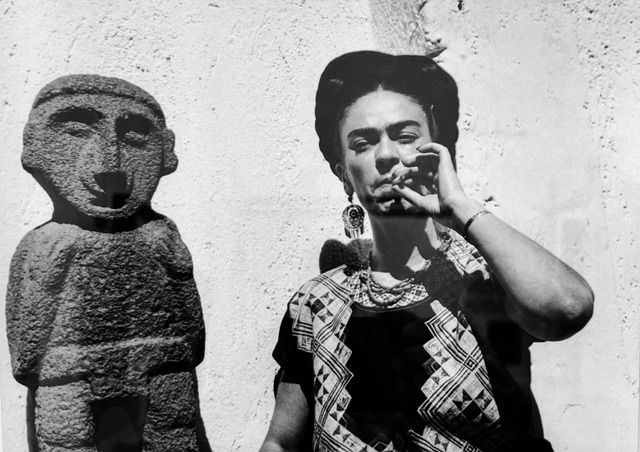
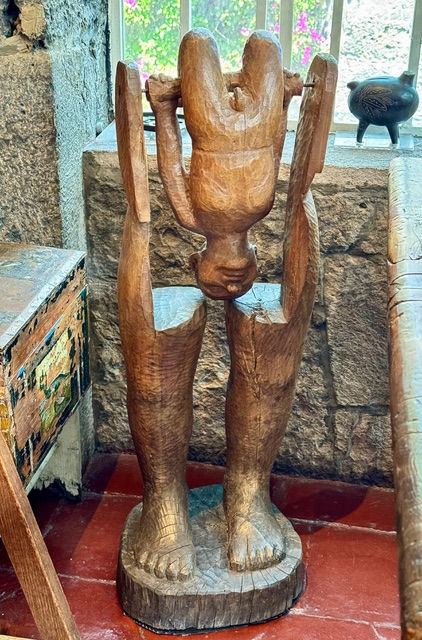
One can’t help wondering what Frida herself would think today of the crowds, the revenue the museum generates, and the many people now employed there, from staff to private tour guides?
Who was Frida Kahlo?
Frida Kahlo (1907–1954) was one of Mexico’s most famous artists. She is best known for her striking self-portraits, which often explore themes of identity, pain, Mexican culture, and her turbulent life.
Key facts about Frida Kahlo
Mexican painter known for vivid, symbolic self-portraits.
Strongly connected to Mexican identity, often wearing traditional Tehuana clothing.
Her art was deeply influenced by lifelong health problems, including severe injuries from a bus accident when she was 18.
She had a passionate and complicated marriage to the famous Mexican muralist Diego Rivera.
The Frida Kahlo Museum (the Casa Azul or Blue House in Coyoacán) is now one of the most visited museums in Mexico City.
Today she is seen as:
a major figure in 20th-century art,
a cultural icon of Mexico, and
a symbol of strength, resilience, and individuality.
Her life and work have made her famous worldwide, which explains why the museum attracts such huge crowds.
Here are five fascinating things many visitors don’t realise about Frida Kahlo, even after visiting the Frida Kahlo Museum:
1. She didn’t originally plan to be an artist. Frida wanted to become a doctor and was studying medicine when she was young. Her life changed completely after a devastating bus accident at age 18 left her with severe injuries. While recovering in bed for months, she began painting using a mirror mounted above her bed.
2. Many of her paintings are self-portraits. She once said she painted herself so often because ‘I am the subject I know best.’ Her portraits often show physical pain, emotional struggles, and symbols from Mexican culture.
3. She carefully crafted her famous look. Frida’s distinctive appearance, braided hair, flowers, colourful shawls, and traditional Tehuana dresses were deliberate. The clothing helped express her Mexican identity, and also helped hide some of the physical effects of her injuries.
4. Her marriage to Diego Rivera was famously turbulent. They married in 1929 and were one of the most famous artistic couples in the world. Their relationship was passionate but complicated, involving separations, affairs (on both sides), divorce, and eventually remarriage.
5. She became far more famous after her death. During her lifetime, she was known mainly as ‘Diego Rivera’s wife.’ It wasn’t until the 1970s feminist movement that her work was rediscovered and celebrated internationally. Today, she is one of the most recognised artists in the world and a major cultural symbol of Mexico.
A detail many visitors miss in the museum. Frida actually died upstairs in the Blue House, and her ashes are still kept there in an urn shaped like a toad, a reference to the nickname she used for Diego Rivera.
Here are three of Frida Kahlo's most famous paintings and the symbolism behind them. Many visitors see them at the Frida Kahlo Museum without realising the deeper meaning.
1.
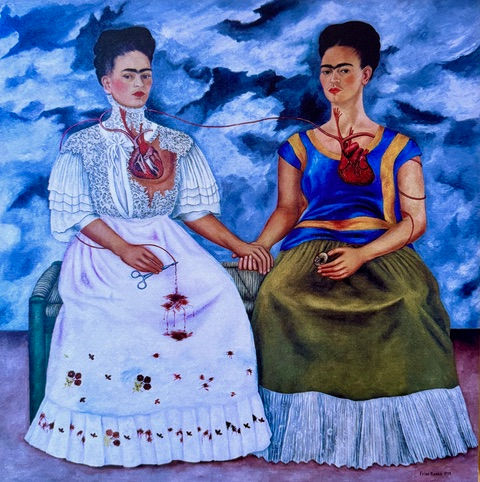
The Two Fridas (1939). This is one of her most famous and dramatic paintings.
The painting shows two versions of Frida sitting side by side.
One wears a European-style white dress, representing the Frida who was rejected by her husband, Diego Rivera, after their divorce.
The other wears a traditional Mexican Tehuana dress, representing the Frida he loved.
Their hearts are exposed and connected by a vein, symbolising emotional pain and the connection between her identities.
The severed artery and blood symbolise her heartbreak after her separation from Rivera.
2.
The Broken Column (1944). This painting reflects the physical suffering she endured after her bus accident.
Frida stands almost naked with her body split open.
Instead of a spine, she has a crumbling stone column, symbolising her fragile body.
Her body is covered in nails, representing constant pain.
She wears a metal medical brace, something she had to wear in real life.
Despite the tears running down her face, she stares directly at the viewer, a sign of resilience.
3.
Self‑Portrait with Thorn Necklace and Hummingbird (1940). This painting is filled with symbolism from Mexican folklore and nature.
The thorn necklace cutting into her skin represents suffering and sacrifice.
A dead hummingbird hangs from the necklace — in Mexican tradition, hummingbirds can symbolise luck in love, suggesting her heartbreak.
A black cat behind her symbolises bad luck and death.
A monkey (a pet given to her by Diego Rivera) pulls the necklace tighter.
Sources AI.





Like yesterday, we retraced our route back to Allende Metro Station, and it proved to be a hot and sticky journey (especially for me on the crowded ancient bus, as I had to sit on the hot metal engine cover next to the driver) on the capital’s crowded Metro transport system.
When we first arrived in Mexico City, in the early hours of Christmas morning, it was cold enough to wear our fleece jackets. Nearly three months have now passed, and summer is approaching. The daytime temperatures and humidity are steadily rising, and the evenings are so warm I can walk around in my sandals, T-shirt and shorts.
One of Lisa’s sandals needed repairing, and after some searching, we finally found a small shoe-repair stall. The cobbler stitched the sandal immediately for just MX$40 (£1.70), an excellent bargain. On the way back to our hotel, we bought some bubble wrap and carefully wrapped our ceramic jaguar; we even managed to squeeze it into my rucksack. Fingers crossed, we’ll be allowed to take it as hand luggage on our flight back to London Heathrow Airport.
Back at the hotel, we downloaded our Frida Kahlo photos onto our iPads, worked on our blog, and checked the latest updates about the developing conflict with Iran.
As it was our last night in Mexico City, we decided to return to the restaurant/bar, El Cuatro 20, so after showering off today’s dust, we headed out at 19:00. We were very thirsty, and the first thing we ordered was two half-litre glasses of their delicious draft Modelo Negra. I had octopus with rice, whilst Lisa ordered flautas (fried tortilla tubes filled with chicken and cheese), both dishes were delicious.
We struck up a conversation with a friendly couple from Utah who sat at the next table. They were around our age, and we quickly discovered we shared similar political views and musical tastes. Far out, man! The time flew by; we said our final farewells to our new friends, and we left together.
Back in our hotel room, we watched the rather gloomy news on television about the latest developments in the American-Israeli war with Iran whilst finishing the rest of our bottle of red wine and of the little bottle of Bacardi rum.
11th March 2026
I woke at 05:30 and caught up with the news, my blog, and diary before Lisa woke at 07:30. Tonight we fly back to London Heathrow on the 22:45 Aeroméxico flight from Terminal 2 at Mexico City International Airport.
We had to vacate our room by noon, but managed to extend it until 12:30, giving us time to visit the top of the Torre Latinoamericana skyscraper, for one last view over the city. The skyline was hazy, and I’m not a fan of heights, but it was still worth it.


We returned by midday, changed, repacked and stored our luggage, including our jaguar, safely wrapped in bubble wrap inside my rucksack, in the hotel storeroom.
At 12:45, we headed to the rooftop restaurant of the Hotel Majestic overlooking the Zócalo. We had arrived in Mexico in the early hours of Christmas Day, and in the afternoon, the first place we visited was this rooftop bar. This was the same place we’d also visited nine years ago, so it felt like a fitting place to end our Mexican adventure.

Today, taxi drivers were staging demonstrations against Uber taxis being allowed to operate from Mexico City’s International Airport Terminal 2. In the morning, they’d blocked all the roads leading into Terminal 2. Our taxi, arranged by the hotel for MX$300 (£12.57), picked us up from our hotel 15:00, as we’d been warned of possible disruptions, and we reached the airport at 15:30. The taxi driver's boss had phoned him on the way to say the protestors were still blocking the roads into Terminal 2, so he had to drop us off at Terminal 1. We then had to take the inter-terminal train to Terminal 2. Normally, this is straightforward, but the airport was in chaos preparing for the upcoming 2026 World Cup, and the lifts weren’t working, meaning we had to haul our luggage up several flights of stairs.
The Aeromexico desk at Terminal 2 told us we were too early to check in, so we found a nearby café, but it wasn’t pleasant, as we were amongst the renovations, and it was noisy and dusty. Afterwards, we found seats downstairs in the departure hall and spent the time working on our blog until check-in opened.
We checked in at 18:00, and our worries about our extra hand baggage, my large rucksack carrying our ceramic jaguar, proved unfounded. When it passed through the security scanner, an officer asked what was inside. I explained, and when Lisa showed him a photo of it he burst out laughing and waved us through.
Time passed slowly until boarding finally began at 22:00. It was rather disorganised, with five different queues forming, and random passengers being pulled aside for additional bag and jacket searches. We were among the last to board the Aeroméxico flight.
Fortunately, we had an overhead locker to ourselves, so we placed my rucksack holding the jaguar, now wrapped in Lisa’s waterproof jacket, to wedge it securely between our Samsonite bags. However, I couldn’t sit in my centre aisle seat, 25E, because someone on the previous flight had vomited on it, and the flight attendants were desperately trying to source another. They found one, and 10 minutes later, I could sit down.
We eventually took off at 23:05, 20 minutes late, with an estimated arrival time of 15:05; we’d arrive almost an hour earlier than scheduled, which suited us perfectly as it meant avoiding the evening rush hour.
12th March 2026
The flight went smoothly, although my attempt to watch ‘F1: The Movie’ was less successful. Ten minutes into the film, my screen went blank. A flight attendant reset it, but the same problem happened several times, and I never did get to see the end. Thankfully, I managed about five hours of sleep during the nine-hour flight, despite some turbulence.
At Heathrow Airport, we passed through immigration quickly. Once again, our worries about being stopped and searched, as we went through the Customs ‘Nothing To Declare’ isle, were unfounded.
After the warmth and sunshine of Mexico, stepping out of Belsize Park tube station, beneath a cold, grey sky, was an abrupt return to reality. Fleece jackets back on against the cold, we walked home and arrived at 16:45, where our Mexican adventure came to an end.
7b. Baja California Sur: 28th February until 8th March 2026

Lisa:
Loreto and the rest of our Baja California Trip
28th February 2026
We set off early without breakfast, keen to arrive on time at a recommended RV campsite in Loreto. It was Saturday morning and we expected it to be full for the weekend. After two hours driving along the coast and through the mountains, we reached Loreto at 9 a.m.

Our navigation system guided us to Campsite Romania, highly praised by fellow travellers. According to them it was one block from the beach, with hot showers, Wi-Fi, and a lovely café opposite serving fresh croissants. It sounded like heaven. - The reality was very different.
The site sat beside the main highway, with lorries roaring past, and behind a scrapyard filled with abandoned cars. We drove in and found only a few ageing mobile homes—no seaside, no café, no sign of the idyllic spot we had imagined. With no mobile signal, we had no idea what had gone wrong. Had our fellow travellers been joking?
We looked at each other, turned around, and I quickly entered the address of our second-choice RV park into the navigator. That turned out to be a much better option. Located on the other side of town, it was just two blocks from the beach and had clean, modern shower and toilet blocks, Wi-Fi—and space for us. Perfect.
We were a bit early, though, and asked to return at midday once our spot was free. No problem. We used the time to stock up on supplies at a few supermarkets before heading back to set up camp. The first thing we did was take a hot shower. After nearly a week of wild camping without proper facilities, it felt glorious. Tea followed, then a much-needed load of laundry.
Clean and refreshed, we headed out to explore the beach and the town of Loreto. There we met a couple from Calgary, Canada, who had arrived three weeks earlier and rented an apartment for a stay of three months. They kindly offered to show us around and took us to Mike’s Bar, their favourite spot, even insisting on buying us a beer.
Their friendliness was overwhelming—but the conversation was rather one-sided, and we soon realised we were more tired than sociable. As politely as we could, we excused ourselves and returned to the campsite.
Back at the RV, I contacted Julian from Vanbaja about our blocked drain. He arranged for someone to come by on Sunday morning to take a look and see if it could be repaired or if a plumber would be needed. One of the advantages of renting from Vanbaja is their local network—they have people across the region who can help when things go wrong.
Relieved that the issue was in hand, we cooked a lovely dinner and relaxed with a bottle of wine. A good end to an eventful day. 🍷
1st March 2026
Sunday began with a leisurely breakfast and a chat with our neighbours. Next to us were two elderly ladies in their eighties from Texas, travelling in a rather posh camper van. They are frequent visitors to Baja California and own a house in San Felipe, about six hours from Texas. They told us they used to travel in one of the huge expandable motorhomes we saw opposite our pitch but had recently downsized. Their current van still looked enormous to us.
Across the campsite stood two real giants: about 18 metres long, each pulled by a 6.7-litre pickup truck, with two slide-out extensions that turned them into something resembling a three-bedroom house on wheels. Soon another large truck arrived, reversing carefully while towing a massive trailer. The only space available was between two shower blocks, leaving barely half a metre on either side. Once the extensions were out, the passage behind was completely blocked, forcing the bikers with tents there to take a long detour to reach their campsite. We couldn’t help wondering how anyone could comfortably drive such enormous vehicles on Baja’s rough roads—or why one would want to display that level of luxury in such a poor region. But, of course, everyone travels their own way.

A few days later the two giants finally left, giving us a wonderful open view of the campsite and the surrounding mountains—only to be replaced by two new monsters. These were German Dethleffs Globetrotter XXL motorhomes, decorated with German flags, one from Jena and the other from Landshut. Their owners had spent nine months travelling through the United States and were now crossing Baja before taking the ferry from La Paz to Mazatlán, Mexico mainland. From there they planned to drive all the way to Argentina. I couldn’t help wondering how those huge, low-clearance vehicles would cope with rough roads further south—or with travelling through places like Sinaloa during a period of drug-gang violence. They spoke hardly any Spanish and only a little English. But again: each to their own.
Behind us camped a French-Canadian couple we had already seen at another site. He is from France, she from Canada, both around our age and clearly experienced travellers. Their setup could not have been more different. They drive a small van they bought in Mexico City, with a mattress and a few storage boxes in the back—no toilet, no shower, no electricity, no fridge. They cook on a small gas stove and keep food cool in an ice box they refill every couple of days. Years ago they shipped a van from France to Veracruz and travelled Mexico the same way. Now they are happily continuing their simple, minimalist style of travel. Over the summer months, they put their van into storage and go back to France, only to return in October before winter sets in.
Late in the morning—about an hour behind schedule, which is perfectly normal here—the man arrived to check our blocked wastewater tank. He is the uncle of the RV park owner. After inspecting the problem, he concluded that a plumber would need to come on Monday and remove the tank. Dave suggested another idea: perhaps blowing air—or water—into the pipe might dislodge the blockage. There was no air pump, but a hosepipe was found. After some determined teamwork involving Dave, the uncle and two park workers, something suddenly shifted. A moment later the wastewater began to flow again. Problem solved—I even have a photo to prove it.

In the afternoon we walked along the Malecón into town. Loreto is a charming and peaceful place. Founded in 1697 as the first Jesuit mission in the region, it once served as the capital of the Californias until a hurricane destroyed much of the town in 1829 and the capital moved to La Paz. Today Loreto is thriving again thanks to tourism. Its seaside promenade, small harbour, restaurants, cafés, galleries and craft shops give it a relaxed but lively atmosphere.


Visitors come in all forms: surfers exploring the coast, retirees enjoying the mild climate, and digital nomads who can work remotely from almost anywhere in the world. Walking along the Malecón, we saw energetic travellers on bikes and elderly couples strolling slowly in the sunshine—each enjoying Loreto in their own way. 🌊🌴


2nd March 2026
Luckily we had Wi-Fi again, which meant I could finally upload text and photos to the blog. Unfortunately, the campsite connection was terribly unstable and kept kicking me off—a nightmare to work with. When I mentioned it to the manager, she kindly gave me access to her private Wi-Fi, which worked much better, although I had to stay close to the office where the router was located.
So I set up my temporary “office” in the laundry room next door and spent five hours sitting between washing machines and dryers, uploading photos and updating the blog. By late afternoon, it was finally done. I felt I had earned a break.
We headed out for an early dinner and enjoyed delicious fish tacos at a restaurant on the City Hall Plaza, sitting outside and watching the last light of the sun fade. Around us were fellow travellers much like ourselves—most of them cheerful, talkative, and a little nosy. 🌅🌮


3rd March 2026
We were planning to leave early the next morning, so we went out to stock up on food. At a hardware shop we bought extra gas bottles for our stove, and at a fishmonger we found some fresh fish for the next few days. Everything went straight into the fridge and freezer.
Shortly afterwards we realised something was wrong: the fridge wasn’t cooling. Dave restarted it, but nothing changed. The lights were on, yet it remained stubbornly warm. Before we started to panic about all the food that needed refrigeration, I contacted Julian for advice. Normally he responds quickly, but this time there was silence. We even tried calling—no answer.
Three hours later, just as I was asking the campsite manager if we could store our fish in her freezer overnight, Julian finally called back. He talked Dave through a series of checks and suggested a cold restart by removing the fuse. After a while the fridge came back to life, making a reassuring—if rather noisy—hum. What a relief.
Over the next few days, however, the fridge stopped working several times, and Dave had to restart it again and again. Even at night we found ourselves listening carefully and checking whether it was still running.
Now, a few days later, most of the frozen food is gone. If the fridge fails completely, our backup plan is simple: fill the icebox with ice and replace it every couple of days. For the moment, though, the fridge has been running smoothly for the past 16 hours without our intervention. Perhaps it will hold out until we return the van on Sunday.
The small pleasures of renting a camper van. 🚐
4th to 7th March 2026
Finally, it was time to move on—again. We set off early, with a long drive ahead. Our friendly Texan neighbours had given us several recommendations, including La Paz and La Ventana, and had even shown us the routes on their well-used paper map.

Originally, we had planned to spend our last few days in Todos Santos, the charming town on the Pacific side of the peninsula. Travel guides describe it as a cultural hub of Baja California Sur, full of galleries, cafés, bars and restaurants—a “must-see.” It sounded perfect. But when we read recent reviews of the nearby campsites, our enthusiasm faded quickly. Many described them as dirty, noisy, poorly maintained, even full of fleas. That was enough to change our plans.
Instead, we decided to stay on the eastern side of the peninsula along the Sea of Cortez. With the TomTom set, we headed off. The route first took us across the mountains toward the Pacific side before looping back east again, bypassing the busy capital of La Paz and continuing on to La Ventana. We had heard wonderful things about it—a surfer’s paradise with a long beach and a relaxed atmosphere—so we were looking forward to seeing it.
After five and a half hours of driving, we finally arrived.
In reality, La Ventana turned out to be little more than a single road running along the coast, lined with restaurants, cafés, bars, hotels, rental apartments and campsites. We checked the campsite that had been recommended to us and were immediately shocked. Although it was right on the beach, you couldn’t even see the sea because the entire area was crammed with cars, camper vans, trailers and tents. The place was packed. There was barely any space between sites and no privacy at all. The front row—those lucky enough to have a sea view—looked as though they had been there for months.
The facilities were even worse: four toilets and a hosepipe serving as an outdoor shower for what seemed like hundreds of people. There wasn’t even a manager’s office on site. We looked at each other in disbelief and quickly drove off to check two other campsites nearby. They were just as bad. Perhaps perfect for young surfers who spend their days on the water and nights in bars and discos—but definitely not for us.
Without much discussion we made a new decision: we would return to where our Baja trip had begun—Los Barriles. We had stayed at Playa Norte RV Park there and remembered it as clean, quiet and right by the beach. After weeks of travelling, that sounded exactly like what we needed: a few days of sun, peace and doing absolutely nothing. According to the navigator it was only another hour and a half away—and, as a bonus, it would shorten our drive to Los Cabos on Sunday morning when we had to return the van.
We hadn’t eaten since breakfast but didn’t want to waste time stopping at a restaurant. So I quickly made sandwiches from our supplies, we drank some water, and we were back on the road. Once again we felt a bit disillusioned—our expectations raised by glowing reports that simply didn’t match reality.
The ninety-minute drive passed quickly through desert and mountain landscapes. Shortly after 5 p.m. we arrived at Playa Norte. The manager recognised us from our previous visit and gave us a nice pitch—slightly away from other campers but close to the showers and toilets. We didn’t have a sea view, but once we settled in with our chairs and a well-deserved cold beer, watching the sun set behind the mountains, it felt like heaven.
The next day we went to the nearby beach—and realised we had made exactly the right decision. We had no desire to explore more tourist hotspots or make more small talk with fellow travellers. All we wanted was a little sunshine and a chance to unwind before heading home.


And that is exactly what we did for the next four days: long walks along an almost empty beach, apart from the occasional dog walker; sunbathing; watching pelicans glide over the water and dive for fish; and observing the kite surfers out in the bay. In the evenings we cooked simple dinners—fresh fish or prawns—then relaxed in the warm evening air.

After nearly three busy months of travelling, we were exhausted and needed time to recharge our batteries.
Tomorrow we leave Baja California and fly back to Mexico City for a few very busy days. On Wednesday night, we finally head home. ✈️🌅
--------------------
Dave:
28 February 2026
We left our campsite at 07:45 without breakfast and reached Loreto about 90 minutes later. The first recommended RV campsite was at the end of a long dusty road, beside what looked like a car breakers yard, which was grim and seemingly abandoned. We drove in and straight back out again.
Lisa quickly entered the coordinates for our second recommended RV campsite, Rivera Del Mar RV Park. It took another 20 minutes to drive there, and thankfully, they had space, though not until 11:30, when the current occupants were due to leave. We didn’t mind, it was clean, well organised, and had spotless toilets and hot showers.
We used the time to head out for supplies. Two nearby supermarkets were disappointing, with poor meat and fish selections, limited wine, and no beer we wanted. A helpful local directed us to an El Cactus liquor store, where we stocked up on the beer and wine we liked, including a bottle of Bacardi rum.
We got back to the campsite at 11:30, and our allocated plot was still occupied, the chap inside the van apparently asleep. For reasons unknown, the staff didn’t knock. He finally woke, moved his van, and we finally moved into our allocated plot at 13:00.
Mid-afternoon, another enormous twin-axle trailer arrived, hauled by a huge 6.7-litre pickup from Canada, parking beside his friends with an equally vast setup. The scale of some of these fancy rigs continues to amaze us.
Later, we walked along the Malecón into town, joining a couple we met en route, and they invited us to Mike’s Bar for a beer, and generously paid before we headed back 45 minutes later.
Lisa contacted Julian from Vanbaja about our blocked grey water tank. After a WhatsApp exchange, he arranged for someone to visit the campsite tomorrow, Sunday.
With that sorted, we set up our table and chairs at the front of the vehicle and placed a lamp on the bonnet. Lisa prepared carrots and potatoes whilst I cooked the second half of our chicken, simple and excellent, especially with a bottle of red wine.
The four people from the large North American trailers gathered in the campground dining area, drinking, eating, talking loudly, and listening to what I assumed was country music.
We washed up in the campground kitchen area and retired with cups of Bacardi and juice to finish watching ‘Once Upon a Time in the West’. We finished the film and switched the lights off at 21:45.
01 March 2026
Another broken night’s sleep in Loreto; distant disco thuds, barking dogs, and cars crawling past with music blasting through open windows were the cause. The camper was stifling, so we slept under just a sheet until about 04:00, when the desert chill crept in and forced us to use the extra blanket.
We were up just after 06:00, working on our diaries, pausing at 08:00 for breakfast of fried eggs, bread, cheese, and our customary large mugs of tea. Even I’ve surrendered to tea, because without a proper kit, the Mexican powdered coffee is grim.
Now that we have WiFi, we messaged Julian at Vanbaja yesterday about our grey wastewater tank that would not empty. To his credit, he swiftly emailed us back and arranged for a local plumber to visit the campsite today. After breakfast, and dishwashing in the camp kitchen (a step up from seawater and sand since we couldn’t use the sink), we showered and continued working on our blog whilst waiting for the plumber.
The plumber arrived late morning, and soon five of us, the plumber, the camp manageress, the cleaner, Lisa and I, stood behind the van debating strategy. The plumber’s flexible metal cable failed to navigate the sharp 90-degree bend in the outlet pipe where it connects to the grey wastewater tank under the campervan. He then used a chemical drain unblocker, which made no difference. Removal of the entire tank was mentioned. I suggested forcing air through the waste outlet with an air compressor. Instead, we improvised and used a long hose connected to a tap, with the plumber pressing the open end to the outlet pipe. The cleaner turned on the tap, and when she did, water splashed everywhere. After a few attempts, a reluctant dribble appeared, and then a glorious gush.
We all leapt back. The stench was ferocious. Two sniffs and you’d be labelled greedy. Bucket after bucket was filled, carried to the toilet, emptied, and refilled once again, until the flow ran clear. Lisa marked the occasion with a photo of the four of us admiring the final bucket of stinky water. Victory.

We worked through until 16:00, celebrating both the revived sink and Lisa’s marathon German translation of the blog and uploading text and photos. Then we showered, dressed up, and headed into town.
It was still hot at 16:30 as we walked along the palm-lined malecón. The light was softening, the mountains crystal clear in the distance, and the waters of the Sea of Cortez a shimmering blue.


We turned right into the centre of town at the far end of the malecon, and chose an outside table at Claudia’s Margaritas bar and grill. Lisa had three fish tacos, I had three shrimp ones, and we pushed the boat out further with four small bottles of Bohemia dark beer, whilst watching the sun slip slowly behind Loreto’s city hall. The bill came to MX$850 (£36.40).

We were back at the RV camp by 19:30, and opened a bottle of wine. We sat outside in front of our campervan, beneath an almost full moon, until the biting insects drove us inside. We finished the bottle in bed, watching the final scenes of ‘Yesterday’, a fittingly light-hearted end to a day dominated by plumbing and perseverance.
02 March 2026
One of the long-term residents at our RV camp told us about a shop where we could buy fish, so after breakfast, we walked there and bought frozen fish for dinner. It’s always nice getting recommendations from people who’ve settled into the rhythm of life here, as they know exactly where to go.
We had hoped to spend a few lazy hours sunbathing on the beach, but the internet had other ideas. Uploading photos for our blog proved frustratingly slow, and Lisa also needed time to do that. Before we knew it, the afternoon had slipped away, and it was already 16:30.
Rather than sunbathing, we decided on a walk along the left-hand side of the beach, and it felt good to stretch our legs after being tied to screens for most of the day.
Back at the campervan, we enjoyed refreshing showers and cracked open a cold beer, the perfect reward. As the evening settled in, we cooked our defrosted fish for dinner, a simple meal that tasted all the better for being local, and eaten under the Baja sky as day turned into night.
———————-
Loreto: an overview.
Where is Loreto?
Loreto sits on the eastern side of the Baja California Sur peninsula, about 360 km (a 4–5 hour drive) north of La Paz along Highway 1.
It’s backed by the rugged Sierra de la Giganta mountains and faces the calm, island-dotted waters of the Sea of Cortez. Offshore lies the protected Parque Nacional Bahía de Loreto.
Population: roughly 20,000
Vibe: Quiet, authentic, outdoors-focused.
A Brief History:
Loreto was founded in 1697, making it the first successful Spanish settlement in Baja California. It became the capital of ‘Las Californias,’ a vast territory that once included present-day Baja California, Baja California Sur, and the U.S. state of California.
At the heart of town stands the historic Misión de Nuestra Señora de Loreto Conchó, the first mission in the Californias, which still overlooks the main plaza today.
From this mission, Spanish expansion northward began, shaping much of the region’s early colonial history.
What Makes Loreto Special?
Loreto blends:
Colonial heritage
Dramatic desert mountains
Rich marine biodiversity
A genuine small-town atmosphere
Unlike larger resort destinations, it has avoided heavy development. Evenings are calm, centred around the plaza, cafés, and simple seafood restaurants, rather than nightlife.
Nature & Wildlife:
Loreto lies within a UNESCO-recognised marine region known for exceptional biodiversity. The waters are famously rich, oceanographer Jacques Cousteau once called the Sea of Cortez ‘the world’s aquarium.’
Wildlife highlights:
Blue whales (January–March)
Dolphins
Sea lions
Mobula rays
Activities:
Snorkelling
Sea kayaking around the islands
Whale watching
Sport fishing
Climate:
Winter: Mild and pleasant (15–25°C)
Summer: Very hot (often 35°C+) with high humidity
Rainfall: Minimal year-round
Winter and early spring are generally the most comfortable months to visit.
Food & Atmosphere:
Loreto is known for simple, fresh seafood:
Fish tacos
Shrimp tacos
Ceviche
Grilled dorado
Small cafés cluster around the plaza, and the town has a relaxed, early-evening rhythm. This isn’t a party town; it’s somewhere to stroll along the malecón at sunset and enjoy the quiet.
Getting there:
Loreto International Airport (with domestic and some seasonal international flights)
Highway 1 connects it to the rest of the peninsula
Who Would Enjoy Loreto?
RV travellers and campers
Whale watchers
Kayakers and snorkellers
Those who prefer scenic, slower-paced Mexico.
For those who enjoyed places like Mulegé or Baja’s quieter beach camps, Loreto offers that same understated feel, but with deeper colonial history and slightly easier services.
It’s Baja without the gloss, and that’s precisely its charm.
———————-

03 March 2026
A lazy start to the day, and after breakfast, we walked along the beach to catch some rays and then along the malecon and watched a few fishermen drive their boats onto submerged trailers and then powerful pickup trucks drag them out of the sea onto dry land. There was a lot of sea fog on the horizon around the Isla Coronado. From there we walked into the centre to look around the famous historic Misión de Nuestra Señora de Loreto Conchó, the first mission in the Californias. On the way, we stopped for refreshments at a coffee shop opposite an RV campsite. This campsite was the one recommended to us and where we originally wanted to stay. However, we couldn’t have stayed here, as our campervan is solar-powered and needs direct sunlight for the solar panel on its roof, but this site was shaded by trees.
We wanted fish for tonight’s dinner, and we’d passed a fish supermarket a few days earlier, so we went there and were very disappointed. The only fish they had was frozen, unnamed and unpriced. However, we did find a proper fishmonger, and bought two pieces of fresh sea bass, enough for tonight’s dinner and tomorrow's too, on the recommendation of a chef buying fish for his restaurant. We got back to our RV campsite, and there was water on the floor of the campervan. Our refrigerator had stopped working. We WhatsApped Julian from Vanbaja but couldn’t get through, so we tried to phone him. He got back an hour later and gave me instructions for a hard reset of the refrigerator. Take a fuse out, wait 5 minutes and put it back. It worked, and we had our fridge back. Whilst doing this, we had a good talk with our French neighbours. They’d bought a normal van in Mexico City, put a bed inside, and bought a coolbox, which they filled every other day with bags of ice. They were travelling around Baja, were our age, and were a very nice and interesting couple.
We cooked the fish as the day turned into night, despite the mosquitoes that suddenly appeared, drank our wine, and retired to bed to watch a Netflix series.
04 March 2026
During the night, the refrigerator had stopped working again, so at 07:00, when daylight arrived, I went to investigate. The solution turned out to be another hard reset.
I began preparing breakfast whilst Lisa showered. Afterwards, we packed everything away. Lisa washed the pots and pans, whilst I showered. Despite the daytime temperatures hovering around 32–33C, the nights were surprisingly cool and damp.
At 08:00, we said goodbye to our new French-Canadian friends and drove out of the RV campsite. A petrol station just a couple of blocks away provided the first stop of the day, where we filled up.
For the first 6 kilometres, a smooth dual carriageway led out of town, but soon enough it ended, and the road narrowed back to the familiar two-lane highway that wound its way into the mountains. The drive demanded your full attention. The bends were constant, the drop-offs steep, and most sections had no barriers at all. Every so often, you passed a small roadside cross, a simple shrine, or a faded bouquet of flowers that marked the spot where someone’s journey ended. It’s best not to dwell on those things for too long and just concentrate on the road ahead.


After a few hours, we changed drivers. By lunchtime, the temperature had climbed to 36C, thank goodness for the campervan’s air conditioning.
Our destination for today was the small beachside town of Ventana, where we hoped to spend a couple of nights at one of the recommended RV campsites. On the way, we stopped in La Paz to refuel again and restock our supplies at a large roadside supermarket. It wasn’t particularly impressive, but we managed to buy some frozen fish and vegetables. Unfortunately, they didn’t have drinking water or a decent selection of wine, so we stopped later at an OXXO convenience store and bought a large bottle of water.
An hour later, we arrived in the town of Ventana and headed straight for the first highly recommended RV campsite. Within minutes, it was clear this wasn’t going to work. The place was packed with RVs squeezed tightly together, many clearly belonging to long-term residents. The best pitches, those with views of the sea, had long since been taken. Some vans were parked so close together that there was barely room to walk between them. The site itself looked tired and dirty, and with so many people there were far too few toilets and showers. There was no office, no manager, and no one around to ask questions. We drove in, took one look around, and drove straight back out again.
The second recommended campsite was just 3 kilometres further along the coast road, but unfortunately, it was just the same. Again, there was no manager or office, and the RVs were packed in tightly, like sardines. This area is popular with the kitesurfing crowd, and although we couldn’t see the sea because of the rows of RVs, we could see the sky above. It was filled with colourful kites, so many of them that from a distance they looked like a swarm of mosquitoes.
Lisa and I looked at each other and said exactly the same thing: ‘No way’.
At that moment, we scrapped the idea of spending two nights in Ventana and made a snap decision to drive on to Las Barriles, the RV park where we had spent the first nights of our adventure. Sometimes it’s simply better the devil you know than the devil you don’t!
Before leaving the campsite, Lisa made a quick sandwich whilst we sat inside the campervan. We also used their facilities. The toilets were filthy, which confirmed that we’d made the right decision to leave. We were back on the road again soon afterwards. The drive to Las Barriles took about an hour and a half and we arrived at 17:15.
The site manager was still on duty and immediately recognised us from our earlier visit. He warmly welcomed us back and guided us to a pitch. It had been a long day, and we had been on the road for over nine hours.
Once parked, we set up camp and enjoyed a long, hot shower. Afterwards, we sat outside at our small table with cold beers in hand, watching the sun slowly sink behind the distant mountains.
As darkness fell, I switched on the lamp by the campervan door to give us some extra light, and we cooked the other half of the sea bass we’d bought earlier.
It had been a long day on the road, but a satisfying one.

05 March 2026
Today turned out to be a wonderfully lazy day. After almost three months of travelling and exploring, we decided it was time to take a break and simply relax.
We’re staying at Playa Norte RV campground, which sits right beside a long, beautiful sandy beach. Our campervan came equipped with a brand-new beach umbrella, so we carried it down to the beach and found a perfect spot just a few metres from the sea. With the temperature hovering around 36C and hardly a breath of wind, the umbrella provided some very welcome shade, and that’s where we stayed for several hours.
The tide was out, which meant there were quite a few rocks to negotiate if we wanted to swim. If the tide had been in, the water would have covered them, and it would have been much easier to get into the sea.


The beach itself stretches for about 5kms, and for most of the afternoon, we were the only ones sunbathing. There were, however, plenty of people strolling along the beach with their dogs. This area is very popular with Americans, and every so often, a dune buggy would trundle past along the beach, usually with dogs in the back.
This stretch of coast is well known for windsurfing and kitesurfing, but today there was almost no wind at all. The sea lay completely calm and flat, too quiet a day for the kitesurfing and windsurfing crowd. We stayed on the beach until about 15:00, before taking a slow walk back to the campsite.
Back at the campervan, we made a cup of tea and sat in the shade of our campervan, catching up on the latest news, particularly the ongoing conflict with Trump/Netanyahu’s private war with Iran. It felt strangely out of place in our peaceful beachside setting. After a shower, we opened a couple of bottles of Bohemia Obscuro dark beer, sat outside, and watched the sun slowly sink behind the distant mountains. As it disappeared, the temperature began to fall into the mid-20C’s.
Although we’re surrounded by desert, the temperature drops gradually through the evening, reaching its lowest point around 05:00. By then it’s cool enough to pull an extra blanket over us. Loreto had been hot during the day too, but the heat there felt more humid, whereas here it’s a much drier mountain desert heat.
In the evenings, it’s wise to put on long trousers, socks and a T-shirt, as there are plenty of small biting insects out hunting for European blood.
Once darkness fell, we switched on our outside lamp and cooked our dinner: frozen vegetables and the fish we’d bought yesterday. This is the magical part of the day, sitting outside, eating dinner on our laps, whilst watching the stars gradually light up the desert night sky. After washing up, we settled down inside the campervan and watched a Christmas special of ‘All Creatures Great and Small’.
Like most people on the campsite, we were fast asleep by 21:45.
06 March 2026
We have two more full days left at Playa Norte RV campground, and we’re thoroughly enjoying the peace and quiet. After nearly three months of travelling, it felt good to slow down and simply relax by the sea.
The campground is spread over a wide desert area dotted with trees. Larger motorhomes can hook up to power, water and waste, but we’re completely self-sufficient. Our campervan runs on solar power and has everything we need: a shower, a sink, a grey water tank, and our trusty Coleman twin-burner stove for cooking. We’re parked in the dry camping area beneath a few trees, where our roof-mounted solar panel can still catch plenty of sun. Conveniently, we’re also close to one of the spotless shower and toilet blocks.
With only two days left before returning the campervan, we decided to enjoy some fresh seafood while we still could. Fish is surprisingly expensive in Mexico City, so the coast is the place to make the most of it. A neighbour told us about a man selling fish from ice boxes beside a convenience store along the main road. We drove there, first filling our water tank from a campsite hosepipe.
The man had three large ice boxes packed with fish and ice. We bought a bag of king prawns and a big piece of halibut. Inside the store, we bought a large bottle of beer, six eggs, a bottle of wine and a small bottle of dark Bacardi rum.
We enjoyed our lazy beach day so much yesterday that we decided to repeat it. We changed and headed off to the beach, armed with our beach umbrella. Today, there was a welcome breeze, and the kite surfers were out in force, their colourful kites dancing across the sky. We settled down on the long sandy beach for another afternoon of doing very little. The most entertainment came from watching pelicans gliding low over the water before suddenly diving for fish.


In the evening, we shared the big bottle of beer while watching the sun sink behind the mountains. Dinner was simple but delicious, pan-fried king prawns followed by halibut.
After washing up, we ended the day the same way many others on the campsite did, by relaxing inside our campervan. We had internet, so we watched a film on Netflix.
For some reason, Lisa had difficulty getting a signal on her phone, and if she did, it disappeared after a few seconds. The Wi-Fi was not strong enough to write on the blog.
07 March 2026
After a lazy start to the day, we headed down to the beach, together with our beach umbrella, and spent most of the day relaxing on the beach until 15:30. After almost three months of sunshine, clouds rolled in late afternoon, and the temperature dropped to a more comfortable mid-20C.
Back at the campervan, we began preparing for tomorrow’s departure, packing our suitcases and tidying our campervan so we could make a quick getaway in the morning.
Clouds shrouded the mountains and spoiled the sunset, so we walked back down to the beach for one last look across the Sea of Cortez, as dusk slowly turned into night.
Later, we cooked the second half of our king prawns and halibut, a very satisfying final meal. What little remained, we packed into an empty yoghurt pot to take with us for lunch at the airport tomorrow.

08 March 2026
We had planned to get up at 06:00 for showers and a simple breakfast of our last avocado and three eggs. In reality, we woke at 03:00 and dozed restlessly before finally getting up in the dark at 05:45.
After my shower, I boiled water for tea and our boiled eggs, which was far easier than frying them and then having to wash the pan afterwards. Once breakfast was finished, we packed the last of our things away, storing the small table, chairs, and our trusty Coleman gas cooker in the back of the campervan beneath the bed. Our plan had been to leave at 07:00, but we were a few minutes late leaving the campsite.
The roads were quiet on Sunday mornings, and our TomTom estimated the journey would take about 1 hour and 15 minutes, though it could sometimes take a little longer on these roads. As we drove south, the surrounding mountains were shrouded in thick cloud, and it looked as though rain had fallen overnight. Nearer to our destination, we stopped to fill the tank, as the campervan had to be returned with a full tank.
We arrived at the VanBaja office at 08:45, just ahead of the 09:00 return deadline; any later and we would have been charged for an extra day’s rental. Julian arrived at 08:55 in a taxi, after his scooter broke down on the way. He checked over the campervan, and everything was in order. We mentioned the blocked grey-water pipe and the fridge needing a couple of hard resets, which he had already shown me how to do by removing a fuse. During our three weeks, we’d covered just over 2,300 kilometres (1,430 miles).
Once the paperwork was completed, Julian kindly drove us to the airport in the campervan and dropped us off just before 10:00. We said our final goodbyes and watched him drive back to his office in our trusty campervan.
At the check-in desk, we asked if it was possible to get an earlier flight. Unfortunately, there were only two flights a day to Mexico City: one departing at 16:08 and the other much later, so we settled in and patiently waited.
We spent the first hour sitting outside the terminal building and ate our lunch, the leftover king prawns and halibut from the night before. Delicious they were too! Afterwards, we went through security and into Los Cabos International Airport (SJD). Inside was a Starbucks, so we ordered coffee and found a table, where we would spend the next few hours catching up with our blog and my diary. We started boarding at 15:33 and left on time at 16:08. The plane was full, and we had a lot of turbulence on the flight. There’s a one-hour time difference, so we added the hour to our flight time. We landed in Mexico City Airport’s Terminal 1 at 19:00, 10 minutes early.
------------------

