
Vamos Amigos! Come with us to Mexico - Travel Blog Part 2.
Updated: Feb 17

As in previous travels we want to share our experiences and adventures with you.
One month into our travels, we have already covered a lot and our post is full, overloaded with text and photos. As a result, we continue from here onwards with part 2 of our travel blog. Enjoy.

———————
Dear readers, over the last two months we have reported here so much about our adventures that the blog post can’t take any more text and photos.
We will open a part 3 travel blog and will continue there with reporting about our trip to the North, including Chihuahua and the train journey through the Copper Canyon and Los Mochis on the Pacific Coast. You can also read about our last destination on this trip, when we travel with a hired camper van through Baja California.
Please check it out.
———————-
Pacific Coast: Sayulita, 2nd February to 7th February 2026

Lisa:
Sayulita
2nd February 2026
On Monday morning, we got up early to catch our flight to Puerto Vallarta. All four of us were ready by 7:15, waiting for Fernando—the taxi driver who'd taken us to Teotihuacan—to drive us to the airport. It cost 900 pesos (£38)!! (The Uber Dave ordered on our arrival had been just 215 pesos/£9, but with four people and luggage, we needed a bigger car.) We sped through the empty streets of Mexico City on a bank holiday morning, arriving early despite the airport already buzzing with travellers.
We squeezed through the crowds until I found a helpful Aeromexico staffer who took us under her wing, printing our boarding passes and checking-in our bags. With the right person helping, it was all straightforward. We sailed through security with time for breakfast. Beverley remembered her HSBC global membership, granting lounge access (no guests allowed), so she and Terry headed there. Dave and I went to the Chilli Cafe next door: hot chocolate and banana pancakes for me (no black tea available), cappuccino and croissant for him. We finished just in time to head to the gate.
The flight ran late but made up time, landing on schedule in Puerto Vallarta. I'd been coordinating with Laura, our Sayulita house contact, who waited outside in her car. With no parking, she looped around the corner, hoping we'd emerge soon. Once outside, my internet died, but then she pulled up in her white Honda. We fit two suitcases in the boot—then it was full. No problem: Laura pulled out rope, we hoisted the other two onto the roof, tied them down, and were off. The hour-long drive cost another 900 pesos.
I felt a twinge of apprehension returning to Sayulita and the house I'd recommended to the group. Friends had tipped us off about Sayulita for our last visit, and we loved it—especially after Thanksgiving, when the American crowds went home and it quieted down. Our old hotel had turned into an pricey boutique hotel, so renting a house suited better for our group of four. Tucked back from the noisy centre and beach, it promised (per Booking.com photos) a stunning terrace view. I hoped everyone would love it.
We arrived and dragged our cases up steep stairs. The property had two apartments: Boho 1 below and our Boho 2 (ours) on top. It featured two en-suite bedrooms, a kitchen/living room, and a lovely terrace overlooking the forest—like being in the treetops. The kitchen had all the basics we needed. I breathed a sigh of relief when the others approved. The beach, which Google Map showed as just a short distance away, wasn’t accessible through the forest, but via the village and was 10 minutes away. No problem.
Once we settled in, we took a walk to explore the area and check out the stores, figuring out the best spots to shop and grab food for dinner and breakfast. With a kitchen on hand, we planned to cook for ourselves over the next few days. I remembered the location of the food and vegetable market, where we bought avocados, potatoes, onions, tomatoes, courgettes, garlic, and a pineapple. Beverley had also picked up avocados from another store—you can never have too many! We also bought olive oil, bread, cheese, beer, and ice for drinks.
On our way down to the village, we'd spotted a restaurant with chicken on the BBQ and made a mental note to grab one for dinner. But when we passed by later, none were available, and the waiter said they didn't have chicken on the menu. Had we gotten it wrong? Nope—it turned out the grilled chicken was just for the staff, courtesy of one waiter's granny. Bon appétit!
Unfortunately, it was too late by then to get fresh chicken or fish, so we settled for tinned sardines in tomato sauce for dinner. No big deal. Many bars were offering happy hour specials—two cocktails for the price of one—so we grabbed a margarita and a pomelo cocktail before heading home to cook. While waiting for our drinks, Dave dashed off to a recommended shop across the village to buy rum for our sundowners on the terrace later.
For dinner, we started with guacamole, followed by tinned pilchards in tomato sauce with potatoes. Yummy! We enjoyed our dinner on the terrace, listening to the sounds around us.

3rd February 2026
We had a good night's sleep, though the room was a bit hot—still, I'm not complaining. After the cold in Mexico City, it was lovely to feel warm again. Dave and I got up shortly after 6 am to sit on the terrace, read the news, write our blog, and listen to the birds singing and cockerels crowing. It was lovely! We were only disturbed a bit later by someone firing up a chainsaw. Grrrh.
Later, we had breakfast again with avocados, toast, cheese, eggs, and butter. After breakfast, Dave and I headed to the village to buy fresh fish from the fishmonger. They'd sold out yesterday afternoon, but today they had plenty of red snappers and a big pile of dorado fillets. We watched the fishmonger filleting the dorado—very skilled with a big sharp knife. We wanted two medium-sized red snappers, but they only had big ones or small ones, so we bought four smaller fish and had them gutted and cleaned. Four fish cost about 200 pesos (£8).
When we got back to the house, we met two Mexican women who had rented the lower part of our place. Mother and daughter, they lived in Oklahoma and had come for a week's holiday. They also owned a house in Guadalajara, where they were heading today for a few days before flying home. The younger woman had a little Chihuahua with her. She explained that it was her support dog—she's diabetic, and it's a trained diabetic alert dog (DAD) that detects high or low blood sugar levels from her breath and body odour, alerting her or even waking her if she passes out.
She's a dog trainer herself, specialising in medical assistance dogs. We were fascinated by how skilful these little dogs can be. When her dog was on duty, it wore a special vest; once she took it off, it was off duty and could relax. On the beach, it went wild—running in circles, digging holes, and so on. You wouldn't believe such a tiny dog carried so much responsibility!
In the afternoon, we headed back to the village. Sayulita is a lovely spot, with plenty of bars and restaurants spilling out onto tables in the street, plus shops selling clothes, jewellery, and handicrafts. It has a very pleasant, relaxed atmosphere. Tourists love hiring golf buggies—loads raced around town. We were offered one too, but declined. Dave told the guy we prefer to walk, and he laughingly called us 'Chevro-legs'.
Terry and Beverley wanted to browse the shops, so Dave and I went to the beach. We passed rows of tents and sun umbrellas packed with people enjoying the sun, sea, drinks, and massages, then strolled along the long beach towards the end of the bay. It was wonderful feeling the warm sun on our shoulders and bodies, cooled by the sea breeze. Pelicans soared high and dived for fish, while swimmers plunged into the waves. Dave went in too and loved the surf, though a strong current meant you had to be careful not to get dragged out.

We passed where we thought our old hotel had been, but couldn't spot it— so many new ones had sprung up along the beach, probably obscuring the view. We were glad we'd found our house, away from the hustle and bustle.
We still had to watch the sun, so at 5:30 we headed home and joined Terry and Beverley on the terrace for tea and coffee. We watched our neighbour take her dog for a dip in the swimming pool. I made a mental note not to use private pools any more—you could pick up dog fleas and other unhygienic things. Or am I just too fussy?
Dave had taken on the task of cooking dinner. This turned out to be quite a challenge, as we had an electric stove with two hobs, a microwave, and an electric American Oster countertop convection oven. Laura, who looks after the place, said the oven is mostly used as a toaster rather than a proper cooker.
Undeterred, Dave looked up on YouTube how this monster worked. According to YouTube, the oven could also be used for baking, and the fish should take only 20 minutes at 400°F. Reality, however, was different.
In addition to the fish in one tray, we had potatoes, courgettes, and carrots in another. That tray was too large to fit on the lower level, so it had to be placed above the fish. To make things more interesting, every so often the oven stopped working, switched itself off, and had to be reset.
As a result, everything took a bit longer—but we had time. We enjoyed a beer on the terrace, with no rush at all. When dinner was finally ready, it was delicious.
4th February 2026
We had a good night’s sleep, although it was a bit hot (I’m not complaining). Dave said he had a toothache and wanted to see a dentist. Beverley and Terry prepared breakfast: fruit salad and yoghurt, toast with cheese, and scrambled eggs. It was very delicious.
After breakfast, Dave and I ventured out in search of a dentist. A Google search revealed several dentists in the village. We chose one with good reviews—mainly from US families who said they visited Sayulita regularly and always went to the same dentist. Possibly this is because dental treatment here is cheaper for foreigners than in their own countries.
The dental practice was on the other side of the village, past the bridge on Avenida Revolución. We were able to get an appointment for Dave that same afternoon, although only for an X-ray to determine what was wrong with the tooth. The dentist explained that he wouldn’t be able to drill or repair it that day because there was no water in the village (only we tourists had water). That was also the reason the woman at the laundry couldn’t wash our clothes that day.
Water is very scarce. Piped water is delivered on Mondays, Wednesdays, and Fridays and stored in cisterns. If you need more water beyond these standard deliveries—as most hotels or Airbnbs do—you have to order extra water, which arrives by lorry and is pumped into the cisterns. This is very costly.
We had seen this system in other cities such as Mexico City, Puebla, Oaxaca, Querétaro, and now here in Sayulita. In recent years, the village has grown immensely, with many new houses and hotels, but the water supply has not been expanded accordingly. For a long time, electricity was the most expensive utility; now water has overtaken it in cost.
We went back to the dentist, and the X-rays revealed that Dave had a massive infection on the upper right side of his gums. The dentist explained various options, and we decided that Dave would take antibiotics for seven days, in the hope that the infection would subside enough for him to be comfortable for the rest of our journey, until he could see our dentist at home.
The cost for everything? 500 pesos (£21.26) for the X-ray and 324 pesos (£13.78) for the antibiotics. Not bad. Pharmacies here, apart from filling doctors’ prescriptions, sell all kinds of medication over the counter—painkillers, antibiotics, Viagra, steroids, and more. I shudder to think how many people self-diagnose and buy strong medication without proper medical advice, relying instead on hearsay from neighbours, pharmacists, or past experiences. A visit to the doctor may simply be too expensive, or the waiting times too long.
Laura explained to us that people like her, who are in work, have the option of paying into a kind of insurance system and can then access public healthcare facilities, such as doctors, hospitals and midwives. In this case, the whole family is also covered and can access healthcare. Public healthcare, however, is not very good: there are too few doctors and too few facilities for the number of people seeking care, and waiting times to see a doctor are long.
On the other hand, Laura’s younger daughter has type 1 diabetes and requires specialist care, which in her case is excellent, as there are diabetes specialists in her area. In other regions, or for other conditions, the situation may be very different. Those who are not in work are unable to pay into a health insurance scheme and therefore either have to pay privately or have no access to healthcare at all, as they cannot afford it.
Sayulita is a holiday village with many tourists and foreigners who spend time here or have decided to settle permanently. We were told that some long-standing American residents of the village have generously donated to local healthcare facilities, for example towards a new ambulance.
After our successful visits to the dentist and the pharmacy, we went home for a cup of tea, and Dave was keen to start his antibiotic treatment as soon as possible. In mid-afternoon, we went with Terry to the local beach and watched the high waves breaking, with some brave surfers gliding along the waves—or falling in. There was a wind warning that day and the current was strong. Terry went into the water and was immediately carried along by the current. Luckily, he is a good swimmer and came to no harm.
In the evening we had chicken. Beverley and Terry had bought grilled chicken with rice and tortillas. We only needed to warm it up, and dinner was ready. It tasted very good.
5th February 2026
This morning Dave and I were out on the terrace by 6 am, writing our blog diaries. It was cool and fresh, and it was lovely to hear the birds, the cockerels and the dogs barking—until, at 7 am, a chainsaw started up again. Later we found out that some tree branches were being cut nearby. Terry joined us on the terrace for a chat.

At 8 am we went to the laundry, hoping that the water had come overnight and that the young woman would be able to wash our clothes. The water had not yet arrived, but she was optimistic that at least some would come during the day. We left our laundry with her and walked into the village to the fishmonger to buy dorado for dinner. Unfortunately, the fishmonger was still closed. The vegetable seller opposite told us they would open in half an hour, at 9 am. We waited for a while, but 9 am came and went and no fishmonger appeared.
We went home and had breakfast with Terry and Beverley: granola with fruit and yoghurt. Afterwards, we returned to the fishmonger and bought one kilo of freshly filleted dorado for 370 pesos. Then we headed home. By this time, Dave’s feet were hurting. The reason: Terry had gone out earlier to take some photos of the beach and had accidentally put on Dave’s shoes. They were the same make and colour, but two sizes bigger, which meant Dave had been squeezing his feet into much smaller shoes. Luckily, when we got home, Terry was back and they were able to swap shoes.
Later, Laura contacted me to say that she had found a taxi driver who could take the four of us, with luggage, to the airport on Saturday morning for 1,600 pesos in cash. This was 600 pesos more than we had expected, but it was a large car and all our luggage would fit, so we agreed. The cash payment meant we needed to withdraw some money.
My internet research revealed that there are two banks in Sayulita, as well as a number of cash machines. However, we were warned not to use ATMs located out on the street, as they are often tampered with and subject to fraud. No thanks. Many of the other ATMs we found were out of order, being repaired, or abandoned altogether. We decided not to use any ATMs and not to risk our card being swallowed—we are only halfway through our trip and still need it.
Instead, we went to one of the banks on the other side of the village. After a long walk, a friendly woman there told us that it was not the kind of bank that had an ATM, paid out cash on cards, or even changed money. She suggested we take a local bus and travel for half an hour to the next village, where there were more banks and ATMs. No thanks. On such a lovely day, we did not want to spend hours travelling in the hope that we might get some cash.
We walked to the other bank, only to hear the same story. The bank staff even agreed that, although Sayulita is a tourist destination, the banking situation is appalling. We had had enough. We decided to change some US dollars the next morning at one of the exchange offices. It is always good to have a plan B—and some cash dollars—to avoid problems.
We then went to the beach, where we met Beverley and Terry and spent a few hours enjoying the sun and watching the waves and the surfers. Afterwards, we walked back at a leisurely pace, buying some potatoes and vegetables for dinner on the way.
Dinner was delicious. The fish was very light and tender. However, once again the Oster oven took longer than expected, and while we were waiting we indulged in guacamole and tortilla chips. By the time the meal was ready, we already felt rather full. Beverley and I had piña coladas—sadly none for Dave because of his antibiotics—while he and Terry stuck to beer. (The dentist had allowed Dave a small amount of beer, but no spirits.)
We were tired from the sun, so we went to bed early.
6th February 2026
We were up early (Dave at 5.30 am, me at 6 am) and sat out on the terrace in the dark—the sun does not rise until 7.30 am—drinking tea, reading the news and writing our blog. I love this time of day, when the village is still quiet, apart from the cockerels, and only just beginning to wake up.
I checked in for our flight back to Mexico City, obtained our boarding passes and emailed them to everyone. Tomorrow morning we have to leave by taxi at 6 am, which means dragging our suitcases down the stairs to the front gate. I made a mental note to locate the light switches beforehand, to avoid any accidents—or leaving half our luggage behind.
Today we wanted to go for a long walk along the beach to the next bay. We had done this walk before and remembered how lovely it is, winding through the jungle and up a hill before opening out onto a long stretch of beach. On our previous visit, we had walked towards what we thought was a restaurant to get some refreshments, only to discover it was a private house where about ten people were celebrating something. They had been very kind and gave us some water. So this time we knew better: there is no restaurant or bar, and we needed to take water with us.
After a quick breakfast, we set off on our own. We had our US dollars with us, but so early in the morning none of the exchange booths were open, so that would have to wait until later.
We walked to the end of our bay and then climbed over rocks into the jungle, following narrow paths through dense trees and bushes. There were many exposed tree roots, so we had to be careful not to slip or trip. We were also cautious about grabbing branches without checking first, in case there were snakes or spiders. We met only a few other walkers, as not many tourists venture that far from the beach.


At one point we took a wrong turning, which led us to a lovely small bay with nobody there apart from us—and two hairy, spiky dead fish. The water looked tempting for a swim, but there were many rocks in the bay, and possibly more hidden underwater, so after a short rest we climbed back up to the jungle path and continued on to the next large bay.


When we reached it, two yoga groups were in full session. We walked on towards the sea and watched the huge waves crashing. We went into the water briefly, but the beach sloped steeply into a dip and the waves were powerful, pulling one further into the dip and making it difficult to get out. A group of young men were swimming beyond the breaking waves, where the sea was calmer, but getting there and back was the challenge. I was too scared to attempt it. Still, it was a magnificent sight, and we enjoyed spending time on this vast beach with very few people around.

After a while it became too hot, so we slowly made our way back, crossing into the next bay and passing the many people on the village beach enjoying the sun, the waves and their beers and cocktails. We noticed groups of armed policemen controlling some of the vendors and checking the papers of those offering massages. This was the first time we had seen armed police in Sayulita; in the big cities we had seen many, but not here.
We left the beach and changed our US dollars into Mexican pesos, then went to the beach restaurant Maika, where we had a Coca-Cola and reserved a table for that evening. Terry and Beverley had kindly offered to take us out for dinner on our last night together, as a thank-you for organising the trip for them. That was very kind. We chose Maika because it had the best reviews in the village. Being by the sea, we wanted to eat fish, but we were careful about where to do so. On our last visit, Dave had suffered food poisoning, possibly from a ceviche at one of the village restaurants. This time, I felt responsible for keeping all four of us safe—fish and seafood can easily spoil in the heat, and I did not want to take any risks. Maika seemed the most trustworthy option, and other customers we spoke to confirmed that the food was excellent. Unfortunately, it closed at 7 pm, so we had to eat at 6.
We went home to shower and change. Terry and Beverley had also found another restaurant they liked, upstairs in a building with a view and live music. However, as we had already booked a table, we decided to stick with Maika. When we arrived, there was loud drumming coming from the beach, so we changed tables. Then live music started up in the bar next door. It was not ideal, and it was impossible to have a proper conversation, especially as Terry’s hearing is affected. But from experience we knew that on a Friday night in a village like this, it would be noisy everywhere. At least here we had a good chance of excellent food.
Dave and I ordered octopus—the best we have ever had. Absolutely delicious. Terry had salmon marinated in orange juice, and Beverley chose pasta with seafood. Both said their meals were very good. Luckily, the live music next door eventually stopped; the band was probably moving on to another venue. It was still a relief to leave the restaurant and walk back through town.
Music was everywhere. We stopped for a while to watch a solo musician making an impressive amount of noise, singing and playing along to backing music from a tin. In the plaza, a singer was performing traditional Mexican ranchera songs. He was excellent. There were tables, chairs and lots of people, and we were invited to join them for food. We learned that the Sayulita community had organised an evening with food and music to raise money for one of their friends, Rafa, who was in hospital with cancer and needed funds for an urgently required operation. It was wonderful to see such a strong sense of community coming together in times of need.
We continued our walk, enjoying the lively atmosphere, and took photos of the beautifully lit bars, restaurants and shops—so different from the daytime view. Finally, we walked home and had a last nightcap with the remaining fruit juice and rum, while Dave had a beer. We went to bed early, as we needed to be up at 5 am to be ready for the taxi at 6 am to take us to the airport.

7th February 2026
Dave woke up before the alarm went off and pulled me out of the deepest sleep. I was actually quite pleased he did, as I was in the middle of one of my horrible recurring dreams in which I have to sit my A-level exams again, completely unprepared and about to fail. What a nightmare! So it was better to get up and get going. Today was another travel day, and we had a long one ahead of us.
We got ready quickly and even had time for a cup of tea. Then, ten minutes before 6 am, José Martinez, the taxi driver, arrived with a car large enough to fit all our luggage, and we started dragging our suitcases down the stairs. The motion sensor lights were not working properly, so in places there was no light at all and we had to be very careful. Still, we managed to reach the entrance safely, luggage and all. The drive to the airport was smooth, and we arrived shortly before 7 am at Puerto Vallarta airport, still in the dark.
As we were so early, the Aeroméxico desk was not yet open, so we went to have breakfast first. When we later joined the queue, there were not many people in front of us—just a few families—but it took a long time for the desk staff to process them. They all had to pay extra for their luggage. Presumably, when booking their flights they had opted for the cheapest fare without checked baggage, as adding luggage was quite complicated, and hoped to sort it out at the airport. Unfortunately, this is much more expensive.
I had done all of this painstakingly when booking the flights for the four of us, a process that nearly did my head in, but it was sorted in the end and much cheaper. The families simply shrugged and handed over their credit cards—less hassle for them. Each to their own.
The flight back to Mexico City was quick, just over an hour. Then it was time to say goodbye to Terry and Beverley, who were staying in Mexico for a few more days before returning to London, while we were heading north to Chihuahua to continue our journey through the Copper Canyon.
We went with Terry and Beverley down to the baggage reclaim area to make sure there were no unexpected problems, then waved them off. When Dave and I went back up the stairs to reach the domestic connections area, we were stopped by a rather snotty security woman who told us we were not allowed to go upstairs and had to go back out through the main terminal and pass through security again. I could not believe it. We were only about five metres from the domestic connections area.
I tried to explain that we had just seen friends off at baggage reclaim and were now continuing our journey to Chihuahua, we had not gone out but stayed in the transit area, but she insisted we had to go back out. We had an argument. I chose to ignore her and continued up the stairs. She shouted for assistance and another security guard arrived. Now I through that we were going to be arrested. But this guy, wearing a yellow vest, was calm, polite and actually listened to what I had to say. He explained that because of extensive construction work at the airport ahead of the upcoming Football World Cup, there were additional security restrictions in place. I could accept that explanation—it was delivered respectfully, not barked at me.
So we turned around and went back down, passing the unpleasant woman, who continued to shout and order people around, clearly enjoying the small amount of power her position gave her.
We got lost on the way out, as there were building sites everywhere and many areas were cordoned off. Most of the security guards we asked apologised for the chaos at the airport and the extra security measures. We understood that. Why she couldn’t show the same courtesy remains a mystery.
It took a while to get back in and pass through security again. Exhausted, we decided to have tea and coffee and returned to the café where we had eaten breakfast five days earlier. I went to the toilet while Dave took our hand luggage to the café and found us a seat. He ended up having an argument with a waitress who repeatedly shoved a menu under his nose and insisted he order food immediately. He wanted to wait for me so we could order together. Was this the day of over-pushy women?
We ordered our drinks and said we needed a bit more time to look at the menu. She clearly did not like that, slammed our drinks down with an angry expression, and disappeared for a while without taking our food order. Service with a smile! Needless to say, she did not earn a tip.
We spent the next few hours wandering around the airport, waiting for our flight. I booked a hotel for four nights in Creel, our next stay after Chihuahua, but the purchase of the bus tickets to Creel were cancelled just after I typed our card details in. I checked, it had not yet been taken out. I also managed to get us tickets for the Frida Kahlo House for when we come back to Mexico City on the 10th of March, the day before we fly back. Lucky we- as the tickets are very scarce and only view tickets a week are released!! Eventually, boarding was called. At the gate, a man asked me to “take my head off”. I laughed—he meant my hat. I explained the difference between a head and a hat, and we all burst out laughing. What a difference it makes when people communicate with a smile and a bit of humour.
We boarded the plane, and the two-and-a-half-hour flight passed quickly. We even made up some of the earlier delay and landed in Chihuahua ahead of schedule.
——————

Dave:
02 February 2026
We were up at 06:00 and met Terry and Beverley in the lobby at 07:15. Fernando, who had driven us to the pyramids, took us to the airport for the eye-watering sum of MX$800 (£33.58). The airport was chaotic and surprisingly cold, just 5°C outside - and not much warmer inside.
We split for breakfast: Lisa and I ate at Covina Urbana - hot chocolate and pancakes for her, croissant and cappuccino for me, whilst T&B used their HSBC Premier Lounge cards (no guests allowed). Our flight to Puerto Vallarta was scheduled for 10:30, but with the airport in disarray due to preparations for the Mexican World Cup later this year, we eventually took off at 11:10. Despite the delay, we arrived on time.
Stepping out of the airport into bright sunshine was a shock, the temperature had jumped to a sticky 30°C. Laura, who Lisa had been dealing with about our Airbnb, met us outside the Pacific Bar after circling the pickup area because of heavy traffic. Some of our luggage wouldn’t fit in her Honda’s boot, so two suitcases went up on the roof rack, and we set off for Sayulita.
The first half hour was slow going through busy resort areas, but once inland the road twisted through lush green hills. Soon we arrived in Sayulita, a small, colourful resort with narrow cobbled streets. A right turn up an even narrower track brought us to our Airbnb, perched on a verdant hillside. Getting the luggage up several flights of steep stairs in the humid heat was hard work, and we were soon hot and sticky.
The apartment has two bedrooms, each with its own bathroom, a shared kitchen, and a lovely balcony overlooking the opposite hillside. Although west-facing, dense foliage blocked the sunset. Laura had to leave for an appointment as soon as we arrived, but her daughter showed us around before we took a short rest and a cup of tea.
Later, we walked into town to explore and pick up food. The beach was packed and the sea dotted with surfers. The streets were lively, lined with bars and restaurants offering happy-hour deals, which we happily took advantage of around 17:30. While waiting for cocktails, I popped into a recommended shop and picked up a litre of Bacardi dark rum for MX$310 (£12.96). A saxophone busker drifted between bars, adding to the laid-back atmosphere.

We grabbed a few beers on offer from a corner shop, and headed back. Sadly, the roast chicken stall we’d planned on for dinner had already closed, so Lisa and Beverley improvised with tinned sardines and vegetables. Back at the apartment, we enjoyed cold beers and rum on the balcony as the evening cooled slightly. Dinner was a delicious guacamole starter followed by vegetables and sardines: our turn to cook tomorrow night.
By 21:30, the early start, travel, and heat caught up with us, and we all headed to bed, ready to settle into Sayulita life tomorrow.
03 February 2026
We were up at 06:00, catching up with the blog on the balcony. Sunrise in Sayulita isn’t until 07:37, noticeably later than Mexico City. Somewhere in the distance a chainsaw whined into life, but it didn’t spoil the moment. The surrounding hills were waking up too, alive with birds chattering in the trees, cicadas and the calls of cockerels hidden in the dense foliage. Predawn is a magical time here.
After breakfast, Lisa and I walked into town to the fishmonger, as I’d volunteered to be the cook tonight. we bought four fresh red snapper for MX$205 (£8.63), an absolute bargain.
Back at the apartment entrance we chatted with the woman next door, a diabetic from Oklahoma with a Chihuahua medical alert dog (DADs). The little dog was trained to detect changes in her blood sugar levels and alert her by pawing, nudging, or barking: fascinating. Back inside, I cleaned and prepared the fish and put them in the fridge.
The morning’s minor drama involved the safe in our wardrobe, which refused to open. Laura arrived ten minutes later with a master key and suggested Lisa leave it on top of the wardrobe. Unfortunately, there was a narrow gap between the wardrobe and the architrave and the key promptly vanished into it. After a bit of careful levering, I managed to retrieve it - crisis averted.
We then headed into town again and walked along the beach, while Terry and Beverley planned to go into town later. With only one set of keys between us, they would have to leave them in the key safe for whoever returned first.
We walked barefoot to the far end of the beach, stopping to sunbathe and for me to swim in the surf. It felt wonderful - warm sand, sunshine, and salt water. On the way back we photographed a wedding through a hotel’s wire fence, photographers, and a band playing behind the happy couple. I could only hope the photographers were better than the band.

After showers, we relaxed on the balcony. I went online to work out how the rather overcomplicated American Oster countertop convection oven actually worked. The fish went into a dish with sliced potatoes and onions, with the remaining vegetables in a separate pan. There wasn’t enough room in the oven for everything, so a few potatoes and carrots had to be boiled. I’d carefully copied the oven instructions into my iPhone notes. 20 minutes to bake the fish, it claimed. In reality, everything took closer to 50 minutes. So much for American convection ovens. Still, the extra time paid off, as the fish (I hoped) were perfect.
We drank a few beers, and Terry had the inspired idea of putting both glasses and beer into the freezer for fifteen minutes. Frosted glasses, perfectly chilled beer: excellent thinking. Later, Terry shared some of his tequila as a nightcap.
By 21:50, full, relaxed, and tired, we called it a night and went to bed.
04th February 2026
We’d both had a rough night. My toothache, which had been nagging for days, flared up badly and kept me awake for hours. The hot, humid bedroom didn’t help. By 06:30, we gave up on sleep and moved out onto the balcony, working quietly on our diaries while the day began. Terry was already up, checking emails beside us. After breakfast we set off at 10:30 to walk into town to find a dentist. Lisa had found three online, one with particularly good reviews, and that’s where we were heading. On the way we stopped at our local launderette to ask about their service. Although it opens at 08:00, they’re affected by Sayulita’s water shortages. On days when the water is shut off, customers have to wait until the supply returns to collect their clothes - one of the growing pains of a town that’s become very popular with tourists.We found the dentist and made an appointment for 14:30, then wandered back towards the centre and stopped for a Coke at the Maika bar overlooking the sea. It’s also a restaurant with a tempting seafood menu, including octopus, and we thought it might be a good choice for our final meal on Friday. It closes at 19:00, which would suit us perfectly with our 06:00 airport departure on Saturday. Later, we walked to the far left-hand end of the beach, where fishermen haul their boats up past the high-water mark using a tractor. Pelicans were feeding on fish remains, and we spent some time photographing them. I also chatted to a group of Americans just back from a fishing trip. There were four of them, and had been out from 08:00 until midday. The cost of the trip was US$350+10% tip. (£256.30).

At 14:30 we were back at the dentist. He was thorough and reassuring, taking several X-rays and diagnosing a root canal issue along with gum infections in two places. His consultation and X-rays cost MX$500 (£21.01), which felt like a bargain. He prescribed Amoxicilina, three tablets a day for a week. We went straight to a pharmacy we’d passed earlier and paid MX$324 (£13.62), including a welcome 10% discount. Back at the Airbnb, we had a cup of tea and I took my first antibiotic.
At 16:00 we returned to the beach to swim and sunbathe. Terry came too, although Beverley stayed behind. The beach was busy and noisy, with crashing waves, music, beers, and cocktails being drunk everywhere. We’d read that red flags were flying in Puerto Vallarta because of powerful surf, and it certainly felt the same here. Terry and I both went in, but caution was needed as every tenth wave was noticeably bigger and could easily knock you off your feet. We walked back at 17:45, picking up some beers on the way. My gums were very tender by then, so I took my second antibiotic.Beverley cooked that evening. She and Terry had bought two cooked half chickens earlier from a small kiosk nearby, which only needed warming in the oven. She’d also made potato salad and guacamole. I limited myself to two small beers — three a day was the maximum I felt sensible with the infection and medication. Feeling tired and slightly odd, I headed to bed early at 20:45. The others weren’t far behind, calling it a night about ten minutes later.
05th February 2026
It was another poor night’s sleep. My toothache and a sore right shoulder, aggravated by my tennis elbow, meant that whichever side I lay on caused pain. By 05:30 we gave up and got up, taking our diaries out onto the balcony. As we worked, we listened to the cockerels and the surrounding forest slowly come alive in the pre-dawn light.
At 08:00 we walked into town, first to drop off our dirty washing at the nearby launderette, then on to the fishmonger to buy dorado for dinner. Sayulita is suffering from an acute water shortage and the water supply is turned off for several hours every day. The launderette had no water, but the lady assured us she’d wash our clothes once it came back on.
When we reached the fishmonger, he was closed and not due to open until 10:00. We waited until just after 09:00, on the off chance he might open early, but he didn’t, so we walked back.
We had a lazy breakfast with Beverley and Terry. Afterwards we headed back into town, knowing the fishmonger would sell out by midday. Terry left a little earlier to collect their washing and take photos of the beach, but accidentally took my sandals. We both wear Keen sandals, his are size 9, mine size 11, so I made the return trip with slightly pinched toes. We bought a long 1kg slice of dorado, also known as dolphinfish or mahi-mahi. One useful discovery: my next pair of Keens will be size 10, as size 11 are just a touch too big.
We got back just before Terry, swapped sandals, and then we went online to book two nights at the Ibis Hotel in Chihuahua, the same one we stayed in nine years ago. After that, we headed back into town to find a cash machine, agreeing to meet Terry and Beverley on the beach afterwards.
We’re wary of using cash machines in small tourist towns, because if our cards were swallowed, we’d be in serious trouble, so we decided to visit the two local banks instead. The first, near the bus terminus and almost out of town, had no cash machine at all. Nor could we withdraw money at the counter or exchange US dollars. I was getting increasingly irritated. What kind of bank doesn’t deal in money? The second bank, closer to the centre, did have a cash machine, but it was out of order, like most of the others in town. There was no counter either, just two women at a small desk, one of whom told us we’d need to take a 30-minute bus ride to the next town if we wanted a bank that issued cash. Madness.
Hot, sticky, and tired after walking in the humid 29C heat, we stopped at a nearby coffee bar to cool down, then walked on to the beach.
Terry and Beverley were already there. We joined them beneath their umbrella and spent a couple of hours relaxing, until the wind picked up and the umbrella collapsed. At 16:00 we headed back separately, as we needed potatoes and to collect our washing, while they went shopping for presents.
Back at the apartment we sat on the terrace with a cup of tea. I showered, partly packed my suitcase for our early departure on Saturday, and prepared the dorado for dinner. We had a few cold beers while waiting for it to cook. As I’d already discovered, our oven isn’t the best. What should have taken 20 minutes stretched to 45 minutes, but the wait was worth it as the fish was cooked to perfection.
By the time we’d finished dinner we were all exhausted. I announced I was going to bed at 21:10, which prompted everyone else to admit they were just as tired and ready to turn in too, which they did.
06th February 2026
We were up at 05:15 and sat on the balcony in the dark, quietly working on the blog while the world slept. A few peaceful hours later, at 09:30, we set off to walk along the right-hand side of the beach, a route we’d last taken nine years ago.
It didn’t take long for things to get interesting. Sand found its way into my sandals, so I wanted to sit on a rock to knock it out. Unfortunately, the rock I’d stood on was razor sharp. I slipped trying to avoid slicing my feet and ended up bruising my ankle and toes instead. I muttered a polite “bother” and carried on.
After clambering over rocks beside an hotel, we followed a narrow jungle path over the headland, dense with foliage, emerging into the next bay. We pushed on into yet another bay of beautiful golden sand and stopped halfway for what we hoped would be a swim. The sea had other ideas. The beach was steep, the surf rough, and within a few steps the water was waist-deep. Waves knocked us off balance and the current pulled seaward. We tried briefly, then sensibly decided it was too dangerous. Better safe than sorry.


It was almost midday and getting hot, so we retraced our steps back over the headland and along the beach.
We were running low on pesos and needed cash for our taxi the next morning. With no banks nearby, and the towns cash machines decidedly iffy, we resorted to a money exchange bureau, changing US$200 at MX$16.7 to the dollar, not a great rate, but unavoidable.
That evening Terry and Beverley insisted on taking us out for dinner to thank us for organising their time with us. We chose Maika, a lovely seafood restaurant overlooking the beach. After stopping in earlier for a cold drink, we booked a table for 18:00, then headed back to the Airbnb for a light lunch. We washed some clothes, I washed our smelly sandals, and left them out in the sun, fingers firmly crossed they’d dry.
We left for Maika at 17:30. A live band played at the beach bar next door, music drifted in from the beach, loud, yes, but it was Friday night in a very popular beach resort, but no worse than the headbangers’ bar we’d enjoyed a beer in near our hotel in Mexico City. Lisa and I both chose octopus, perfectly cooked, and enjoyed a few beers. The restaurant closed at 19:00, but we were finished by then. Terry and Beverley picked up the bill, and we thanked them warmly.
After dinner we wandered through town, taking photos of the lively Friday night atmosphere. People and music spilling out of bars, a Mexican singer at full volume playing in the town square, cars and golf buggies cruising slowly through the streets. We’d had enough and slowly made our way back.


We sat on our balcony one last time. I had a beer, the others cocktails, and I set my alarm for 04:55. Our taxi, arranged through Laura, would collect us at 06:00. It would still be dark, and the steep steps down to the road meant we’d need to be careful with the suitcases.
I went to bed, and the others followed shortly after.
07th February 2026
I had a poor night’s sleep, waking several times feeling bloated and bunged up — thanks, no doubt, to the antibiotics. Although I’d set the alarm for 04:55, I was awake by 04:45. I made a couple of cups of tea, knocked on Terry and Beverley’s door, showered, and finished packing.
Our taxi arrived at 05:45. We loaded up carefully, taking extra care on the unlit steps, and were on our way by 06:00. The drive to the airport was straightforward and we arrived in the dark at 06:50. The fare was MX$1,600 (£67.68), which we shared. Inside, the airport was absolutely freezing. We found a coffee shop and bought coffee and croissants.
Check-in was easy, though slowed slightly by two families with small children. Our suitcases were tagged and disappeared into the bowels of the airport. Next came security, which we sailed through, apart from one woman officer who managed to drop my watch onto the floor (dumme Gans!) By 08:30 we were all sitting at Gate 4, waiting for our 09:56 departure flight.
We arrived in Mexico City 15 minutes early but couldn’t disembark straight away because we were too early. Terry and Beverley were staying on in Mexico City for the final three days of their Mexican adventure. We went with them to collect their bags, said our goodbyes, and watched them leave.
Our own onward journey was less smooth. When we tried to head back upstairs to continue in transit, a security guard refused to let us through, meaning we had to trek all the way through the airport and go through security again. With a long wait ahead and hunger setting in, we found ourselves back in the same freezing restaurant we’d endured when flying out to Puerto Vallarta, complete with the same surly, pushy waitresses. No tip, I’m afraid.
Time passed surprisingly quickly, despite a bored young girl lying on the ground nearby repeatedly bouncing a half-full water bottle on the floor. Our flight finally departed at 15:40, 25 minutes late, but was scheduled to land at 17:25, 20 minutes early, which it did.
During our three-hour stopover in Mexico City airport, we were productive and booked tickets for the Frida Kahlo Museum, for the 10th of March, for when we returned back in Mexico City, as well as securing a cheap hotel in Creel for three nights, from Monday 9th to Wednesday 11th February.
We landed in Chihuahua beneath a lowering sky, the surrounding mountains shrouded in rain clouds. We were quickly through the airport and used the official taxi rank, paying MX$286 (£12.10) for the 25-minute journey to our hotel, the Ibis Chihuahua.
4. Central Mexico, 25th January until 2nd February 2026
Mexico City visit 28th January to the 2nd February 2026
Lisa:
28th January 2026
We arrived after a 3 hour journey from Queretaro in Mexico City at the North Bus Terminal. It took us over 1/2 hour by taxi to our hotel in the district of Roma, near the centre of the city. The journey showed, once again, how huge this city is. We passed by shanty towns on the outskirts of the city that have organically grown up on the hills. Some of them, after years of isolation have only recently been connected to the rest of the city by several cable cars. A brilliant idea to enable people to connect with the city, enable them to go to work, go to school, go to the doctors … open up a different life. We had similar projects seen in Medellin, Colombia, a few years ago with great success.
When we came closer to the centre, the traffic in Mexico City was horrendous. Too many cars, too much traffic on the huge two and four-lane roads and soon we were stuck and in stop and go mode we finally arrived at the hotel.
Later we met our friends, Terry and Beverley, and we walked around the district of Roma in search of a restaurant for dinner. First we had a drink in a bar, then we found a Taco place which seemed to be popular and good as many people queued and the place was packed. We joined the queue and then ordered a selection of Tacos (small tortillas with fillings of a choice of chicken, meet, cheese etc). Very tasty. After dinner we discussed our plans for the next few days over a drink and to celebrate their arrival.
29th January 2026
Today we went to the Anthropological Museum in the district oft…. This is in walking distance of our hotel and gave us the opportunity to walk through the beautiful Bosque de Chapultepec.
—————-
Back ground:
Chapultepec Park (Bosque de Chapultepec) is one of the largest and most historically significant urban parks in the world, covering over 650 hectares (1,600 acres) in the heart of Mexico City. Its history dates back to pre-Hispanic times, when it served as a sacred area and leisure retreat for Aztec rulers, and it has remained closely linked to Mexico’s political and cultural life ever since.
The park’s most prominent landmark is Chapultepec Castle, the only royal castle in the Americas. Built in the 18th century, it later became a military academy and an imperial residence before being transformed into the National Museum of History, which shows Mexico’s past and offers panoramic views of the city. Chapultepec is also a major cultural centre, home to renowned institutions such as the National Museum of Anthropology, the Museum of Modern Art, and the Tamayo Museum.
In addition to its cultural attractions, the park provides extensive green spaces, lakes, gardens, and walking paths, making it a popular destination for recreation, boating, picnics, and outdoor exercise. It also includes the Chapultepec Zoo, one of the most visited in Latin America. Overall, Chapultepec Park blends nature, history, and culture, making it an essential and iconic part of life in Mexico City.
——————-
The park is a very popular destination for Mexican families, in particular on weekends when thousands of visitors come here. Sunday is the most popular day to visit because the museums are free, and visitors may spend the entire day in one or more sections viewing the attractions, picnicking, or grilling. Despite its local popularity, however, foreign visitors usually only see the small fraction of the park near the museums.

This is also the part that we walked through on our way to the museum. We strolled passed the many stalls that sell sweets, drinks, food, and many handicraft items and stopped to watch a group of indigenous boys in their traditional clothes spiralling down a pole, like we had seen in Cholula.
————
Back ground:
The Museo Nacional de Antropología in Mexico City — one of the most important anthropology museums in the world — showcases Mexico’s rich human history, from early humans to the great civilizations of ancient Mesoamerica and the diverse indigenous cultures that still exist today. The museum’s collections are divided into archaeological and ethnographic sections that cover Mexico’s cultural heritage:
The National Museum of Anthropology presents a broad overview of Mexico’s cultural history, from the earliest human settlements to modern indigenous communities. Its most famous galleries feature pre-Hispanic civilizations, including the Aztec Sun Stone, the monumental Coatlicue sculpture, Olmec colossal stone heads, and rich Maya artifacts, such as jade masks and a reconstruction of King Pakal’s tomb. There are also important collections from Teotihuacan, Zapotec, Mixtec, and Toltec cultures, showing their art, religion, and daily life.
The ethnographic halls on the upper level highlight Mexico’s living indigenous peoples, displaying traditional clothing, crafts, tools, rituals, and beliefs. Together, the exhibits offer a clear and engaging picture of Mexico’s archaeological heritage and its continuing cultural diversity.


The museum also hosts changing exhibitions, cultural events, and educational programming that explore different themes in anthropology and history.
Overall, the museum offers a comprehensive, immersive journey through the history and cultural diversity of Mexico — from its earliest inhabitants to the rich traditions that continue today.
————-
It’s been my third visit to the National Museum of Anthropology in Mexico City, the first in 1988, then in 2026 and now. Each time I am overwhelmed by the complexity and amount of the display. I find it very interesting and each time the exhibitions have changed. I always find something new. Unfortunately, the information provided is not well documented. I would have liked to have more background information to many of the items on display, but it seems to me that the curators expect the visitors to have a certain prior knowledge of Mexico’s history. In addition, there are only few note boards also translated in English language, so foreigners, who are not speaking Spanish are at a loss. We will have to read up on Wikipedia later on to better understand the complexity of the display of the exhibition. - A reason to come back again, perhaps this time with more prior knowledge.
After our museum visit we made our way by metro to the district of Coyacan, where Frida Kahlo’s house is located. We want to suss out what the ticket situation is. At our last visit, Dave and I queued at the house to get our tickets. As the staff recognised, that we were elderly people, they invited us to the front of the queue to get our tickets, and in we went. Not so anymore. Latest since the 2002 Friday Kahlo film with Selma Hajek, the visitor numbers have jumped enormously. Many tour operators offer tours, often combined with other throw-in tours to nearby or further away tourist attractions. When we checked online with the Kahlo Museum itself, the tickets were sold out until mid February. Unfortunately, that’s too late for our friends who by then will be back in London. So we went there to personally enquire the ticket situation. When we arrived at the blue house, there was a long queue which we joined. Staff walked along the queue and controlled the tickets. A couple in front of us were sent away because their ticket had expired by an hour, there was no way to slip in with the next group. The groups are organised by 1/2 hour entries. We were told there were no tickets available to buy at the house there and then, but only online a few would be still available, but the earliest free date was the 19th February. There are many offers on the internet where to not ticketed and tours to Friday Kahlo’s house but the very helpful staff member warned us, as in recent years fake agencies have made a business of selling expensive last minute tickets, but the tickets are worthless, not valid. When I pressed her for more information she gave me the names of two agencies, of which she has seen tickets that were accepted and they had not heard any complaints from disgruntled visitors. - good to know. We tried them later, again, but without success. Unfortunately, Terry and Beverley have to go home without having seen the Friday Kahlo house. We can try to book at a later date, as from time to time a few dates are available for tickets. We shall try every day before we go back to London.

Afterwards, we strolled through the leafy streets of the district Coyoacan, a lovely district with a bohemian atmosphere but a long history. Originally a pre-hispanic settlement, Coyoacan predates the founding of Mexico City itself. After the Spanish conquest, it became one of the first Spanish colonial towns in the Valley of Mexico. Its historic centre preserves colonial architecture, cobblestone streets, plazas, and churches and has a picturesque, almost village-like atmosphere within the busy metropolis.
Coyoacán is famous as a bohemian, artistic, and intellectual centre of Mexico City: Many famous artists, writers, and thinkers lived there, including Frida Kahlo, Diego Rivera, José Juan Tablada, Salvador Novo, Octavio Paz, and historians and painters from Mexico’s cultural history. This has given the area a vibrant creative and cultural identity that persist today.
We walked through the cobblestones streets and admired the colonial architecture and took in the lively atmosphere on the plaza. We found a restaurant where we had dinner. Groups of musicians passed by offering their music services for a tip. We agree to two guitar players to play for us and they play the old famous song: Besame mucho (Kiss me a lot). I had heard it so many times, in many different interpretations, but these two older guys did not really sing it with the passion this overly sentimental (cheesy) song deserves. The food was good. I had a Mexican speciality chicken leg with a sauce. The chicken leg turned out to be a breast and the sauce was not the yellow brown sauce I had been promised by the waiter but the Oaxacan brown chocolate based mole with chili. I did not complain and ate it as I was hungry. It was good, but once again too much meet and heavy for my sensitive guts. As I sad already, I will have to find a strategy to find food that is easier digestible. After dinner we lazily decided, rather than to walk the long way back to the metro to take an uber taxi home. The taxi ride took about 40 minutes and the friendly taxi driver was chatty talking telling us about the traffic in the City, the changes over time with the cars etc. The time of the long drive passed quickly and soon we arrived back at the hotel.
30th January 2026
The next day we went to Teotihuacan, the pyramids north of Mexico City. We hired a driver via the hotel, Fernando. He was also our tour guide for the trip. He spoke very well English and was very knowledgable. We drove up to the North of the city, passed by the North bus terminal where we had arrived a few days earlier from Querétaro. The we came to the outer districts of Mexico City, with favela like houses being built up on the hills. Fernando pointed out that four different cable cars that were recently built to connect these settlements with the city, its infrastructure such as the metro and metrobus station ‘indios verde’, enabling people to get to work, to school, shopping etc., hence releaving poverty for the population. A scheme that we had already seen successfully implemented in Medellin, Colombia.
About 20 minutes later, we arrived in Teotihuacan. But before we entered the site of the pyramids, Fernando dropped us off at an area where a woman told us about the Obsidian stones and cactus plants famous in the area, then after having offered us a selection of Mescal, Tequila and local liquor, she ushered us into a store where many handicraft items were displayed in the hope that we would buy. We don’t like being pushed into buying things and were disappointed that in what we considered a private tour we landed in a tourist trap, Anyway, we made the best of it , had a look around and found a stack of Mexican hats and had fun photographing each other with one of these hats on. Then it was time to move on to the pyramids.

Fernando walked us through telling us about the history of the place, the meaning and the different stages of excavation. This is the third time I had been in Teotihuacan and this time there were more places to see and areas were accessible now that were still cordoned off then because of ongoing excavation.
————
Teotihuacan — History in a Nutshell
Teotihuacan was one of the largest and most powerful cities in the ancient world, flourishing roughly between 100 BC and 550 AD. At its peak, it had over 100,000 inhabitants, making it bigger than Rome at the time.
It is not known who built it—even the Aztecs, who arrived centuries later, found it abandoned and named it Teotihuacan, meaning “the place where the gods were created.”
The city was a major religious, political, and economic centre, controlling trade (especially obsidian) across much of Mesoamerica.
Around 550 AD, Teotihuacan collapsed—likely due to internal unrest, political conflict, and fires, possibly worsened by drought. It was never rebuilt, but its influence shaped later civilizations like the Maya and Aztecs.
The Most Important Things to See
The Pyramid of the Sun is one of the largest pyramids in the world and was built around 200 AD. It was likely connected to solar worship and sacred caves beneath the structure, making it the symbolic heart of the city.
The Pyramid of the Moon dominates the northern end of the site and was used for rituals and sacrifices. The large plaza in front of it illustrates how public ceremonies would have taken place and also offers an excellent viewpoint over the entire city.
The Avenue of the Dead served as the city’s main axis, linking all the major monuments. Its layout was designed to reflect cosmic order rather than simple urban planning.
The Temple of the Feathered Serpent (Quetzalcóatl) displays a richly decorated structure. Archaeologists found mass sacrifice burials here, revealing the city’s militarised power.
The Residential Palaces & Murals show colourful murals of gods, animals, and ritual scenes. These complexes reveal daily life and social organisation.
Teotihuacan wasn’t just big—it was carefully planned, religiously symbolic, and internationally influential. Later civilisations treated it as a sacred place, believing the gods themselves were born here.
————-


After Fernando’s explanations he introduced us to a man who showed us how the colours were produced that were used for the painting of the walls and the pottery. Fernando also recommended this man’s goods as they were of good quality and he would give us a good price and then left us to walk around the site and explore on our own. We walked up the Pyramid of the Moon, but access was only allowed until the mid base level. The Pyramid of the Sun is not accessible to avoid accidents, as the stones are to slippery. It was hot that day and the sun was burning. The site was interesting, the views great, we took a lot of pictures and then afterwards we climbed into Fernando's taxi, tired but happy, and were driven home.
After a rest, we met again to explore the area of our district, Zona Rosa. What a difference it is now in comparison to the quiet Christmas time walking through the busy streets. The roads are packed with cars, pedestrians hurry home after work or out for something to eat. We passed many restaurants, shops, bars, sex shops. Finally, we found the restaurant Casa Tono where we had our first Mexican food when we had arrived. Unfortunately, this is more like a fast food restaurant where people quickly grab a quick meal before they go on whatever they want or need to do on this evening. So staff expect a quick order and turnaround. But it took us a while to translate the unknown Mexican dishes on the menu and decide what to eat. In the meantime, a big platter arrived with guacamole with fried plantanes, creme, cheese and chicharon (better known as pork scratching). It was on offer for us as a starter, and startled but also to buy ourselves some time we accepted and ate it hungrily. Finally, we decided to order a selection of dishes to share as the best way to get to know Mexican food. The food was okay, cheap enough, but it came as a surprise when the bill came that the starter was the most expensive item. Never mind. We paid the bill and left to wander around Zona Rosa. It was Friday evening and the area was packed with people celebrating a night out. There was music everywhere, discos, people eating in restaurants or fast food joints. In a bar we had some drinks. Dave and I ordered Mochito, Beverley had a Margarita, which all turned out to be overly sweet, only Terry was sensible and stuck to beer. Afterwards, we called it a day and walked back home to the hotel.
31st January 2026
Today is Saturday and we went to the famous Sabado Bazar on Plaza San Jacinto in the district San Angel. San Angel is in the south of the city, near Coyoacan. It is complicated to get there but luckily there is the Metrobus that runs directly there. We took the Metrobus near our hotel from Hamburgo to Bambilla, which takes about 38 Minutes. Then we walked to the Plaza San Jacinto, passing many handicraft shops and cafes on the way. This Saturday Bazar is a well known handicraft market, perhaps the most famous in the country, and is well frequented with visitors. Part of the market is housed in a beautiful colonial style house, but also has many stalls outside and in neighbouring houses. The market offers more upper market products with better quality than you usually can find on street stalls or markets, including handmade jewellery, clothes, soaps and body oils, traditional and stylish Mexican handicraft of different kinds.
Dave and I found a jaguar, similar to that we had seen in the gallery in Oaxaca. The jaguar is important for certain religious authorities in many Mesoamerican cultures, who often associate the jaguar as a spirit companion, which will protect the religious figures from evil spirits and while they move between the earth and the spirit realm.
We both fell in love with it and discussed the logistics of getting him home. Rodrigo, the owner, promised to wrap him up in bubble wrapping and keep it for us until we are coming back to Mexico City in March and then delivery it personally to our hotel. Done, deal. We got it. I may regret it if I have to hold him on my lap all the flight from Mexico City to London and then on the tube home. But never mind. We took a picture of him, we will call him Max, and said our good byes to him and the owner and hope the deal will actually work.

The market had many more interesting items on show. There were a few jewellery items which I liked. They were handmade and I had a good chat with the designer. But they were too expensive (after all we just had bought Max). Dave liked one section where a guy made wonderful lamps and other items out of metal, glass and other unusual materials. I am sure he will write more about this. We chatted with the designer, a very friendly elderly man (well about our age) and took some pictures of him with us. Dave promised to send them to him. I had a long chat to him about the political situation in Mexico, Nicaragua and overall in the world. Unfortunately, time flew by and there is never enough time to come to a solution. We said our goodbyes.

Next we want into the neighbouring house where beautiful items were exhibited. Beautiful to look at but impossible to take them all home.


Later we met up again with Beverley and Terry, who had successfully bought some items to take home as presents. We had a coffee/tea and croissants and other goodies in a cafe and then made our way back on metrobus. We got off at the station Campeche and walked towards the district of Candesa, famous for its beautiful street lined streets and beautiful houses varying from colonial to elegant 1920s-30s buildings with Art Deco charm. It is loved for its laid-back, stylish vibe. It has many excellent cafes, bakeries, restaurants and relaxed bars.
On the way looking for a suitable restaurant we sit down at a bar for a rest and drink a beer. The owner sat with a few family members at the table next to us with a half full bottle of Tequila. He paid a women selling flowers to give a rose to Beverly and me and then invited Dave and Terry to drink a glass of tequila with them, which Dave kindly shared with me. We had a good chat, me translating, and Terry and the owners son Antonio got on very well with each other. Time is passing quickly, we thank them and leave as we still need to find a restaurant to eat.
We passed an Argentinian restaurant and, to make a change to Mexican food, chose to eat here. Beverley went for pizza, I chose pasta to calm me sensitive guts. They boys wanted to try Argentinian steaks. And there was a lot on offer. The waiter brought a big plate of a selection of meat cuts to explain the variety of steaks they had. Dave selected a churrasco steak and Terry went for a half-portion of Tenderloin (400gr), which he barely managed to eat and had to ask us for help. We kindly obliged. It was delicious and very soft. We also shared a bottle of red wine and dined in style. No space for desert, though. Just good that the restaurant was close to our hotel so we did not have to go very far.


1st February 2026
Today is Sunday and we had a leisurely morning. At midday we went by metro to the Centre of town to show Terry and Beverley the historic town centre with the Zocalo, the Cathedral, and the National Palace. Behind the Cathedral some indigenous dressed in traditional outfit with masks and feathers offered cleansing rituals. We had seen that before, but never went through it ourselves. So Beverley and I went for it. But what we thought was a short ritual, turned out to take up much more of our time. We were led to one of many queues as many people, mostly Mexicans, were patiently waiting for their cleansing. We had to queue for over half an hour and had ample time to watch the going ons. Beside our queues some indigenous people performed dances to the sound of drums, a little 3 year old boy joined them and danced happily amongst them. There were sounds of howling monkeys, roaring lions, and all sort of birds produced by indigenous who blew into seashells.

The three girls in front of us were from Mazatlan visiting the capital for a few days. They told me, they have this cleansing procedure done regularly and said it is very relaxing. Then it was our turn. The cleansing involved being sprayed with some cleansing water (that looked like washing up liquid or disinfectant that we used in times of Covid) fresh smelling oils massaged on the forehead and neck, smoke from incense being waft around face and body, some prayers murmured. The young man who did my cleansing was kind, he made the procedure personal by asking the name and where you came from and what you did. He already seemed a bit tired and still had a long queue to go through.
After that we moved on through the crowd looking for the hotel which Terry and Beverley had booked for when they come back from the coast. We had a coffee/tea at the rooftop restaurant. It was a Boutique style hotel in a old beautiful colonial building, the staff was friendly, we liked it and decided to book the hotel for the few days when we come back to Mexico mid March before heading back to London.
Then we strolled along a handicraft market at the plaza next to the hotel and walked the streets to take in the atmosphere of the historic centre.

At the end of the street Republica de Cuba we came across quite a few white tents. An middle aged man approached us and told us they were the tenants of the house Cuba 11. Whey had been living in this old colonial building for generations, paying rent to their landlord. Once the landlord had died, an estate agency took over but went bankrupt. They sold the house to two people who wanted to renovate the house to create AirBnBs to make money. So without further notice, they evicted the 19 families of the building. Now these 19 families with children, older people, their whole belongings, furniture, kitchen utensils were out on the streets. The father of one died of a heart attack after a few days. They erected tents and wrote complaints to the government - so far without success. They gave interviews in local and international newspapers to tell their story and put pressure on the government to act. The eviction happened by the end of August and still there was no solution found. In the meantime, they live in tents with their furniture, beds, couch, wardrobes; they have various kitchens where they cook in turn. They have to look for places where they are allowed to use the bathrooms or washing facilities.


It is a horrendous situation, but they stoically stay there in the hope that the government will bow to pressure and find a solution and, if they can’t go back to their apartments, find suitable housing for them. How brave these people are. I attach a link to an article that was written in September 2025, 10 days after their eviction for everyone who wants to know more.
Back in the hotel we had a rest and met up for dinner at 7.30 pm. The restaurant “Casa de los Abuelos” that we had chosen to go to, did not offer any alcohol, so we went to the cellar bar Santa Leyenda next door. It was a lively atmosphere there. Groups of mostly young people were enjoying cocktails or drinking beer of 5 Liter glass containers with several taps to pour beer. They had great fun. A band was playing. I took a photograph of the group of friends at the next table and they invited me over to have their photograph taken with me. Time passed quickly and we had to leave to get some food. The restaurant next door was a lovely light environment, more in cafe house style with paintings on the walls and huge lamps on the ceiling. Luckily they had a menu with pictures so that we could clearly see what food we were ordering. Dave had chicken soup and I had quesillos and we shared. The soup was very tasty with lots of chickens, white beans and various vegetables; it came with a side dish consisting of chicharon (park scratchings), avocados, tortillas, beans; hence it was very filling. It would have been enough for us both. So Dave was not very keen on helping me with my quesillas. So again, we felt we had eaten too much.
On the way back to the hotel we passed many bars were people were chatting and drinking and celebrating. The next day was a bank holiday and free of work for many people. Hence the festive atmosphere.
——————-
Dave:
28th January 2026
The coach arrived at Mexico North Terminal at 15:50, 10 minutes early, and it was an easy walk from the coach with our luggage to the taxi rank. We paid MX$180 (£7.56) at the taxi booking kiosk for a taxi to our hotel. The roads were quite busy and the taxi took about 30 minutes.
We checked in room 332, where we had a quick shower. Lisa phoned our friends Terry and Beverley in their room and we met up with them in the lobby. From the lobby we walked around the streets checking out the restaurants and showed them Sevilla, our nearest underground Metro station. We had a wander, stopped for a beer in a bar along Cozumel. We continued with our wander, and finished up in a simple, but very noisy and busy local restaurant frequented by young Mexicans. The food was basic but good. The restaurant was along Florencia, a block away from our hotel.
We walked back to our hotel at 20:10 and went into the bar to discuss our plans for the next four days over drinks.
29th January 2026
I had a poor nights sleep woke up about 02:00 and could not get back to sleep for a few hours. I woke at 07:30, wrote up my diary and then we showered and came down to the café in our hotel to have a croissant and a cup of coffee, and wait for Terry and Beverley, who were having breakfast, to appear. Their hotel deal included breakfast, our deal was cheaper and didn’t.
Today we’re walking to nearby Anthropology Museum of Mexico City, Museo Nacional de Antropología.
The National Museum of Anthropology in Mexico City is one of the country’s most important museums and an absolute highlight. Located in Chapultepec Park, it showcases Mexico’s indigenous cultures and pre-Hispanic civilizations, from the Olmecs and Maya to the Mexica (Aztecs).
The museum is famous for the Aztec Sun Stone and its striking modern architecture, centred around the iconic umbrella fountain in the courtyard. There are 22 permanent exhibition halls, but even a short visit gives a powerful insight into Mexico’s history and cultural identity.
Entry is inexpensive, free for Mexicans on Sundays, and the museum is typically open Tuesday to Sunday. Allow at least two to three hours for a highlights visit - more if you want to do it justice.


Later we sat down to discuss plans for the next few days and sort out a few things. We met in the hotel lobby at 11:30 and walked slowly through a park to the museum, arriving at 13:30. Entry cost MX$210 (£8.78).
We left at 15:00 and travelled by Metro to the Frida Kahlo Museum, hoping to buy tickets for the following day despite confusing information online. After two Metro lines and a 20-minute walk through some seedy streets, we reached the museum to find a long queue. We were told tickets could only be bought online and the earliest available date was 18 February, which was especially disappointing for Terry and Beverley as they fly home before then. We were directed to the nearby Museo Casa Kahlo, which opened in September 2025 and costs MX$270 (£11.28), but we really wanted the original museum.
Tired and thirsty, we walked to a nearby square and at 17:40 found a noisy bar for drinks, as most places insisted we eat. Terry and Beverley, with Lisa’s help, spent a long time online trying to buy Frida Kahlo tickets, but the process seemed dubious and they eventually gave up. It looks unlikely they’ll be able to visit.
Hungry, we wandered the square and at 19:20 chose a restaurant called Ave Maria. We started with a cocktail for Beverley and beers for Terry, Lisa and me. Terry had a couple of glasses of red wine, one from me as the waiter mixed Terry’s and my plates, and I’d ate some of Terry’s potatoes before I realised! The food was good, but once again their was too much of it. The bill came to MX$2300 (£96.19).
We were too tired for the Metro, so I ordered an Uber back to the hotel for MX$210 (£8.78), a 40-minute journey.
We plan to visit the Teotihuacan Pyramids tomorrow, and asked reception about a taxi to take us, wait for two hours, and bring us back. After some delay, we were told the driver would only be available in the morning. We let Terry and Beverley know and finally turned out the lights at 22:15.
30th January 2026
Another poor night’s sleep had us both up at 05:30, working on photos and the blog. After our usual croissant, coffee, and tea at Starbucks at 09:00, we met T&B at 10:00and arranged a taxi through the hotel concierge to visit the Teotihuacan Pyramids.

————-
Where is Teotihuacán and what are the Teotihuacan Pyramids?
Teotihuacan was an ancient Mesoamerican city located about 40 km northeast of Mexico City, flourishing roughly 100 to 550 BC. Its name, later given by the Aztecs, means ‘the place where the gods were created.’ It has been a UNESCO World Heritage Site since 1987.
There are two main Pyramids.
The Pyramid of the Sun is one of the largest pyramids in the world. It was built around 200 BC, and aligned with astronomical events, possibly of religious, or ritual, significance.
The Pyramid of the Moon is older than the Sun Pyramid, and sits at the north end of the Avenue of the Dead. It’s associated with water, fertility, and the Great Goddess.
Who was the Great goddess?
Among the most striking figures at Teotihuacan is the Great Goddess, a powerful female deity whose real name is lost to history. She was closely linked to water, fertility, and renewal, and may have been the city’s most important god.
In murals, especially those at Tepantitla, she is shown with water, seeds, and vegetation flowing from her hands, wearing an elaborate headdress filled with birds and spiders. The imagery feels nurturing, yet cosmic, suggesting a goddess who sustained both life on earth and the cycles beyond it.
Walking the site, it’s easy to miss her among the vast pyramids, but once you know her story, the murals feel less decorative and more like a quiet reminder that Teotihuacan’s power wasn’t just monumental, but spiritual too.
The Temple of the Feathered Serpent (Quetzalcoatl) is located in the Citadel complex. Inside is decorated with carved feathered serpent and rain god (Tlaloc) heads and there is evidence of large-scale ritual human sacrifice.
The City once housed 100,000 to 200,000 people, and was laid out in a a grid system. It was one of the largest cities in the ancient world. The central axis of the city was the Avenue of the Dead.
What happened to the city?
It was mysteriously abandoned around 550 BC. The causes may have included internal unrest, drought, or political collapse.
—————


Fernando, our driver and guide, arrived at 10:30 and we set off shortly after. Traffic was heavy leaving the city, but he’d allowed for it and we arrived just after 11:30. As expected, we were first routed through a ‘five-minute’ stop at a tourist shop - maguey, obsidian, mezcal tastings, which stretched to nearly an hour. Not our favourite part.
Once inside the site, Fernando proved to be a knowledgeable guide, showing us areas that had been closed on our visit nine years ago. Sadly, climbing the Pyramid of the Sun is no longer allowed, now deemed too dangerous after years of wear. At the Pyramid of the Moon, climbing to the first level is still permitted, with the help of a central cable - steep, unforgiving steps that made the descent just as challenging. Beverley sensibly stayed at ground level.
We walked along the Avenue of the Dead, took photos at the Sun Pyramid, and picked up a couple of small Aztec musical instruments as souvenirs. At 15:00 we headed back to the hotel, arriving at 16:20. We paid Fernando MX$5,000, including a well-deserved tip as he’d been a safe driver and an excellent guide.
After a short rest, and more work on photos and the blog, we met again at 18:00 and headed to La Casa de Toño, in Zona Rosa. The food and beer were good, but the service was lightning fast - eat and move on. By 19:45 we’d eaten were back exploring the streets.
Zona Rosa was in full Friday-night frenzy: packed bars, deafening music, and crowds everywhere - oh to be young again! We briefly wandered into a strip club by mistake (interesting) then tried a cocktail bar, sticky seats and overly sweet drinks, before deciding we’d had enough. The streets were jammed with traffic, police cars cruised with lights flashing, and the pavements were so crowded you had to walk in the road. At one point a friendly stranger even offered me a swig from his bottle of mezcal; I politely declined.
By 22:00 we were back at the hotel, said our goodnights in the lobby, and agreed to meet again at Starbucks at 10:00 in the morning to plan Saturday.
31st January 2026
I had a good night’s sleep and woke at 06:45. After making myself a coffee and a cup of tea for Lisa, we got down to working on the blog. We wrote until 09:30, then showered and went down to Starbucks for our usual croissant, tea and coffee at 09:45. We waited there for Terry and Beverley to finish breakfast so we could plan the day, agreeing to meet back in the hotel lobby at 11:30. The weather forecast wasn’t great: cloudy, the possibility of showers, and a maximum temperature of 16°C.
Our plan was to take the Metrobus to the famous Saturday market, El Bazar Sábado, in San Jacinto Plaza, San Ángel. We walked several blocks down Hamburgo to the junction with Avenida Sonora and caught the Metrobus, which runs in its own dedicated lane in the middle of the road, with stations also located in the centre of the traffic. It’s quite a long journey and we arrived around 13:00.
El Bazar Sábado is housed inside an old building, and Beverley was immediately in her element, wandering among the many shops and stalls. The place was packed with tourists, and whilst weaving through the crowds we came across a jaguar sculpture that we both instantly fell in love with. It was priced at MX$6,500 (£270.46), but after a bit of negotiation we agreed on MX$6,000 (£249.66), saving £20.80. We paid by credit card. As we’ll be returning to Mexico City at the end of our tour and haven’t yet chosen our final hotel, part of the deal is that they’ll deliver the jaguar - carefully wrapped - to whichever hotel we decide on.
The market itself was absolutely fascinating. I had an interesting chat with a silver-bearded designer who makes lamps, lampshades and ornaments, from such things as camshafts and other engine parts. I’d fallen in love with one of his lamps. The design was of a jellyfish. It was about a 12 inches (38.5cm) tall, the glass head had the light source inside, and it had many thin metal tentacles dangling down. Alas, it was far too expensive.

Right at the end of our visit we found a building filled entirely with clay skeletal creations, of people, various vehicles, and even small skeletal footballers dangling from the ceiling. They seemed to be happy for us to take photos of their wonderful objects, creations and paintings.


It was impossible to explore as a group, so we split up and agreed to meet Terry and Beverley at a designated spot at 15:15. By then we were in need of a sit-down, so we found a café, Lego El, where we could get cups of tea, coffee and something to eat.
This should have been the warmest part of the day, but it was still overcast, and breezy, which brought the temperature down to 15°C. It was cool enough for me to put on my fleece.
We left at 16:30 and took the Metrobus back toward Condesa, an area near our hotel, getting off at the Campeche stop to explore the area. Within minutes we stumbled across yet another bazaar. I was thoroughly bazaared out by now, so I sat on a post outside and wrote up my diary and waited for the others.
We continued wandering the streets and eventually stopped for a beer at a bar called Guardatiempos (something like: take care of your time). We declined an offer of tequila as we entered, from what appeared to be the bar owner and sat at a corner table with our beers. At the next table the owner and a couple of friends were sitting around a litre bottle of tequila, half full, or perhaps half empty.
A woman appeared and handed Beverley and Lisa a single rose each. They initially declined, assuming there was a catch, but the bar owner assured them they were a gift, paid for by him as a gesture of friendship. When we went to leave, Terry and I were offered large glasses of tequila by the owner and his friends. We toasted one another, chatted, took photos, and left with warm farewells, Beverley and Lisa clutching their roses.
For dinner we chose an Argentinian restaurant near our hotel, Quebracho. The food was good and we shared a bottle of wine. As we left, the restaurant was beginning to fill up. The bill came to MX$2,300 (£95.70), which we split, with a 10% tip added. Terry covered the tip as he’d had the most expensive steak.
We left at 21:35, were back at the hotel by 21:50, and agreed to meet again in the morning at 11:00.
01st February 2026
We were up just after six and spent the morning working on the blog and photos until ten. After showers, we went down for our usual croissants and coffee, meeting Terry and Beverley at 11:00 to plan the day. We agreed to meet again at 12:30.
It was a lovely sunny day, around 20C, though it’s set to drop to 3C tonight. We walked to the Insurgentes Metro, changed lines, and got off at Zócalo. Lisa and Beverley queued for about 30 minutes to be cleansed by one of the indigenous soul cleansers in the square, costing MX$100 each.

We then walked to the Hotel Santo Domingo, where Terry and Beverley will stay after returning from Sayulita. We were shown a room and liked the hotel enough to book ourselves in for three nights - our final nights in Mexico. We took a coffee break in their covered rooftop restaurant before leaving.
Outside the hotel was a small market. I sat and wrote my diary while the others explored. Later, we walked back to the Balderas Metro station, then back to Sevilla, checking out restaurants along the way. Although Beverley isn’t keen on Mexican food, we chose a Mexican place, only to find it didn’t serve alcohol, so we planned a stop at a nearby bar first.
We went to the bar, which turned out to be a very loud headbangers’ place with Mexican wrestling on the screens. During our beer an heavy metal band came on stage, much to the appreciation of the people in the crowded bar. We finished our beer and moved on.
Dinner was at La Casa de los Abuelos. I tried pozole (soup) with chicken and pork for the first time and it was excellent and shared it with Lisa, along with three quesadillas. The others had chicken, and Terry even managed a pudding.
On the walk back, Terry was limping after missing a step earlier walking down the stairs into the headangers’ bar, and Beverley’s cold was affecting her sinuses, so we stopped at a chemist for a nasal stick. Although we’d planned an early night, it was 22:15 by the time we returned to the hotel and said our goodnights.
Queretaro, 25th to 28th January 2026
Lisa:
25th January 2026
On Sunday afternoon we arrived in Querétaro via Mexico City. Querétaro is located in central Mexico, on the Mexican Plateau, at an altitude of 1,860 metres. It is famous for its grand colonial centre, bustling Plaza de Armas, and vibrant restaurants and pedestrian streets. Its well-preserved historic centre was designated a UNESCO World Heritage Site in 1996.

Querétaro is deeply steeped in Mexico’s history, and its people are very proud of that heritage. Here are a few interesting historical facts for those who are interested.
—————
Background Information:
Querétaro was founded by the Otomí people and was incorporated into the Aztec Empire in 1446. It served as an outpost against enemies from the north until 1531, when it came under Spanish control. Querétaro then became a major base for Franciscan missionary work in North America and served as a way station and supply centre for the rich mining districts of Guanajuato and Zacatecas.
In 1810 it was the scene of a plot against Spanish rule that led to the uprising headed by Miguel Hidalgo y Costilla, a Roman Catholic priest and revolutionary leader known as the father of Mexican independence, although the initial movement failed to achieve independence.
Finally, in 1867, the forces of Benito Juárez defeated those of Emperor Maximilian at Querétaro. Maximilian, of the House of Habsburg, and his generals were executed by firing squad on a nearby hill.
The Mexican Constitution of 1917 was written in Querétaro, and the city later became the birthplace of Mexico’s Institutional Revolutionary Party in 1929.
—————
It is fascinating to walk through the centre of Querétaro. We admired the colourful colonial houses—some majestic, others smaller—as well as the many churches, convents, plazas, and monuments. It is a pleasure to stroll around, discovering something interesting around every corner.


We came across a cultural centre that exhibits information on independence struggles around the world, including Mexico. Entry is free, and we managed a quick visit before it closed. The streets and plazas were busy with people enjoying their Sunday afternoon and evening. In one plaza there was a karaoke-style session, with people taking turns to sing their favourite Mexican songs while others danced. We joined in and earned some applause from the spectators. Around the corner, the Plaza de Armas hosted a DJ, with people dancing—some quite professionally. The atmosphere was joyful and relaxed.

Then we were getting hungry and there was a huge choice of restaurants, but some look better than others. We chose the restaurant San Miguel opposite the Museum of Independence. And it turned out to be a good choice. To Dave’s delight they had beer, and we ordered a shared dish which was brought in a hot pot of volcanic stone, with a selection of pork, beef, chicken, sausages, in a sauce with a corn husk, avocado and peppers in it. It was a lot of food, even for two people. It was very good though, but we felt stuffed when we walked home. No space for desert.

Querétaro is about 700 metres higher than Oaxaca and the evenings are freezing cold. The hotel room was cold, without heating of course, so I asked for extra blankes and we were sitting wrapped in blankets.
26th January 2026
This hotel offers a 24/7 supply of hot water. There is a water cooler with a hot-water tap at reception, so I can have hot water for my teabag whenever I want.
When we left the hotel in the morning, we sat on a bench in the sunshine for a while to warm up. Then we found a lovely café for breakfast. On the way back, we noticed a statue of a accordeon player in a courtyard. Curious, we went inside, where a man welcomed us and invited us to look around. It turned out that the building houses the Cultural Institute of the local university, and he was the head of the department. They had just opened a small exhibition about their work, and he proudly showed us around. The institute offers music courses covering a wide range of instruments.

Again and again, we saw many courtyards like this—outwardly plain houses concealed beautiful spaces, full of surprises.

At noon, we took an Uber to Cervecería Hércules, a visit that had been highly recommended by the hotel receptionist, another fascinating project, deeply rooted in history.
—————
Background Information:
Cervecería Hércules was founded in 2011 in Querétaro by Luis and Carlos González. It is a prominent craft brewery located in a former 19th-century textile factory in the Hércules neighbourhood. The complex honours its 173-year industrial past (1846–2019) by transforming the former textile mill into a lively beer garden and cultural centre.
The site originally operated as a mill known as El Colorado before becoming a textile factory in 1846, owned by Cayetano Rubio. At the time, workers and their families lived on the factory grounds. They shared kitchens and other facilities, and each family was allocated a single bedroom. For many years, the working day lasted up to 19 hours, until legislation was introduced to reduce it to eight hours.
The textile factory remained a local economic pillar until its closure on 30 September 2019. When cheap fabric from Asia entered the market, the Mexican textile industry became no longer viable. A new business concept was developed, and in 2011 a brewery was founded with the goal of producing high-quality craft beer while reviving traditional brewing methods. Today, the company specialises in classic European styles and lagers, and makes use of local ingredients such as native corn. Cervecería Hércules preserves its industrial architecture, offering an experience that beautifully combines working-class history with modern beer culture.
—————
The existing factory buildings were revamped for use by the brewery. Other parts have also been renovated and are now rented out to local small businesses producing soap, textiles, and similar goods. The former bedrooms where workers’ families once lived are now used by the newly established Boutique Hotel Hércules. It is all very posh now—though we found it rather sterile.
A woman I spoke to at Cervecería Hércules told me that the people running the brewery today are the children and grandchildren of those who worked for generations in the textile factory. They try to preserve the sense of community that once existed by maintaining the site as a lively cultural space, a beer garden and hosting events such as concerts and film screenings.
When I asked the security woman whether it wouldn’t be convenient to have your accommodation right where you work, as people did in the old textile factory days, she disagreed. No, she said—she wouldn’t want to live at her workplace, because you could never really switch off from work. She explained that factory workers had complained that when they were on shift work, they couldn’t sleep, as the constant noise of the weaving machines kept them awake. Fair enough—you can’t really argue with that.
A taxi took us back to the centre, and the kind driver even stopped so we could admire Querétaro’s impressive aqueduct—an engineering landmark and unmistakable symbol of the city. Built in the 18th century, it is one of the largest aqueducts in Mexico, stretching 1.28 kilometres and supported by 74 arches, with an average height of 28.5 metres. It was constructed because the city lacked a reliable and healthy drinking-water system; the old canals and pipes supplied water that was dirty and unhygienic, contaminated by the butcher shops.

After that, we continued wandering around Querétaro, exploring its many churches and former convents—now museums—and admiring the beautiful architecture.
In the evening, we headed towards a recommended restaurant, but first we wanted to see Querétaro by night and take photos of illuminated houses, churches, and anything else that caught our eye. Unfortunately, the weather was cold and windy—12 degrees, but feeling more like 1—so our night photography adventure was cut short, and we hurried into the restaurant Tikua to warm up ourselves near the gas heater.
As often happens when a menu is full of unfamiliar dishes, our minds went completely blank. Once again, we put our fate in the hands of the waiter. Dave ordered a generous plate of pork ribs with a delicious sauce and tortillas. I opted for something “lighter” (in theory): tacos filled with pork and sauce. The food was very good—but, once again, extremely filling. We really shouldn’t have eaten so much of the free dips they brought us while we were waiting… but we were hungry, and free dips are dangerous.
27th January 2026
For today, we had planned a day trip to the nearby town of San Miguel de Allende, another World Heritage treasure renowned for its beautiful colonial architecture and enchanting cobblestone streets. However, we decided against visiting, as there was still so much more to explore in Querétaro and we didn’t want to rush through yet another town.
After breakfast, we first headed to the old Railway Station—now a museum—only to find that it was closed today. The station was first used on 1 May 1903 and was later declared a historical monument by presidential decree on 17 March 1986. It was built following the principles of British railway engineering.

Passenger rail service in Querétaro, particularly the Mexico City–Querétaro line, was discontinued in 1996 following President Ernesto Zedillo’s decision to privatise the state-owned rail company, Ferrocarriles Nacionales de México, and to terminate most passenger services across the country. In the meantime, plans to revive the Mexico City–Querétaro passenger line have been discussed, but so far such initiatives have failed twice.
On our way back to the centre, we passed a restaurant with an intriguing bar filled with mirrors and bottles. As we approached to take photos, the staff invited us inside and even suggested taking pictures of us behind the bar. Such kind people.

The rest of the afternoon was spent delving deeper into the city’s history by visiting former convents that have since been converted into museums. Querétaro was once a stronghold of Spanish power, and as a result churches, convents, and monasteries were built throughout the city. During the Reform period of 1861 to 1864, a nationwide effort to separate church and state led to the closure of these religious institutions, and monks and nuns were sent home. Many of the buildings were subsequently repurposed as government offices or for military use. One notable example is the Convento de las Capuchinas, which is particularly famous for having served as the final prison of Maximilian of Habsburg in 1867, shortly before he and his generals were executed. After years of decline and abandonment, the site has now been restored and transformed into a cultural space, housing an art gallery and the city museum.

After so much culture, we needed a break and decided to take one of the open-top city buses. We were the only passengers. The tour lasted about an hour and passed through the centre of Querétaro, but we have to admit that these tours are usually disappointing. The distorted loudspeakers make it almost impossible to understand the commentary, which is only in Spanish, and there is never enough time to explore anything in depth. You can make a mental note to return to places that catch your interest, but by the end there are so many that it becomes impossible to follow up on them all. We consistently find that wandering aimlessly through the city on our own—open to whatever we may encounter—leads to more interesting discoveries and unexpected surprises.


In the evening, we ate at another restaurant outdoors, accompanied by a live band. Once again, the portion was far too much for me—very filling—even though this time we hadn’t started with any dips. In the future, we will either share a dish, or I will stick to something lighter, like soup or guacamole. One way or another I will find a solution.
28th January 2026
Today we are heading back to Mexico City by bus. We expect to arrive by late afternoon just in time to meet our friends Terry and Beverley, who arrived today and will be joining us for the next two weeks.
Please note that for the next week or so we will not have much time to write, but will upload a few photos and make up for it later.
——————
Dave
25th January 2026
A bit of a cock-up this morning. We were up at 05:30 and ready to go by 07:00 when the Uber taxi I’d ordered to the airport messaged to say sorry, no taxi - try again later. Cue mild panic.
Lisa went downstairs to speak to Emma, one of the Airbnb’s part-owners. Luckily, she’s an early riser too. She contacted their reliable taxi driver, who arrived just 15 minutes later in his new yellow cab. The fare was MX$350 - about twice the normal price - grrr!
By 08:00 we were in the check-in queue at the Aeroméxico desk at Oaxaca International Airport. We had only a short wait to check in our suitcases and then sailed through passport control and security. There was enough time for something to eat and a drink before boarding.
Our scheduled take-off was 09:40, and we left just eight minutes late. The flight time to Mexico City was meant to be 1 hour 20 minutes, but we arrived at 10:40 - a good 20 minutes early. There was a 20-minute wait for our luggage, though the most frustrating delay was Lisa’s queue for the ladies.
Next task was booking the bus from the airport to Querétaro. Fortunately, the bus terminal is right next to the airport exit. As we’ve come to expect, buying tickets was fast and efficient. We paid MX$625 (£26.20) each. Ten minutes later our suitcases were taken, our rucksacks went through airport-style scanners, and at 11:40 we boarded the coach and set off for Querétaro. The journey would take around three hours, dependent upon traffic.
We’re travelling with Primera Plus, and what a difference compared to the buses nine years ago. The coach was very modern, with separate men’s and women’s toilets. Each passenger seat had a large 40 cm (16-inch) LCD screen, plenty of legroom, fully reclining seats, and even leg rests.
The only downside was that everyone with a window seat had their blackout curtains closed. We were in the front inner seats, numbers 2 & 3, on opposite sides of the aisle, but the glass partition separating the driver from the passengers was also blacked out. Thankfully, the girl sitting next to me kindly opened her curtain part-way so I could at least see out.
We made good time and arrived after three hours at the bus terminus in Queretaro.
We took an official taxi to Hotel Madero, our home for the next 3 nights. Our room was small, presentable and cold. We dropped off out bags, freshened up and the went out with our camera to explore the area. Queretaro is a city and spread over quite a large area.
We were looking for a restaurant for tonight and decided on one with many Mexicans dinners. We explored some more and were hungry, so we returned to the San Miguelito restaurant and shared a typical Mexican dish, a Molcajete por Mexico, which came in a pipping hot grey volcanic lava dish that stood on it’s three stubby legs. Before the main dish arrived they brought fried tortillas and several spicy dips, which went down well with the cold beer. The Molcajete por Mexico hit the spot, but Lisa said that too much emphasis was placed on the meat, and not the vegetables. I was impressed with the meat and even more impressed with the volcanic lava dish the food came in, which was still untouchable, even when they came to take the empty three-legged dish away.

After the meal we slowly made our way back to the hotel, and shared a couple of glasses of wine, which we’d bought earlier in a OXXO supermarket.
26th January 2026
We were up early, working on the blog before heading out for breakfast. After a shower, we discovered a lovely little coffee shop called Croissanto, stopping along the way to photograph interesting street scenes and the menu from the restaurant we’d eaten at the night before — I wanted to remember the name of the dish we’d shared.
Back at the hotel, we picked up our cameras. Our receptionist had recommended Cervecería Hércules, a former textile factory converted into a brewery. An Uber collected us from just outside the hotel and, twenty minutes later, dropped us at the entrance for MX$90 (£3.76).
Cervecería Hércules is far more than just a brewery. Established around 2011–2012, it produces a wide range of fresh, unpasteurised beers, from traditional styles to more experimental brews. Housed within part of the old El Hércules textile factory, the industrial character remains unmistakable — thick walls, high ceilings, rusting machinery, and vast spaces now filled with gleaming stainless-steel vats.
The complex feels like a small village, with craft shops, workshops, and Hotel Hércules occupying what once housed factory workers and their families. Lisa was very disappointed as there was no information available about the social history of the people who worked and lived within the El Hércules textile factory. This aspect seems to have been erased and all the information, and tours, are all about the production of Hercules beers.
Finding the beer garden took some wandering, as there were no signs. We passed small artisan shops, including one selling olive-oil-based soaps from Spain, before finally reaching the busy beer garden at the back. Half of it was outdoors and other half covered, with the kitchen visible at one end, it had a relaxed, atmosphere. The menu was simple and well suited to the beers offered — sausages, pizzas and Mexican dishes. We shared guacamole, plantains, and half a pint of Hércules beer, which was excellent.

Despite its modern use, the old factory has retained its character, making Cervecería Hércules one of Querétaro’s most interesting places, if you enjoy craft beer and industrial history.
We had trouble getting an Uber back due to poor WiFi signal, but flagged down a passing taxi instead. We paid MX$110 and accepted our drivers offer to stop at a mirador to view the city’s impressive aqueduct, which was well worth the extra MX$20.

He dropped us at Plaza de Armas, where we sat in the sunshine listening to a violinist play for diners beneath outdoor canopies.
After more blogging and photo editing back at the hotel, we ventured out again to a restaurant called Tikua. The restaurant was above the normal restaurants in the area. I had pork ribs and Lisa had pork tacos with sauce, and both were excellent. We sat beside one of those large industrial barbecue heaters, and were very happy that we did as it was cold inside and the outside temperature had dropped to 1C, and boy oh boy did we notice it when we walked the short distance back to our hotel. We were more than pleased too that we’d asked for extra blankets for the bed for our room was cold.
27th January 2026
We were up early to catch up on the blog, then headed out for breakfast at our favourite coffee shop, Croissanto. After such a cold night it wasn’t surprising to see people on the streets still wearing scarves and winter coats at 10:30am.
Back at the hotel we booked our Prima Plus coach back to Mexico City (Terminal México Norte) for tomorrow at 13:00, made a few notes for why we wanted to see in the afternoon, including a trip on the tourist tram around the centre, and then walked to the city’s old railway station.
The Antigua Estación del Ferrocarril, built in the early 1900s and inaugurated in 1904, is now a cultural centre and museum preserving Querétaro’s railway heritage. Unfortunately it was closed, but one office door was open and a man working inside kindly let us in to look at the old photographs on the walls. The station was declared a historic monument in 1986 and forms part of the city’s UNESCO World Heritage zone.
Walking back towards the centre we passed Cantina La Casa Verde (opened in 1928). We took photos through the open door before being invited inside to stand behind the bar holding a bottle of mezcal. The barman was happily to take our photo.

We continued our walk back into the historic centre, stopping at the Templo de San José de Capuchinas and the nearby city museum.
Why are the majority of Mexican museums free to enter? Because in Mexico free, or near free access, has been baked into cultural policy for decades. Culture and education are seen as something that everyone should have access to, not just for the people who can afford a ticket. Many museums are run by the federal or state government, so entry is subsidised by public funds. The philosophy behind this is simple: you’ve already paid for this with your taxes, so go inside and learn. England could learn a lot from Mexico.
Querétaro’s historic centre is a joy to wander around, with narrow alleyways, shady parks and pedestrian-friendly streets.


We stopped at a café for a break, Lisa with a cup of tea and me with a Coca-Cola, enjoying the sunshine despite a cool breeze. After a short visit to the art museum, opposite Tikua Sur Este where we ate last night, we headed to Plaza de Armas to find the tourist tram.
We reached the Plaza and had to ask a policewoman if she knew where the pickup place was. She immediately got on her phone, and within seconds a guy approached. He took us to the starting point, and we paid him MX$300 (£12.61) for us both. It wasn’t a tram but a modern small open sided single decker bus, and we were the only ones on the tour. Just after 16:00 we set off in the sunshine.
We had a 55-minute tour covering the main landmarks, with brief stops at Santa Rosa de Viterbo, the aqueduct, and the Mirador. Pleasant enough, though slightly underwhelming. We finished the afternoon sitting in Jardín Zenea, enjoying the late sunshine, before returning to the hotel to work for a few hours on the blog.

We wanted to have something simple to eat after last night’s blow-out meal and intended to eat in the adjoining small restaurant next to our hotel. Unfortunately they didn’t sell alcohol, so we left. We finished up at the swanky Meson de Chucho El Roto restaurant, on Plaza de Armas. It was busy and they had a three piece band playing out front, keyboard, drums and violinist. Good too. We chose something simple together with bottled beer. Afterward we went back to our hotel to continue watching James Bond in Goldfinger on Netflix.
28th January 2026
I had a good night sleep but got up at 05:15 to write up our blog as I needed to catch up on two days. I finished at 08:00 and then we packed our suitcases because just before midday we’ve got to leave the hotel. We went for breakfast at the Croissanto for our usual croissant and cappuccino, Lisa a tea instead of coffee. We had a slow walk back to our hotel and then sat on the little table outside our room and worked on the photos and our blog until midday. We said goodbye to the receptionist, and then walked to the road junction on our right, where I ordered an Uber for MX$107 (£4.49). We only had to wait two minutes and it arrived. 25 minutes later we arrived at the Premier Plus bus terminus. Check-in was painless and then at 11:45 we boarded, ready for our 13:00 departure. Once again security was tight, and had to put our rucksacks through the scanner, were security opened them to check there was nothing untoward inside them. Once again, we’ve managed to get the front seats, but this time seated together in seats 3 and 4. Our journey time will be approximately three hours, dependent upon the traffic and then when we arrive get a taxi back to our hotel in Mexico City, the Galeria Plaza Reforma. The same one we stayed in when we first arrived in Mexico on the 25 December 2025. Our friends Beverley and Terry arrived from Heathrow this morning at 05:00 and we’ll be meeting them later. Our ETA at our hotel should be around 17:00.
3.Oaxaca 4th January until 25th January 2026 - (Continuing)
Oaxaca, 18th - 25th January 2026
Here is our report about the last week of our time in Oaxaca. The other reports on the previous two weeks can be found in part one of our travel blog.
Lisa:
18th January 2026
We are starting the last of our three weeks in Oaxaca. Time is running fast and there are so many things to see and to do. However, we also are exhausted and need to tread slower and take it easy. After all, we are still another two months on the road.
Today, Sunday, was an easy day devoted to art. We went to a photography exhibition that had been highly recommended. The Centro Fotográfico Manuel Álvarez Bravo was established in honour of the renowned Mexican photographer, one of the most important figures in 20th-century Latin American photography. His career spanned from the late 1920s to the 1990s, and he was influenced by the Mexican muralist movement as well as broader cultural and political efforts to redefine Mexican identity. He received many awards and died in 2002 at the age of 100—a truly remarkable figure. We were very much looking forward to seeing his work.
Unfortunately, the gallery was not showing Álvarez Bravo’s photographs, but instead featured the work of a young Mexican female photographer. From the outset, we were not impressed. Many of the photographs were out of focus and blurred—the kind of images we would normally delete. We also struggled to understand the message or intention behind the work, as there were no information cards explaining how the photographs had been taken or what they were meant to convey. We left shortly afterwards, feeling quite disappointed. This was especially frustrating because, to our knowledge, this gallery—bearing the name of such a renowned photographer—is the only dedicated photography gallery in Oaxaca. It seems a missed opportunity, as there is so much potential to present both historic and contemporary photographs of this vibrant city to a national and international audience.
Our luck did not improve that day. The other exhibition we had planned to visit—a private art museum that was also highly recommended, the Belber Museum—turned out to be empty, apart from a single large statue of an angel. We had checked the website beforehand, which stated that the museum was open. Perhaps it has moved or closed down altogether and the website was never updated.

In order to lift our spirits we went into a cafe opposite the Santo Domingo Church, where Dave relished an iced Mocca, with chocolate and lots of creme. That went down very well.
The night before we did not sleep well as nearby was a music festival until 3 am in the morning. It was not our music taste; it was more like a howling, and reached our ears despite our usually quite effective silicon earplugs. So we were a bit tired all day, which also may have affected our spirits.
19th January 2026
For today, the plan was to visit the Botanical Garden on the grounds of the former Monastery of the Santo Domingo church. On the way to the Gardens we used a different route and explored another beautiful area, so far unknown to us, with lovely little shops and cafes. We sat on a bench in the shade and watched the world go by.

The Botanical Gardens currently have reduced entry times and limited capacity, and we were told there were still two hours to wait until the next entry at 5 p.m. We used the time to go on one of the open-top tourist buses to get around Oaxaca. Unfortunately, the loudspeakers blasting information about the sights in Spanish were overdriven and crackling, and they hurt our ears. I soon gave up trying to understand what was being said and simply enjoyed being driven around town in the sunshine.

Usually, these hop-on, hop-off buses have several stops so tourists can take pictures, but the only stop on this tour was at an ice-cream parlour, where we were urged to buy ice cream—possibly owned by a family member of the driver (we didn’t). After that, the bus swiftly returned to the starting point. The “one-hour” tour ended after just 40 minutes, which seemed fitting given that we had started with a half-hour delay. Still, we made it back in time to join the queue for the Botanical Gardens.
—————
Background information:
The Botanical Garden was founded in 1994. It was originally part of the Dominican monastery, and the Dominican friars began building Santo Domingo in the 1570s. They moved into the monastery in 1608 and remained there till the 1860s.
The Dominicans were expelled in the early 1860s — at a time when, nationwide, all church properties were expropriated and nationalised. The federal government took over the whole complex and handed it to the military, and Santo Domingo served as a cavalry base until 1993. The military used this space to exercise forces, to hold military practices, to park military vehicles. They destroyed much of the Dominican garden, that was once famous for its wide range of plants, including algarve, cactus and medicinal plants. When the military left in 1993, the new owners started to reconstruct the buildings, but nothing happened to the garden until finally in 1998 when they began to prepare the soil, to plan out the garden and to begin planting, and the garden opened to the public in late 1999.
————
We were told that a change in administration was the reason for the reduced entry times and limited capacity. Entry was free, and only up to 30 people were supposed to be allowed in at a time to prevent overcrowding. I counted 44 people in our group, but when we entered, another group was just finishing their visit. How they had been admitted while the rest of us had previously been turned away remains a mystery—apparently, there are different rules for different people.
We were led by two guides into one specific area of the Botanical Garden and were not allowed to wander into the other sections. So we took photos of the lovely selection of cacti and agaves in the fading afternoon light, carefully avoiding the sharp spines. After 20 minutes, our time was up.

I had assumed these restrictions were due to a lack of funding, but when I spoke to one of our minders, Jesús, he explained that the problem lay with the new leadership, who had yet to agree on a clear strategy or decide what they wanted to do with the Botanical Gardens and how to manage them. What a pity, as this is a beautiful garden that needs care and deserves to be open for the public to enjoy. I do hope they get their act together soon.
21st January 2026
Yesterday, we enjoyed a much-needed lazy day of shopping, resting, and planning ahead. Today was market day in the Valley of Etla, so we went to the Abasto Market to catch a colectivo taxi to get there. By now, we know our way around town. There was already a taxi waiting with two passengers, so we got in and off we went. Our driver was young, energetic, and very amicable. Dave was lucky enough to get the front seat because of his long legs, while I was squeezed into the back with a Mexican couple. When we set off, I noticed that Dave’s seatbelt was fixed behind his seat, so I handed it to him to fasten. The driver said it didn’t work that way, and instead of being annoyed by my insistence, he stopped and fixed the seatbelt properly. Dave was embarrassed by all my fussing, but the driver didn’t mind at all. He turned on some loud, hot Mexican music and sang along. When I asked about it, he told me it was a well-known Oaxacan band that plays at weddings and funerals. The music was lively, and our driver sang enthusiastically while drumming on the steering wheel, darting in and out of lanes to overtake slower vehicles. He drove fast and only used the brakes at the very last moment to avoid hitting other cars. Just good that he crossed himself three times before we set off. Still, I was glad I had insisted that Dave wear his seatbelt. As for me, I was so tightly wedged in the back that I couldn’t move anyway. It took about half an hour to reach Etla, and I must admit I was relieved when we arrived safely. The other passengers, however, seemed completely unbothered and slept through the entire journey.
The village of Etla lies about 17 km northwest of Oaxaca. Despite being called a village, it is in fact a small town, best known for its weekly Wednesday market. Here, visitors can find traditional local foods such as Etla’s white cheese, tamales, and goat barbacoa prepared in an earthen oven. Tamales are made from corn dough and filled with meats, cheeses, fruits, vegetables, herbs, or chilies—whatever suits one’s taste. They are steamed in corn husks or banana leaves; the wrapping is either discarded before eating or used as a makeshift plate. Goat barbacoa is a typical Oaxacan dish in which a whole goat, seasoned with onions, coriander, and other herbs and vegetables, is baked underground for about eight hours. We had a taste of it in Zaachila.
Etla’s white cheese is famous throughout Oaxaca. Known as quesillo, it is a type of string cheese that is rolled into a ball. It is still hand-produced by a number of families in the Etla area, using a surprisingly complex process. Traditional quesillo is made from a curdled mixture of fresh milk and sour milk. Once the curd has solidified, it is cut into cubes, which are then melted by pouring scalding hot water over them. The melted curds are stretched until the characteristic cheese threads form. Water is then added to stop the melting process, and the threads are rolled up into the familiar cheese balls commonly seen in markets throughout Mexico.
There is a legend that this cheese-making process was invented by accident. According to the story, in 1886 a family left their 14-year-old daughter, Leobarda Castellanos García, in charge of making the household’s traditional cheese. As teenagers sometimes do, she became distracted and let the milk curdle beyond the usual point. In an attempt to save it, she poured hot water over the curds and accidentally created the stretchy, gummy mass that became the basis of what is now known as Oaxacan string cheese.
When we arrived in Etla, we went straight to the market in the town centre. It had a lively yet very relaxed atmosphere. We both felt safe, and the people were extremely friendly. Not many tourists make it up here.
We wandered through the aisles of both the outdoor and indoor markets, curious to see what was on offer. The outdoor market was similar to others we had seen, but the indoor market showed all the regional specialities. We stopped at a cheese stall to talk to a woman about how the cheese is produced. Each evening she makes the cheese, a process that lasts through the night, and the following day she sells it at the market. The cheese comes as long, thin strands—about half a centimetre thick and an inch wide—which are rolled up into a ball. You can buy it by length; we bought a metre, which rolled up into a palm-sized ball.


We then strolled through the various sections of the market, taking in the smells and colours of the produce: the vast meat and sausage area, the fruit and
vegetable stalls, and the bread, tortilla, and taco section. We bought some tamales filled with zucchini flowers and a little meat. They were delicious and spicy. We watched the lively comings and goings of the local people as they went about their business, meeting friends and family at this weekly event.
After a while, we left the market and strolled through town, trying to find a good spot from which to photograph the surrounding mountains. However, they were always obscured by houses, trees, or electricity cables.

Then a middle-aged man on a bicycle approached us, speaking perfect English, and simply wanted to have a chat. It turned out he had lived in the United States for 30 years, where he worked as a mechanic repairing RVs and raised a family. About seven months ago, he was expelled by ICE from the country where he had built a life for himself and his family. Now he was back in his home country, but settling in again was difficult, and finding work was hard, as he had spent his entire adult and working life abroad. Most of all, he missed his family—his wife and daughter, who are still in Utah. What a mess. We talked for a while, then wished him all the best, and he cycled on.
We continued our walk and stopped for a Coca-Cola at a small restaurant. To our surprise, the drinks were served with a bowl of peanuts and some chicken tacos in a spicy sauce. Yummy.

Then we decided to hire one of the many three-wheeled vehicles—tuk-tuks—for an hour to see more of the surrounding area before heading back to Oaxaca. The driver, a young lad, clearly enjoyed taking us up the hills and along the cobbled village streets until we reached San Agustín Etla, perched on top of a hill with wonderful views of the surrounding mountains. We took a few photos, and before we knew it, it was time to head back.


We greatly enjoyed this little adventure, bouncing along in the tiny vehicle and taking in the scenery. The young lad dropped us off back in Etla, where the colectivo taxis to Oaxaca were waiting.
There was a long queue for the taxis, but it soon became our turn, and we squeezed in with five other people—three in the back and Dave and I in the front beside the driver. It was a tight fit, and after the fast drive we were glad to get out, stretch our legs, arms, and backs, and return everything to its proper position.
It had been a great day out.
22nd January 2026
The next few days were spent relaxing and revisiting places we had enjoyed before. We went up to a viewpoint behind our house. It was a steep climb, which is why we had avoided it until then, even though it came highly recommended for its views. The view was indeed fantastic: a wide panorama of the city with the mountains in the background. However, getting there was unpleasant, as we had to walk through a dirty, neglected, slum-like area to reach the top. We won’t be coming back.
I had found a tortilla mill near our house and bought some tortilla dough (masa), which went perfectly with the black beans I had soaked all day and wanted to cook for dinner. So Dave and I tried making tortillas by shaping a small amount of dough into a ball, flattening it into a thin, round tortilla, and roasting it on a pan. We had great fun, although our tortillas were not as round or flat as the ones you can buy at the market—but they tasted great. We had enough dough (and black beans) left for breakfast the next morning. Yummy.
By the way, we’ve finally figured out why our showers have been cold in the mornings for the past few days. Our new young neighbour next door always takes long showers in the evening and uses up all the hot water. Since the hot water is produced by the solar panels on the roof, and there’s no sun at night to heat it, the water just stays cold. Not ideal when morning temperatures are around 5–7°C! How thoughtless of her. On top of that, there’s a drought in Mexico, and everyone—including tourists—is asked to conserve water. She’s also not very communicative: she never talks to us and usually runs past without even saying hello or nodding. I understand that young people don’t want to chat with their “grandparent-aged” neighbours all the time, but a quick greeting or a nod to acknowledge someone’s presence when we are sitting on the terrace, literally just metres from her, seems like basic politeness. Are we expecting too much?.
Well, we’ve now adjusted our routine: we take warm showers in the evening (hair washing included) and just hop under a quick cold shower in the morning to wake up. Now, she doesn’t have any hot water either—so at least she has one reason to be annoyed with us! These are the little challenges of life here. It’s not too bad, as long as it doesn’t get worse. - And we only have a few more days here in Oaxaca.
23rd January 2026
All morning we worked to solve a problem with my Sony camera. To repair the fault, it needed an update of its software. After many attempts and lots of search on the internet, Dave managed to get the update downloaded and installed on the camera. Well done. We learnt a lot about things, a few years ago I wasn’t bothered about and didn’t need to know. Well, that’s technology for you and we have to keep up with it.
After this huge effort we deserved a piece of cake and a coffee in one of the cafes which we only recently found in town. And to my surprise: They had black tea. That made my day.
24th January2026
For the last few days we wandered through Oaxaca, camera in hand, revisiting favourite spots and snapping photos—like the Guzmán church. We also checked in on old acquaintances. The jaguar in the gallery is still there, patiently waiting for us to take him home.
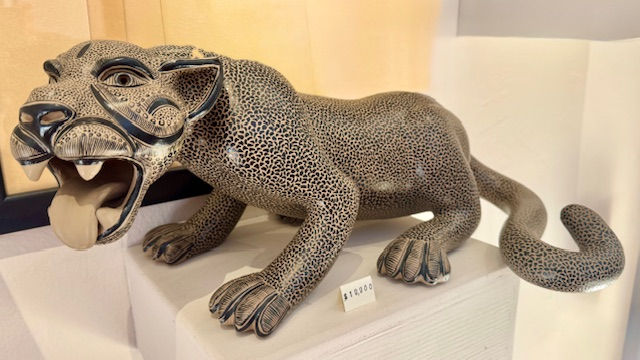
Over the past three weeks we explored Oaxaca almost entirely on foot. According to our pedometer, we averaged about 8,000 steps a day—roughly 6.4 km. That adds up to around 128 km of strolling through Oaxaca’s streets. Not bad at all, though sadly this was our only form of exercise.
Now our visit is coming to an end. We planned carefully: the fridge is empty, supplies depleted, and tonight was our last dinner out—a rooftop restaurant to celebrate our time in Oaxaca in style. Before heading there, we took one final walk through the town centre to photograph Oaxaca in the evening light. Along the way, we passed two wedding celebrations—music and traditional dancing filling the streets while the couples were still in church.


Eventually, hunger and thirst won. We arrived at the restaurant already dreaming of a cold beer on the terrace. When we ordered, the very nice young waiter, Sally, shook his head. “Sorry—dry weekend.” Dry… what now? It turns out there are local elections on Sunday in Oaxaca, and for the entire weekend alcohol sales are banned across the state of Oaxaca. No restaurants, no shops, no off-licences. Nothing until Monday morning. Disaster. Tragedy. We could not have picked a worse night for our festive farewell meal. Still, leaving wasn’t an option—the situation was the same everywhere, and we had absolutely nothing left at home. So we accepted our fate, ordered food and water, and made the best of it. And honestly? The food was excellent—really delicious.
In the end, it was still a pretty good way to say goodbye to Oaxaca. Even without the beer.
Tomorrow we're going to Querétaro. To be on the safe side, I checked online beforehand to see if elections are also taking place there. Good news: the last local elections in the state of Querétaro were in 2024. So chances are good that we'll be able to drink beer there legally again. 🍺
—————
Dave:
18th January 2026
It had been a noisy night, with much wailing and screeching echoing through the dark. It sounded as though it came from a nearby church, but we later discovered the source was the large tent-like structure of the Auditorio Guelaguetza. The open-air amphitheatre sits on Cerro del Fortín, directly behind and above us, and is famous for hosting the vibrant Guelaguetza festival, celebrating Oaxacan culture, dance, and music.
There had indeed been a major event on Saturday night that ran into Sunday morning. It wasn’t the Guelaguetza festival itself, as that is held in July, but a large-scale ticketed musical event featuring popular Mexican singers Virlán García and Germán Montero, along with Banda La Prestigiada. The ungodly racket woke us at 01:00 and continued until after 03:00. Still, we’ve been here for two weeks and this was the first time noise had disturbed our sleep, so we can hardly complain.
We had a leisurely breakfast, enjoying the sunshine on our terrace. At noon, our 20-litre plastic water container was replaced. In the afternoon, we planned to visit a photo exhibition and another nearby museum that had caught our interest.
Throughout the morning and early afternoon, people were letting off bangers that exploded with almighty bangs. Whether this was connected to the musical event on the hill behind us, we weren’t sure, but the local dogs certainly didn’t approve, barking and yowling in protest.
It turned out to be an unsuccessful afternoon on the exhibition front. The first venue was closed, and peering through the window we saw the premises were completely empty. We moved on to the photo exhibition. This was the opening day of the exhibition. Unimpressed, we left after ten minutes.
We stopped for a coffee at The Italian Coffee Company café opposite Santo Domingo church on Calle Macedonio Alcalá. A chill wind had picked up, and from the open upper-floor window we looked out across at the church, shivering slightly, paid our bill and left.
By the time we got back it was still chilly. Cloud had obscured the sun, so sitting out on our roof terrace was out of the question.
19 January 2026
We spent the morning and much of the afternoon working through photos for the blog, before deciding to head out to the Botanical Gardens of Santo Domingo de Guzmán. On the way, we wandered along the touristy side streets around Calle Macedonio Alcalá, pausing to sit on a bench beside a ghostly white female mannequin.
At the gardens we found the iron gates chained shut. Entry was free, but strictly limited to guided groups of 30. Tours lasted just 20 minutes, with no wandering allowed, and the next available slot wasn’t until 17:00. We were advised to return by 16:30 to queue, so we decided to fill the time elsewhere.
We opted for one of the open-top tourist bus tours of the city, booking tickets for MX$100 (£4.50) each. The bus arrived late, finally setting off around 15:30. It was hot on the top deck, but pleasant to roll through the streets in the sunshine. The tour lasted only 45 minutes, five of which were spent stopped for an ice cream, but it worked in our favour as we made it back to the gardens in good time.
While queuing, I chatted with a Mexican who spoke good English and his deaf wife, getting a laugh when I jokingly signed ‘bullshit’ with my hands at the security guard’s queue instructions.
——————
Background information:
The Botanical Gardens of Santo Domingo de Guzmán in Oaxaca showcase the rich plant life of the region, with carefully arranged cacti, agave, and native species from across the state. Set beside the former Dominican monastery, the gardens blend natural beauty with history, offering a calm, educational walk that highlights Oaxaca’s biodiversity and traditional uses of plants.
——————
Inside, two guides gave a short introduction before leading our group around the gardens beside the former Dominican monastery. The fading sun cast long shadows, making photography tricky, and we were kept firmly to the path, not that wandering off was appealing with so many viciously spiked cacti. The collection of cacti and agave was impressive, though beyond these and a small pond near the entrance, there wasn’t much else to see, apart from the high stone walls of the former monastery. The gardens were well maintained but felt in need of a bit more investment.
We left in the fading light, picked up bread at the good bakery to last for the next few days. Back at our Airbnb we shared a beer on the terrace while watching the afterglow of sunset. Later, we cooked the third portion of our pork ribs and ate outside, just comfortably warm enough to linger into the evening.
20th January 2026
I was up at 06:00 this morning, and finished writing up the diary for the yesterday. We had a lazy breakfast, then Lisa carried on working on the blog, adding photos and uploading both the English and German versions. We spent the whole morning on it. Lisa was especially busy translating, uploading photos, and publishing the German version as well. It’s not easy, as the iPads don’t work as smoothly as the Mac.
Afterwards, we needed to go to the good supermarket, Chedraui, at the top of Calle Niños Héroes. We set off at 13:45, and had to wait 50 minutes in the blazing sunshine for the bus to arrive, and there the supermarket’s facial recognition didn’t work for me, despite repeated attempts. Perhaps I should’ve combed my hair! We bought two tins of beer, a bottle of wine, some nuts for tonight, and a few avocados, then took the bus back. These bus drivers are lethal, and don’t seem to care about the safety of their passengers, as I they’re constantly swerving, or slamming on the brakes, jolting us passengers around.

We spent a lazy hour sitting in the late-afternoon sunshine on our balcony. Later we shared a beer, and at 18:45 it was time to oven-cook the last of our pork ribs for tonight’s feast. Norbert, our friend living in El Salvador, phoned and we had a natter.
It was just about warm enough to eat on our terrace last night. Tonight it’ll be 1°C warmer, so by 21:00 the temperature will only drop to 13°C—positively tropical! That’s how quickly the temperature falls here, and by dawn it’ll be down to 7°C, which is better than a few nights ago when it dropped down to 5°C.
21st January 2026
After breakfast we went to our local market to buy more pork ribs and a few vegetables to see us through until Saturday.
Today’s plan was a trip to Etla, a village just north of Oaxaca City, with its Wednesday market. Etla lies in the Etla Valley, one of the three valleys that surround the capital, and is an easy journey from the city.
Finding the right bus can difficult and confusing, so like most people we took a colectivo taxi. The rank is near the Central de Abasto market, and the colectivos are easy to spot, painted red and white with their destinations written across the windscreens.
There were already two passengers inside. Lisa climbed into the back with them, and I took the front seat next to the driver. Nothing in this taxi worked. The dashboard was completely dead - no speedometer or instruments - and when I tried to fasten my seatbelt the driver had to stop and rummage around under my seat to find it. I briefly wondered whether sitting in the front had been a good idea, but at least I now had a working seatbelt.

Music from a local band blasted from the speakers at full volume. The driver sang along at the top of his voice, whilst swerving between lanes of traffic in search of the fastest route. Meanwhile, the man in the middle of the back seat slept soundly. He was clearly used to this. Thirty minutes later we were dropped at the outdoor Etla market. The fare for us both was MX$40 (£1.80).
————-
Background information:
What is so special about Etla?
Etla is quieter and more rural than Oaxaca City, surrounded by open fields and low hills, with a slower, steadier pace of life. It isn’t a place you visit for sightseeing, but somewhere you go to understand how the valleys around Oaxaca quietly support the city itself. There’s little to rush you here; the countryside feels close, and daily life moves to its own rhythm.
The village is best known for its food, particularly quesillo, Oaxaca’s string cheese. Much of the cheese sold in the city comes from this valley and is still produced by small family operations using traditional methods. Food here is shaped by what grows nearby rather than by fashion.
The centre of the village is functional rather than pretty. It hasn’t been dressed up for visitors and feels lived-in and purposeful. There’s a small zócalo, a church, and a handful of streets where everyday life unfolds. Market day is Wednesday, when stalls appear selling vegetables, bread, and simple food, and most people seem focused on getting on with their day rather than catering for tourists.
—————
We wandered through the indoor and outdoor markets, taking photos of the meat stalls - carefully, as stallholders don’t like their photos being taken.


Afterwards we walked towards the edge of the village, passing the church and looking for good viewpoints over the surrounding mountains. Unfortunately, buildings and electricity cables spoiled most of the views.
On our way back a man pushing his bicycle stopped to talk to us. He was Mexican and his English was good, and we chatted for a while. He told us he had lived in Utah for 30 years, where his wife and child still are. Because of Trump’s ICE policies he had been deported and was now back in his home town in Mexico, hoping one day to return and be reunited with his family. We assumed his papers weren’t in order, maybe an illegal.
Not long after, we stopped for a Coca-Cola at a wonderful little café-bar. At the back was a dance floor surrounded by tables and chairs, the walls covered in murals, and music videos playing on two flat-screen TVs. Five other people were drinking and eating. When our drinks arrived they came with a plate of peanuts, slices of lemon, and unexpectedly two small tacos filled with chicken and tomato. The bill came to MX$70 (£2.97).
Back in the centre we approached a tuk-tuk driver and asked what he would charge to drive us around for an hour, maybe into the hills to see the surrounding villages. We agreed a price: MX$100 (£4.24) and set off.
The tuk-tuk struggled on the steeper slopes, but the slow pace suited us. We stopped a couple of times to take photos of the impressive landscape. The highlight was San Agustín Etla, with its striking church and art centre. Unfortunately, we didn’t have time to visit the centre itself. Our ride ended back at the taxi rank in Etla.
The return trip to Oaxaca was just as hairy, if rather uncomfortable, as Lisa and I had to share the front passenger seat. At least this taxi had a working speedometer even if it didn’t have seat belts, and we made a stop to refuel. We got stuck in traffic before we reached the end of our journey, so we jumped out at a set of traffic lights and walked the rest of the way back to our Airbnb.
When we got back our cleaner had just finished cleaning and changing our towels and sheets. Lisa took our washing to the local laundry, whilst I washed our smelly sandals. Later we wrote emails and caught up on the news, enjoying a cup of tea and the late-afternoon sunshine on our terrace.
It was warm enough to eat dinner outside - pork ribs, vegetables, and Lisa’s special black beans.
22nd January 2026.
It takes time to write up our diaries, and we’re usually up at 06:00 doing just that. We’ve been in Mexico for just over four weeks now and we’re tired; it takes real concentration to get the facts right.
On the way back from the laundry last night, was a corn mill, where Lisa bought some corn dough, so we could make our own tortillas for breakfast. We did, and ate them together with boiled eggs, avocado, and black beans on our sunny terrace. So after our 10:00 breakfast, we switched off, chilled on our terrace under the sunshade, and read the latest news on our iPads.
We’d promised ourselves to walk to the Mirador — the viewing area high above and behind us — ever since a Canadian couple we’d met told us they walked there every morning, saying how beautiful it was, with the whole valley laid out in front of you. So we set off at 16:00, walking up the cobbled road just outside the entrance to our Airbnb. After checking the route on the iPhone, and negotiating a few twists and turns, we came to a steep set of stone steps zig-zagging upwards. The last part was grim. We spent more time looking down, as the area was covered in dog turds and the smell was something else altogether. This was the edge of the city — totally run down — with rubbish everywhere, even an old washing machine thrown over chain-link fencing.
The final steps were especially steep as they climbed the retaining wall of a dual carriageway curling around the huge tented Auditorio Guelaguetza. This landmark sits on the hill behind our Airbnb, and is visible for miles. At the foot of the wall, a young woman and her infant were playing in the dirt outside a corrugated shack — a sobering sight.
At the top there was a car park where people stopped briefly to admire the view and take photos from the Mirador. Clearly there had once been grand plans: steps led down to a couple of long-abandoned restaurants, their owners’ dreams now as decayed as the ruins themselves. No, it wasn’t a pretty place. You could see the vast Oaxaca Valley spread out before you, but the view was spoiled by the smells, trees blocking sight-lines, filth, and electricity cables strung between tall poles. We took what photos we could and then headed back down, once again through the smells, dodging dog turds.


Time was getting on and we hoped to stop for a coffee, but nothing we passed appealed. We paused briefly to photograph the Guzmán church below, though even that was marred by cables strung across the street. We abandoned the coffee idea altogether and headed home, stopping only to buy a bottle of juice.
After showers we sat on our terrace to watch the sunset, sharing a cold beer before cooking the last of our pork ribs with vegetables and black beans. It was just warm enough to eat outside.
23rd January 2026
With three days left before the end of our three weeks in Oaxaca, and our move on to Querétaro, we’re enjoying every minute of the sunshine and heat - especially breakfasts and evening meals on our terrace.
While I prepare breakfast, Lisa goes down to collect our clean laundry and buy fresh tortillas from our local corn mill. Lisa has been having a problem with her Sony camera, and a recent firmware update promised to fix it. I searched online and tried several suggested solutions, including downloading the update onto a formatted memory card, but nothing worked.
After more searching, I discovered that the only way to update the firmware was via the Sony Creators’ Cloud application. When we bought the cameras, we’d downloaded the app onto our smartphones and registered as members. The app is designed for professional photographers and acts as a hub for the whole Sony Creators’ Cloud ecosystem, including a web-based content management system - ideal for professionals, but not really for us. We prefer the much simpler Adobe Lightroom.
However, if you want to update the firmware on a Sony camera, you have no choice but to use Sony Creators’ Cloud. The cameras must be paired to a smartphone, and the update is managed directly through the app. Once we finally understood this, it was straightforward: we linked Lisa’s camera to her phone and followed the app’s instructions. After the firmware had downloaded, we completed the update on the camera itself.
Ten minutes later, the camera was fully updated and the problem was fixed - though the whole process had taken almost two hours.
To celebrate, we walked into the centre and stopped at a café opposite the entrance to the Jardín Etnobotánico. We sat in their cool, open courtyard - Lisa with tea and cake, me with a Coca-Cola and cake. Afterwards we walked back via an OXXO supermarket to buy some nuts to nibble on later while watching a Netflix James Bond film on my iPad.
At 18:00 we had our usual cold-beer sundowner on the terrace, and later our final dinner here: the last of our oven-cooked pork ribs and vegetables, accompanied by our last bottle of red wine.
24th January 2026
Tomorrow we’re leaving for Querétaro, so later we’ll have to pack. I couldn’t sleep and was up at 06:30am to write up yesterday’s firmware update problems with Lisa’s camera. Before breakfast we washed a few clothes, and part packed our suitcases. We breakfasted on the remaining food in our fridge and then checked our emails.
Tonight we’re walking into the centre to take night time photos, and afterward walk back to the restaurant with a roof terrace we’d earmarked for our last meal in Oaxaca. On the way we stopped at Galeria Romeo to have one last look at the magnificent Jaguar they have for sale. There were two, but someone in Chicago bought one. We took photos to remind us of it. It cost MX$10,000 (£419.60). Postage would have be expensive, so too the UK import tax.

We continued into the centre as darkness fell, and followed a procession. Two large swirling papier-mâché puppets, followed by a noisy brass band, twirling traditionally dressed ladies of mature age, and a huge crowd making their way to the Guzmán church. We mixed with the crowd and took many photos.


However, we were a little disappointed, because we remembered doing the same 9 years ago, and then the streets more flamboyant and atmospheric. Now it seemed the fire had gone out, and this was just a Saturday night exercise for the tourists.
We walked back to Casa Abuela Maria, and its wonderful roof top restaurant to celebrate our last night in Oaxaca. We chose a table overlooking the street and ordered two beers, and they told us they’re not allowed to sell alcohol, as there’s a local election taking place this weekend. No alcohol sales anywhere in the town until Monday, until the election is over! So we’re sat there drinking water with our meal, on a Saturday night, to celebrate our last night in Oaxaca. Local elections - Cheers is not the word that springs to mind! (Clucking bell is are the words that springs to mind)!

We made our way home and checked the corner shops to see if it’s true that the sale of alcohol is banned this weekend. It is. We have a little rum left and some juice, so we sat on our terrace and shared what’s left.
25th January 2026
A bit of a cock-up this morning. We were up at 05:30 and ready to go by 07:00 when the Uber taxi I’d ordered to the airport messaged to say sorry, no taxi - try again later. Cue mild panic.
Lisa went downstairs to speak to Emma, one of the Airbnb’s part-owners. Luckily, she’s an early riser too. She contacted their reliable taxi driver, who arrived just 15 minutes later in his new yellow cab. The fare was MX$350 - about twice the normal price - grrr!
By 08:00 we were in the check-in queue at the Aeroméxico desk at Oaxaca International Airport. We had only a short wait to check in our suitcases and then sailed through passport control and security. There was enough time for something to eat and a drink before boarding.

Our scheduled take-off was 09:40, and we left just eight minutes late. The flight time to Mexico City was meant to be 1 hour 20 minutes, but we arrived at 10:40 - a good 20 minutes early. There was a 20-minute wait for our luggage, though the most frustrating delay was Lisa’s queue for the ladies.
Next task was booking the bus from the airport to Querétaro. Fortunately, the bus terminal is right next to the airport exit. As we’ve come to expect, buying tickets was fast and efficient. We paid MX$625 (£26.20) each. Ten minutes later our suitcases were taken, our rucksacks went through airport-style scanners, and at 11:40 we boarded the coach and set off for Querétaro. The journey would take around three hours, dependent upon traffic.
We’re travelling with Primera Plus, and what a difference compared to the buses nine years ago. The coach was very modern, with separate men’s and women’s toilets. Each passenger seat had a large 40 cm (16-inch) LCD screen, plenty of legroom, fully reclining seats, and even leg rests.
The only downside was that everyone with a window seat had their blackout curtains closed. We were in the front inner seats, numbers 2 & 3, on opposite sides of the aisle, but the glass partition separating the driver from the passengers was also blacked out. Thankfully, the girl sitting next to me kindly opened her curtain part-way so I could at least see out.
We made good time and arrived after three hours at the bus terminus in Queretaro.

