
Vamos Amigos! Come with us to Mexico - Join our Mexican Travel Blog - Part 1.
Updated: Jan 27

As in previous years, we want to spend this winter in a warm place. This time, our destination is Mexico. We have been in Mexico a few times before, last in 2016. We liked it very much and always wanted to go back, with more time, to explore more of this fascinating country. This time, we want to avoid big crowds and some tourist attractions but go off the beaten track as far as possible.
We will set off on Christmas Eve to Mexico City and take it from there. If you like, follow us on our journey.
Impressions of Mexico from previous visits
The highlights will include visiting the outstanding Anthropological Museum, Frida Kahlo’s Blue House and Diego Rivera's Murals in the National Palace in Mexico City and strolling through the picturesque colonial “magic towns” of Querétaro, San Miguel de Allende, Zacatecas, and Puebla, delving into their history and culture. In Oaxaca, we’ll take cooking classes to learn how to make delicious Mexican dishes and chocolate sauce with chilli, and visit nearby villages to observe cheese making, weaving, and tequila production.
Farther north, we’ll explore the Copper Canyon by riding El Chepe, the region’s famous railway. For the final three weeks, we’ll travel through Baja California in a campervan, hoping to spot not only cacti but also whales and other exotic species.
At least, that’s the plan—let’s see what adventures await us on this trip.

As in prior travel blogs, we both will share our expressions of this trip here. As you will see, although we visited the same sights, we experience and remember them differently.
Dear readers, over the last four weeks we have reported hier so much about our adventures that the blog post can’t take any more text and photos. We will open a part 2 travel blog and will continue there with reporting about our last week in Oaxaca, 18th to 25th January.
Please check it out.
https://www.rememberrelatereflect.com/en/post/vamos-amigos-come-with-us-to-mexico-travel-blog-part-2
3. Oaxaca 4th to 25th January 2026

Lisa
11th January 2026
In the meantime, we have arrived in Oaxaca. Our Airbnb is lovely: bright, with a terrace that offers a view of the mountains—a perfect place to stay for the next three weeks.
We left Puebla on Sunday around midday and rode for five hours by bus through an impressive mountainous landscape. Oaxaca lies at 1,500 meters above sea level and is surrounded by mountains. During the day, temperatures reach up to 30°C, but at night they still drop to between 8 and 10 degrees.

We arrived in the late afternoon and, after settling into our lovely new home, went out for a meal. Our apartment is right in the centre of town, only seven blocks from the Zócalo, the main square. We were here nine years ago, and slowly the memories are coming back. Despite the Christmas decorations and markets, we recognised some streets and buildings. Among the many outdoor restaurants around the Zócalo, we chose one we had visited before, and once again we were not disappointed. The food was excellent, and we shared a pitcher (1.7 litres) of dark barrel beer. After our bus journey, we were thirsty and hungry—and happy to be back in this town after all these years.

We strolled around the square and joined a group of people dancing to cumbia and salsa music played by a DJ, a regular event on the plaza that we remembered from our previous visit. It felt good to move to the music and dance. Someone even made a video of us oldsters dancing and told us we were in great shape. We then walked home leisurely. It felt good to be back.
The next morning, we brought our washing to a launderette around the corner and bought some essential food for breakfast and dinner at the local market nearby. After a very tasty breakfast with local produce on our sunny terrace we contemplated what to do in the next days and weeks in this town.
First of all, we urgently needed a break and fully intended to take it easy, having been on the go non-stop since leaving London ten days earlier. However, before any resting could occur, there were texts to finish and upload—together with carefully selected, relevant photos—to our travel blog. Friends had already started enquiring whether we were “okay” or possibly “lost,” since nothing new had appeared online for several days. No pressure at all!
This is where I discovered, again, the limits of my relatively new iPad. While it is brilliant for many things—photos, news, general life administration, and travel due to its conveniently smug little size—it turns out that its very iPad-ness makes it less than ideal for writing a blog on the road. Many editing and photo-editing features simply don’t work. As a result, a significant amount of editing is now generously outsourced to my long-suffering blog companion, Titania, in Munich. Fortunately, she claims to love editing and insists she doesn’t mind. I choose to believe her.
Still, Dave, always on the lookout for something computer-related, discovered an Apple Store on the outskirts of Oaxaca and suggested we “just have a look” at what they had on offer. This innocent suggestion, as it turned out, was anything but simple.
Google Maps showed us the location and recommended public transport to a stop where the road to Atzompa—a village north of Oaxaca—begins. We were directed, redirected, and generally waved about to various places from where carros (shared taxis) allegedly departed, because apparently buses do not go there. At several points I suggested giving up, taking a proper taxi, or simply going home, but Dave assured me this was all “part of the adventure.” Alright then.
Eventually, we found a carro that promised to take us where we wanted to go for 13 Mexican pesos each (£1.08 / €1.24). Three women were already squeezed in the back seat of this elderly Toyota, patiently waiting for the car to fill up so it could leave. Our arrival was greeted with visible relief—at last, the car was complete. Dave and I squeezed into the front beside the driver, each of us occupying approximately one cheek of the seat. My remaining cheek was on the gear stick. Every time the driver needed to change gear, I had to lift my entire body while Dave grabbed my knee and rotated it toward him so the driver could operate the gear stick. Then I sank back down onto it again. Teamwork. Romantic Latino music blared from the radio. The women in the back slept peacefully. We motored on. The journey took longer than expected, and when I checked Google Maps, we were already well past our intended stop and almost in Atzompa. Getting off in the middle of nowhere seemed pointless, so we continued all the way.
Just before arriving, a procession of 30 or 40 bright green three-wheeled motorbikes—tuk-tuk-like, flower-decorated, and festive—passed us, coming from Atzompa. It turned out the village was celebrating its 200-year anniversary. The houses and plaza were decorated, and people were gathering in anticipation of festivities. After a short walk through the village and its market, we decided we’d had enough culture for one afternoon and wanted to return to Oaxaca. We consulted Google Maps again, and at that exact moment a tuk-tuk stopped in front of us, its driver asking if he could help. I showed him the map and asked if he could take us to where we wanted to go. “Plaza Bella? No problem.” We climbed in. He dropped off his existing passenger and sped off, cool wind blowing, life suddenly much easier. Twelve minutes later, he stopped in front of a massive shopping centre: Plaza Bella. We paid him 10 pesos each (£0.83 / €0.96) and went off in search of the Apple Store.

Apple did indeed have the MacBook Air Dave had researched online as the best option for me. I tried it and liked it. The young and helpful salesman assured us that Apple, being an international company, offered worldwide warranty. Unfortunately, the laptop was more expensive than in the UK, and the shop would not accept my iPad in exchange—only laptop for laptop. This made the purchase firmly unrealistic. I resigned myself to my iPad, knowing that better options were available once we’re home. Dave, ever hopeful, has already found refurbished ones online at a much friendlier price. We thanked the salesman, who pointed us toward a bus stop with excellent connections back to the centre. It turned out the shopping centre was very well connected. One simply had to know where to look—or what to look for. Thus ended our first of many little adventures in Oaxaca.
Over the next few days, we wrote our diaries, read books and explored the town centre, trying to retrace our steps of our previous visit: This included the Church of Santo Domingo, in front of which we had once photographed many happy couples on their wedding day. It was also here, on the top floor of a café, that on a Sunday morning we had observed and photographed a Mexican rock band performing while filming their promotional video.
The city seems to be busier, full with locals and tourists; with any more hotels, restaurants, galleries and handicraft markets catering for tourists. We found the lovely hotel where we had stayed last time, La Case del Sotano. It had become a pricy boutique hotel - unaffordable for us if we wanted to stay three weeks in this town. Travelling for almost three months calls for a different approach to accommodation—ideally one that includes a kitchen, if we want to stay solvent. We visited some of the many galleries and handicraft stores. Some offered beautiful items, but at rather high prices, especially when compared to the inexpensive—and often cheaply made—goods sold at street stalls.

The sun was burning, so we set out to buy Dave a straw hat with a wider brim—his baseball cap was doing nothing to protect his ears, which were already turning a worrying shade of red. We found a nice one straight away, but it was too expensive. We then tried many other places, all unsuccessfully: the hats were unsuitable for a wide variety of reasons. In the end, we returned to the first, more expensive stall. Dave is now happy.

Later, the sun burned my neck as well, so I too bought a wide-brimmed straw hat. Now everyone can tell from a distance that we are tourists.
Tired from our walks we rested in many cafés. We were particularly keen to find one café we remembered from our last visit nine years ago. It was set in a beautiful courtyard of a university library, near a building that had been partially burned during student protests over a decade ago and was still boarded up when we last saw it. We searched extensively. No one we asked had any idea what we were talking about. We gave up.
The next day, we tried again. This time, a young woman remembered and led us there. It was nearby. We must have walked past it countless times. And there it was: a shady courtyard surrounded by trees and houses, smaller than we remembered, but peaceful and inviting, with tables, chairs, and pictures on the walls. I ordered an iced cappuccino for Dave, who had been dreaming about this very moment since leaving Oaxaca all those years ago. I ordered black tea, only to be told they didn’t serve tea because they were coffee specialists. I settled for a hot chocolate, which coffee specialists apparently still make. Dave’s iced cappuccino arrived—lukewarm, with a few ice cubes floating in it. In the past, it had been with crushed ice and creamy. Sometimes, it’s best to leave dreams untouched. Still, we enjoyed sitting in the quiet courtyard, escaping the bustle of the streets, and—always important—making use of their clean toilets.
On our walks through the streets we admired many of the colourful murals, wall paintings, some more artistic, others with a deeper meaning behind it.


We also went to various tourist centres to enquire what tours were on offer. Last time we had been in Oaxaca for 5 days and had taken various tours into the neighbouring villages, we visited a Mezcal destillery, learnt how to weave, making carpets, pottery; we visited the archaeological sites of Monte Alban and Mitla as well as the waterfalls of Hierve el Agua. Now we did not want to repeat ourselves but to learn something new.
What about a cooking course? I had been had this idea for a while and gently trying to persuade Dave to do one with me. Eventually, he agreed (absolutely no pressure involved whatsoever), and we chose one from the many on offer. “Qué Rico es Oaxaca” is a family-run cooking course. Alfonso, the son, learned to cook from his grandmother and mother and later trained as a professional chef, working in Mexican restaurants around town. These days, his main occupation is running the cooking course for tourists—with some hands-on help from his parents.
The six of us participants were picked up at a nearby market, where Alfonso introduced us to the impressive array of spices and chillies used to make mole, the famous Mexican sauce that seems to contain roughly everything. We also stopped at a stall to buy masa, the dough used to make tortillas, a cornerstone of Mexican cuisine. Tortillas can be bought anywhere—at markets or in supermarkets—but, as we were solemnly informed, those made from freshly prepared dough are vastly superior.
The dough itself is made from whole dried corn kernels (maíz) soaked in limewater to soften them, then ground on a stone grinder to create a fresh, wet dough. This masa must be used immediately to make tortillas; otherwise, it hardens and becomes brittle.
After that, Alfonso took us to his house and the cooking class officially began. We put on our aprons and were each handed a wooden chopping board and a large, very sharp knife. Today, we were told, we would learn to prepare twelve different dishes.
But first, Fernando, the father, was given the important job of loosening us up and setting the mood. This was achieved with a shot of mezcal and a few well-practised jokes. Luckily, we had eaten a big breakfast.
We were then introduced to the menu and assigned tasks: chopping vegetables and onions, frying rice, roasting plantains, grinding spices, shaping tortilla dough into small balls and pressing them into neat little tortillas, stirring the mole, whisking condensed milk with eggs for dessert, and much more—all under Alfonso’s calm guidance and the watchful eyes of his mother. Everything was in preparation for a three-course meal.
In between tasks, Fernando reappeared with yet another bottle of mezcal for tasting, and we also learned how to make margaritas. Dave and I took it easy on the alcohol. Daytime drinking tends to make one sleepy, and given the abundance of large knives, we felt caution was advisable.
The food we produced was amazing: guacamole with fried tortillas; tortillas filled with black bean purée and topped with a salad of cabbage, carrots, onions and Oaxacan cheese as a starter. The main course was chicken with mole sauce, served with fried rice and vegetables. Dessert followed—lechesilla (custard) with Oaxacan chocolate.
After the meal, there was, of course, another mezcal tasting—three different types this time. At this point, everyone was relaxed, well fed, and still miraculously in possession of all their fingers.


Overall, it was a successful cooking class—although I personally could have done with less mezcal and fewer of the occasionally not-so-funny, rather tiresome jokes, which I was also expected to translate for those who didn’t understand Spanish. Nothing sharpens one’s enthusiasm like explaining a mediocre joke after several shots of mezcal.
It was interesting meeting the other participants: all younger than us, probably in their late twenties—two from Germany (Stuttgart) and two from the Netherlands (Amsterdam). They told us about the tours they had done or were planning to do. That evening, they were heading back to their hostel for a salsa class, followed by dancing and drinking until the early hours. It sounded exciting. It also sounded utterly exhausting.
Compared to them, we felt like boring old farts. Then again, we had done exactly the same things when we were younger—and apparently survived—but right now it held absolutely no appeal whatsoever. Wisdom, or age? Possibly both.
On the way home, we found ourselves contemplating more seriously: what exactly did we want from our time in Mexico, and what did we really want to see and experience in Oaxaca?
That’s not an easy question and we have not yet found an answer to that. What we definitely don’t want is to be herded around in a tour group by an uninterested guide, pressured into buying things, and taken to restaurants where the guide conveniently earns a commission. Nor do we feel the urge to taste 30 different types of mezcal in the middle of a hot day. We much prefer to explore things ourselves, at our own pace, and on our own terms.
More to come later.
——————-

Dave:
04th January 2026
We leave Puebla behind today, heading for Oaxaca. The circular bus station feels like an airport, with coaches pulling in nose-first, packed tightly together, constantly arriving and departing. At 1135, 10 minutes before our scheduled departure, the departure board is still blank. Lisa goes to ask a conductor, who points us to our bus. Our luggage is tagged, given a receipt, and we board, seats 1 & 2, the very front seats. At noon, as we pull away, I take out my phone and switch on our heating back home, as London is in the grip of a cold snap, and will get down to -3C overnight.
We’re driving through a parched, barren mountainous wilderness covered in tall, spindly cacti. The steep-sided, two-way mountain road twists its way upward, and it takes our driver some time to choose the right moment to overtake the fully loaded trucks crawling up the steeper sections. Bridges span deep chasms, with dried riverbeds visible far below. In Crete, drivers move onto the hard shoulder to allow faster vehicles to pass and to make room for oncoming traffic. Mexico, it seems, operates much the same system and the slower cars move over to let faster traffic pass.
We arrive in Oaxaca 1710 and the weather is noticeably warmer than Puebla. We take a taxi to our Airbnb, where we’ll be for the next three weeks. Our Airbnb in Puebla was cheap and cheerful, this one is positively luxurious. We’re at the top of the house, and we have a south facing terrace too. There’re plenty of stairs, so its a slog getting our suitcases up the narrow flights of stairs.
It’s dark once we’ve unpacked, and we set off to explore and find a restaurant to eat. Our Airbnb is 4 blocks from the centre of town, the Zocalo, and when we get there it’s lit up with Christmas decorations, and there’s a huge Christmas tree taking pride of place in the centre. We were hungry and thirsty and after a brief circuit of the Zocalo choose restaurant, Terrazza Nova. It was a good choice, the food was excellent and we ordered a 1.7 litre jug of beer. Yes, we were thirsty!
After we paid the bill (£35) we crossed the plaza and in one corner a DJ was blasting out music and a large group of people were dancing. We joined them and had a great 15 minutes. Maybe it wasn’t such a good idea after drinking beer and eating a big meal - frothing up the beer in our tummies! From there we walked it home.
05th January 2026
We must have been tired, as we didn’t wake until 0700. When I opened the curtains the sun was just rising, casting an orange glow over the houses on the far side of the valley. From our balcony the view was superb, with the floodlit towers of the Basilica de Nuestra Señora de la Soledad standing out in the near distance.
We needed supplies before breakfast, so after showering we walked down to the main road. Directly opposite was Mercado IV Centenario, a typical Mexican market spread over a large area and divided into countless small stalls. Each seller offers their own produce, so shoppers choose who they think has the freshest vegetables or meat. Alongside fruit, vegetables and meat, there were stalls selling bread, cakes, eggs, cheese, sweets, even pots and pans. Inside, a café area catered for workers grabbing breakfast before starting their day. If you needed something, you were sure to find it in this market.
Back at the flat, I made a three-egg omelette with spring onions and mushrooms. We took breakfast out onto the terrace and ate in warm sunshine beneath the patio umbrella.This was the 13th day of our adventure and we were running out of clothes, so we found a launderette, just around the corner. We dropped off two plastic bags stuffed with dirty washing. It was their first day back after the Christmas holidays and the place was bursting at the seams, so our laundry wouldn’t be ready until after 2000 on Wednesday.
The Mercado didn’t sell beer or wine, so we walked to the nearby Soriana Mercado. It was the most chaotic supermarket we’ve ever seen. While I was looking at beer offers, someone walked off with my trolley. I grabbed another and kept a firm hand on this one! Their beer selection was OK, the only wine on offer was overpriced Lambrusco, nor did they stock Lisa’s black tea. We did, however, find a small metal oven dish, which our flat lacked. Back home, we unpacked and spent some time working on our iPads.
Later, we decided to try the Chedraui supermarket, which was some distance away and reachable by local bus. Finding the bus stop wasn’t easy as there were no signs. Our first attempt at flagging down a bus failed, but after Lisa asked a few people we learned about the designated stopping areas for buses. We paid MX$8 (about 33p) each, and got off ten minutes later.
The Chedraui supermarket was the complete opposite of Soriana Mercado: clean, organised and well stocked. There was an excellent wine selection, and Lisa was delighted to find Twinings teabags. We also bought a small knife and a potato peeler, as the flat’s knives were blunt.
The return journey followed a dual carriageway. Lisa tracked our route via Google Maps on her phone, and we guesstimated where to get off. We learned too that to stop the bus you press a bell by the rear exit. We got off too early and had to walk back via the parallel road, but it wasn’t far.
We celebrated our success — wine and teabags at last — by sitting on the terrace watching the sun set. Dinner was boiled potatoes and carrots, with chicken, spring onions and green pepper, baked in our new tin dish. We ate outside with a glass of wine, the warmth of the sun stored in the walls keeping us cosy.
London was in the midst of a cold spell. The temperature was -4C and the fountains in Trafalgar Square were frozen over. I set my alarm for 0100 local time, 0700 London time, as I needed to override the timer of our central heating, as it automatically switches itself off at that time.
06th January 2026
Today we set out to visit the MacStore at Plaza Bella, on the north-western outskirts of Oaxaca. Lisa is finding it hard to work on our bilingual blog using her iPad, as the iPad version is far more limited than the full Mac version.
Online information suggested several buses passed the mall, so after breakfast we walked to the stop a block from Jardín Morelos. Once there, we discovered none of the buses actually went to the place where we had to go: where the road up to Atzompa starts, and neither drivers nor shopkeepers could help. Eventually, we tried our luck with a shared taxi and struck gold, the driver was heading that way. Three stout Mexican ladies were in the back, so we had to share the front passenger seat. One elbow was sticking out of the window, the other arm was wrapped around Lisa’s legs, so the driver could change gear. It was very cramped, and cost MX$26 (£1.07) for us both.We were dropped in Atzompa, but not the Plaza Bella where we needed to be. Nearby, was a church and a communal area, which was hosting celebrations for the town’s 200th anniversary.

From there, we flagged down a three-wheeled tuk-tuk, who had a passenger inside. Yes, he would take us to the Plaza Bella, the lady inside moved over so we could get in, and off we went. A block later the lady got out, and we rattled along the bumpy back streets, picking up a passenger on the way, before reaching Plaza Bella.
The mall was huge and busy. After a Coca-Cola, we found the MacStore where a helpful young lad talked Lisa through the MacBook Air. It was more expensive than in the UK, and she decided to wait and buy one once we got back home. The young lad told us where the nearby bus stop was to get us back into town.
The return bus journey was smooth until we reached town, and then we were snarled up in gridlocked traffic, so like many others we got out and walked the final stretch, between the stationary traffic, enduring the exhaust fumes, until reaching Jardín Morelos 5 minutes later. From there it was a further 5 minute walk thorough the Mercado to our flat.
Back home, we made tea and continued working on the blog. Uploading and placing photos on the English blog took hours and Lisa would have the same again tomorrow, with the German version.
Dinner was oven-baked chicken drumsticks, courgettes and onions with boiled vegetables, eaten on our terrace, which was decidedly cooler than last night.
07th January 2026
We started the day slowly, exhausted after catching up on our blog, now complete up to, and including Puebla. After breakfast, we went in search of the hostel we’d stayed at during our last visit to Oaxaca in late 2016. According to my old diary, it was the Hostal Casa del Sótano on Calle Tinoco y Palacios, and was only a few blocks from where we were staying now.
Fifteen minutes later we were outside the building. A rather snooty young lady, reluctantly, let us into the reception area, where we could see the familiar two-storey courtyard, now transformed into a classy boutique hotel. The restaurant on the first floor was still there, but the new pool, and spa area, were strictly off limits to us. We thanked her and moved on.
We wandered along Calle Macedonio Alcalá, and stopped to view Santo Domingo church, which brought back vivid memories of a spectacular wedding we photographed all those years ago, and stopped for a cold drink in a café opposite, admiring the views of the church, just like we did 9 years ago, from the first floor window.

Oaxaca's Templo de Santo Domingo de Guzmán is a magnificent church and former convent, not a cathedral; it's a stunning example of Baroque architecture famous for its incredibly ornate, gilded interior, particularly the Rosary Chapel, and is one of Oaxaca's most visited historical landmarks.
Higher up the street was a trendy market, where I reluctantly bought a straw hat for MX$250 (£10.29) to protect my head and ears from the fierce 30C sun beating down from a cloudless blue sky. Lisa also felt the heat, and shortly after she too bought a broad brimmed straw hat.

We failed to find the burnt out building, set alight during a period of student unrest, as we wanted to have a coffee break in a courtyard café opposite that we’d loved back then. Instead of a coffee break, we spent hours wandering the increasingly crowded streets, trying to find this building and courtyard cafe, as we soaked up Oaxaca’s vibrant atmosphere. The Zócalo was still decorated for Christmas, so too the brightly lit huge Christmas tree.

Tired of the heat, we headed back, briefly in the wrong direction (my bad), then bought half a dozen eggs from a corner shop, after finding the food market closed. Back home, we made a brew, and relaxed on the patio, greeting our new neighbours, from Earls Court, London, who’d just arrived. As soon as the sun went down, so too did the temperature. We prepared dinner, oven cooked chicken and veg, together with potatoes and carrots. We opened a bottle of wine and ate our delicious dinner on our patio in our fleece jackets.
08th January 2026
We had an early start, as we needed to go to the market for supplies, and bread rolls for breakfast, as well as pick up our laundry. At 0900 people in the street were wrapped in thick coats and hats, even inside the market it felt cold. Standing in the sunshine was pleasant enough, but in the shade it was decidedly chilly. After 1000 it became more comfortable.
To make a change from chicken, we bought a rack of pork ribs from two ladies selling pork. It was about 60cm long, and cost MX$200 (£8.23), enough for four evening meals. We also bought potatoes, courgettes, tomatoes, onions, peppers, carrots from various vegetable sellers, and finally four bread rolls. On the way back we collected our laundry.
We had a leisurely breakfast and then relaxed on our terrace until midday, when we set off to wander the streets of central Oaxaca.
We found the Bibliotheca Café we’d visited nine years ago, opposite an old stone colonial-style building that once housed a university department. We’d tried to find it yesterday without success, but today we were in luck. Back then there had been student riots, and the university complex had been set on fire. The building had been boarded up, and you could see where the flames had blackened the stonework above the outer windows.
To celebrate being back in this wonderful café, we sat outside in its open courtyard and ordered drinks. They didn’t have tea, so Lisa chose hot chocolate, while I ordered an iced cappuccino. I vividly remembered the one I’d had last time — crushed ice, and really ice-cold. This one came with ice cubes and wasn’t quite cold enough. Still, not everything can be perfect.
Before leaving the UK, we’d talked about taking a Mexican cooking course. Over our break, Lisa checked what was available and found plenty of options. We booked, and paid MX$3,100 (£129), using our Wise card, for ‘Qué Rico Es, a traditional Oaxacan cooking class. The class is tomorrow at 1030, meeting at the Mercado Sánchez Pascuas car park, next to the big tree on Porfirio Díaz Street. It’s only a fifteen-minute walk from our Airbnb.
We then made our way to Macedonio Alcalá, the lively pedestrian street lined with restaurants, bars, and cafés. Most of the buildings are two storeys high, nearly all with covered rooftop terraces. With no particular plan, we simply wandered, taking photos, as the late-afternoon light was perfect, and finished by visiting the Templo de Santo Domingo de Guzmán and its surrounding complex.


We checked the maps on our phones, and took a shortcut back to our Airbnb, via narrow cobblestoned back streets. There were plenty of murals painted on the walls, and we stopped to photograph the best ones.
Once back, we caught up on our diaries and followed the latest developments in Trump’s megalomaniac, seemingly never-ending march to take over the world. Afterwards, we oven-cooked the pork ribs and vegetables and dined out on our terrace.
Adam from our gym had recommended a book, ‘Under the Volcano’, which was set in this part of Mexico. Lisa bought a copy but found it heavy going, and the print too small, and to our surprise discovered the film adaptation on Amazon Prime. The film stars Albert Finney, who plays a former British consul battling severe alcoholism in Mexico. It was an excellent performance by Albert Finney, who played the drunken English consul very convincingly, but it was a very disturbing film.
09th January 2026
Today we had our cooking course, and we planned to leave just after 1000, as it was only a 15-minute walk to our pickup point by the big tree in the Mercado Sánchez Pascuas car park.
There were six of us waiting by the big tree at 1030. The instructions could have been clearer, as there were two car parks, both with big trees— one at the front and one at the back. We were waiting at the front, but the meeting point was actually in the rear car park. Alfonso arrived shortly after 1030, greeted us, and then took us across the road to a small mill. There he explained how corn (maize) is processed into masa, which is used to make tortillas, a Mexican staple.
We crossed back over the road and entered the market, walking through the large vegetable section to buy our ingredients. With each vegetable Alfonso explained its purpose in the cooking process. He did the same with the different peppers, naming each one, and describing its strength, from mild to red-hot.
Alfonso then drove us about 20 minutes to his family home, which he shares with his parents, his father Fernando and his mother. After Alfonso introduced us in the large kitchen, Fernando promptly produced a bottle of mezcal. He filled our glasses — but not his own — and we raised a toast to the next few hours. Fernando was small, squat, and tubby, and I got the impression that Alfonso and his mother had already warned him to keep off the mezcal.
We were each given a wooden chopping board and a very sharp knife. Fingers crossed no one would lose a finger, after downing those generous glasses of neat mezcal. Then the work began, starting with slicing vegetables very thinly, and being told which bowl each batch belonged in.
After a while we took a break, and out came another bottle of mezcal, together with orange liqueur, lemon juice syrup, and ice. We were shown how to mix the ingredients for a margarita, placing them in a cocktail shaker and giving it a vigorous shake. The rims of our glasses were coated with salt and chilli powder. Another toast followed, and then it was back to chopping before the cooking proper began, with everyone helping at different stages.
We made guacamole as a starter, prepared the tortilla toppings ourselves, using maize masa, and cooked the main course of chicken with a delicious Mexican sauce. Even the Mexican dessert, which we all helped make, turned out spot on.
To finish, Fernando brought out three different bottles of mezcal for us to taste. After several more toasts a short speech followed — during which the tip box made an appearance. We said our goodbyes to Fernando and his wife, and at 1600 Alfonso drove us back to the supermarket car park.


I’m not usually one for touristy activities, but Lisa was keen to try the Mexican recipes (which Alfonso was kind enough to send to our email addresses), when we get back home to London, so for that alone it was worthwhile. That said, I did rather enjoy it — even if a Mexican restaurant still isn’t something I’d cross town for. Also, drinking during the day is something we don’t normally do, nor do we usually eat quite so much. We took a leisurely stroll back through the tourist streets in the hot sunshine.
————————-
Lisa:
10th January 2026
On Saturday we set off to our weekly trek to the impressively well-stocked Chedraui supermarket. Armed with fresh eyes—and freshly acquired knowledge of Oaxacan cuisine thanks to our cooking course—we inspected the aisles with the confidence of people who now know their chillis and their moles.
Before even entering, however, we were confronted by modern technology. As in all supermarkets here, rucksacks must be locked away to discourage casual shoplifting. But instead of the familiar coin-operated lockers, these are controlled by facial recognition and guided by a female Asian voice speaking English with a heavy accent. As not many people were using these lockers I could not find out whether the face recognition identified us a English speaking foreigners, or whether this English guidance is for everyone. I will pay more attention next time.
It took us a moment to find out how the system works. You stand in front of the machine, press a button to request a locker, then present your face to the scanner. For shorter customers there’s even a little step. Once your face is approved, a locker pops open obediently. You stow your bag and close the door. Retrieval is equally futuristic: press “release,” show your face again, and—open sesame—your locker door springs open. We were rather proud of ourselves for mastering the process. Even the security guard, who had followed our efforts with interest, rewarded us with a raised thumb. Well done!
After shopping, we wandered through the town centre, photographing beautiful houses and their hidden yet equally beautiful courtyards. We paused to listen to the band of a procession, drifted through several art galleries, and ended up talking with the owner of one newly opened gallery. He is a young Mexican architect who lives and works in New York and is dedicated to sharing Oaxacan culture more widely. Together with his local partner, he has spent five years developing this gallery, which opened just three weeks ago. They travel through the region collecting work by local artists and are now cataloguing the pieces to sell internationally, with the aim of creating a fund to support the development of local artists. We were struck by the quality of the work. Both of us fell for a roughly 70-centimetre jaguar sculpture (not including its tail). The only problem: how to get him home? Hand luggage for the rest of the trip seemed impractical - and the tail would stick out. Still, we wished the gallery every success.
Later, we sat on a low wall in front of a church and watched a group of dancers rehearsing on the plaza. Dressed in traditional black and red, they were clearly preparing for a local event—no lights, no audience, just us and a handful of children.
Back home, I fried plantains as a starter, followed by pork ribs and vegetables cooked by Dave in the oven. We ate on the terrace, looking out toward the mountains, far removed from the noise and bustle of the streets below, happy to be here.
11th January 2026
The next day, Sunday, we headed to La Merced Market at the other end of town. This is the kind of market that sells absolutely everything: fresh fruit and vegetables, meat, cheese, spices, plastic buckets and bowls, baskets, handicrafts—and, most famously, mole, the legendary Oaxacan sauce. There are seven different types, each with its own colour and personality. We had made a yellowish one in our cooking class and it was excellent.

Making mole, however, is famously labour-intensive, so enterprising locals sell it ready-made at the markets. At La Merced it is even attractively packaged for tourists, complete with instructions. This seemed too tempting to ignore. For tonight’s dinner, I chose a black mole and we were excited: something to look forward to in the evening.
Another section of the market is devoted entirely to medicinal herbs. Alongside familiar names like camomile and thyme are baskets filled with mysterious mixtures of twigs and leaves. These are meant to be boiled for at least fifteen minutes and then drunk as tea. I’m always fascinated by them, though I still vividly remember the bitter brew a Nicaraguan curandero gave me in the 1980s for stomach trouble. The taste lingered for hours; whether it helped I can’t really say.
Small handwritten cards explain what each mixture is good for: digestion, liver and kidney detox, chest infections, bladder issues, incontinence, impotence—and almost anything else you might be suffering from. Dave dismisses all of this as nonsense. I, however, grew up with my mother’s cupboard full of herbal teas for every imaginable ailment, so I remain a believer.
I bought a small piece of curcuma root. It looks like a large worm, is red inside, and stains everything yellow. My Myanmar colleagues once recommended it to me for stomach problems (they call it turmeric), and it worked. Here, the woman assured me it also helps against sore throats—perfect timing, as I had developed a cold overnight. Later at home, I persuaded Dave to chew a small piece as he also had a bit of a cold. He wasn’t impressed, and when he later caught sight of his yellow tongue in the mirror, and yellow bristles on his toothbrush, he nearly panicked. What a wimp.
On our way home we met a Canadian couple, about our age, and got chatting. They love Mexico—especially Oaxaca—and have been coming here for years. They used to drive their motorhome all the way from Canada, but now, like us, they fly in and get around on local buses. They shared plenty of tips and stories, including watching whale mothers and calves in Baja California, where we’re heading in March. Time flew by. It’s rare to meet like-minded travellers these days, but when it happens, we relish a good natter. They’re heading home in three weeks, and we wished them well.
That evening, full of anticipation, I prepared our mole negro, following the instructions on the packet to the letter. We were looking forward to pouring it generously over our freshly grilled pork ribs. One taste was enough. We looked at each other, said nothing, and scraped it straight off our plates—into the toilet. Dinner was infinitely better without it. We concluded that one does not, in fact, have to like everything just because it is Mexican.
12th January 2026
On Monday, 12 January, I spent the entire morning uploading texts and photos to the blog. Just as well, because shortly afterwards the internet went off. According to our landlord, it was a region-wide outage and would “surely be fixed very soon”. We could live with that. Luckily, the electricity stayed on, which felt like winning the lottery, as everything in our lives now requires charging: iPads, iPhones, watches, batteries—existence itself seems to depend on a power socket.
With no internet to distract us, we set off for the nearby Central de Abastos Market. It’s huge and well worth a visit. Conveniently, it also sits next to a bus station and the collectivo taxis, so we used the opportunity to investigate where they actually go. This turned out to be an exercise in patience and guesswork. There is no notice board. Instead, you inspect the front of each bus or taxi and hope the destination is written somewhere legible. After some wandering and squinting, we did at least discover services to Atzompa and Plaza Bella, whom we knew already. Navigating transport here clearly requires either time, stamina, or insider knowledge—or ideally all three.
The Central de Abastos is said to be the largest market in Oaxaca, and it certainly feels like it. It’s a wholesale market, with huge lorries rolling in, unloading mountains of goods. Strong men hauled enormous sacks of fruit and vegetables on handcarts, pulled by other strong men, all moving at impressive speed. The place buzzed with serious business. We carefully made our way through, took photos, tried not to get run over, and not to be too much in the way of those working, eventually bought fruit and vegetables ourselves.


On the way home, we stopped at our local market where I picked up black beans and fried tortillas, later prepared them as a starter with fried plantains. Sadly, it was too cold and windy to eat outside. The evening temperature was in single digits. Oaxaca can be full of surprises.
13th January 2026
The next day, 13 January, we went early to the local market to buy fresh meat. Early is essential, as most vendors don’t have fridges and the meat is displayed proudly all day long. With the internet still down, we decided to do something cultural and visited the Museum of the Culture of Oaxaca, next to Santo Domingo church. We had been there before and were so impressed that we wanted to see it again. It’s considered one of Mexico’s finest regional museums and covers the history and diverse cultures of Oaxaca, highlighting the continuity between pre-Hispanic and contemporary life.
The ticket also included an exhibition of works by the renowned Mexican woodcarver Manuel Jiménez Ramírez. We admired his vividly painted wooden animals before moving on to the main museum, housed in the vast former Santo Domingo monastery. The building alone is breathtaking: endless corridors, countless small rooms, and large windows at the ends offering a view to gardens and mountains beyond. The monks clearly lived very well.

We spent two hours wandering through the exhibitions. Some pieces we recognised, others were new, and some we searched for in vain—particularly sections on the Spanish Inquisition and Emiliano Zapata, which had fascinated us on our previous visit. They were gone. Even the staff seemed unaware they had ever existed, although tourist guide books still list them. Disappointing. Overall, the exhibition felt thinner, less challenging—or perhaps we were simply tired. Either way, it reminded us that sometimes it’s better not to return and instead preserve the memory.

The old monastery was freezing, and my throat began to feel like it was on fire—possibly from the dust of the books and other exhibits. I persuaded Dave that we needed to leave and sit on a sunlit stone wall outside to warm up. Revived, we crossed the road to a café and had coffee (Dave) and lemon ginger tea (me) on their roof terrace overlooking the Santo Domingo complex. We had a chat with the lovely young waitress, who told us that on Friday evenings a band plays there—an excellent reason to return before we leave Oaxaca. We didn’t linger long, as the wind picked up again.
On the walk home we discovered a bakery selling bread that doesn’t disintegrate into breadcrumbs when cut—a rare and valuable find. We bought two loaves to test. We also stumbled upon another restaurant with a roof terrace; we checked it out and the smell of roasting pork made my mouth water instantly. Another must-visit before departure.
Back home, I prepared yet another starter of black beans and tostadas, followed by pork chops with leek and chickpeas from the market. Cooking with the local produce we’d found on our market tours was a pleasure. We always liked to try something new and asked the sellers how to prepare it.
And finally, the internet returned. The evening programme was saved.
14th January 2026
The next day, Wednesday, 14 January, the internet behaved impeccably, allowing us to follow our usual morning routine: reading the news, answering emails, and writing our diaries. By the time the sun finally made an appearance on our terrace, it was warm enough to have breakfast on the terrace.
Our original plan was to take a colectivo taxi to the market in Etla, a village north of town. However, the weather forecast promised rain and strong winds in the afternoon, so we postponed that adventure until next Wednesday and instead stayed in Oaxaca to explore more of the city’s indoor markets. We thought we knew them from previous visits. We were wrong. They looked noticeably different—remarkably sanitised, even.
We started at Mercado Benito Juárez, named after Mexico’s first Indigenous president, a Zapotec born in Oaxaca. Opened in 1894, it is one of the city’s oldest markets. It is generously stocked with fruit and vegetables, chillies, tortillas, tamales, cheese, meat, fish, chocolate, chapulines (fried grasshoppers), gusanos de maguey (agave worms), countless varieties of mezcal, and an impressive selection of traditional drinks. You can also buy hairbrushes, knives, scissors, electronic accessories, leather belts and bags, and traditional handicrafts. In short: everything.
This eclectic mix makes it popular with both tourists and locals. There is also a section devoted to herbal medicine, where I studied the handwritten cards with great interest. There appears to be a cure for every ailment known to humanity. Among the herbs stood a statue of an Indigenous man applying green ointment to his face. I have no idea what it was meant to cure, but I suspect it was mainly meant to sell ointment. I opted for the safer option and bought honey for my sore throat.

Directly opposite is the equally famous 20th November Market, named after the street where its building is located. This one is mostly about ready-to-eat food and bread. It is packed with bakeries and small eateries serving Oaxacan classics such as tlayudas—huge tortillas topped with meat or sausage. We wandered past rows of stalls where locals and tourists alike were happily eating. One section was particularly inviting: warm, smoky, and filled with charcoal BBQs where meat and sausages sizzled, accompanied by spicy sauces and grilled onions. Highly tempting.


Both markets were impressive and a pleasure to walk through. Every sense was fully engaged. And yet, something was missing. We clearly remembered a vast section devoted to tools and electrical bits, but it had vanished. After some enquiries, we were told it could be found at the Abastos Market, which we had visited the day before. But we had not found anything like that. Reluctantly—but curious—we decided to walk there again, as it wasn’t far.
On the way, we passed the Artisania (handicrafts) Market and popped in, only to be disappointed. We had seen far better craftsmanship in small shops around the Zócalo. At the Abastos Market, we entered through a different entrance—and there it was: a sprawling wonderland of tools. Agricultural equipment, car-repair tools, household hardware, electric cables, screws, screwdrivers—name it, they had it. Dave was in paradise.
We spent a long time wandering through this section. We even spotted several large metal bowls like the one we had seen a few days earlier, prompting Dave to chase after a pair of legs carrying one, just to get a good photo. We were told these bowls are used for cooking stews—or for scraping pig skin. Versatile objects. How we had missed this entire section on our previous visit remains a mystery.

Eventually, thoroughly overwhelmed, we headed home. In a side street we discovered a small shop selling mechanical typewriters in all shapes and sizes. I had to stop and take a photo. In this age of total digitalisation, it seemed extraordinary that anyone would still sell—or buy—a mechanical typewriter. But judging by the thick layer of dust on the plastic covers, business was not exactly booming.

By the way, the forecasted rain never showed. In fact, since our arrival at Christmas, we’ve seen none—despite the BBC’s persistent warnings to the contrary.
15th January 2026
The next day, Thursday, we hopped on a bus to the village of Zaachila, about 19 kilometres south of Oaxaca City. The ride took 45 minutes and cost a grand total of 20 Mexican pesos for both of us—less than a pound.
It happened to be the weekly market day, and the town was buzzing. Farmers and vendors from the surrounding areas come to town to sell their goods, and very few tourists make it this far, so the place has stayed delightfully authentic. The market is enormous—you could easily spend hours wandering through it. A small section is housed inside the market building next to the church, but most of the stalls spill out onto the streets. Some vendors simply lay out their goods on a plastic sheet on the ground, while others set up tables under tarpaulins to shield themselves and their goods from sun or rain.
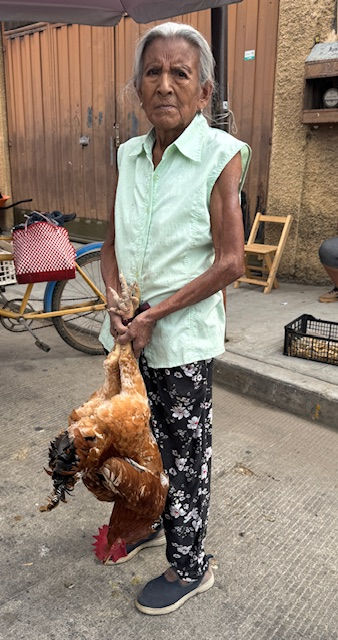
We entered through the livestock section, where live chickens, chicks, cockerels, guinea fowl, turkeys, and even rabbits and guinea pigs were on display for sale. I was fascinated by the scene: one vendor grabbed young chickens and tossed them into a cardboard box one by one with impressive skill, handing the box straight to a customer. Meanwhile, others carried cockerels or turkeys home, feet bound, heads down. Cackling, chatter, and the occasional squawk filled the air.


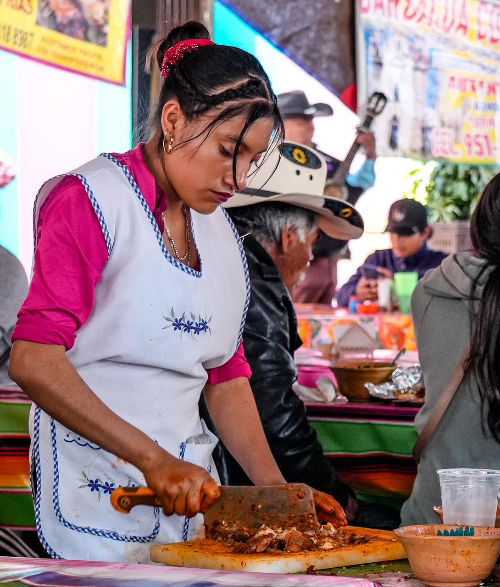
Moving on, the market offered literally everything: hats, clothes, shoes, combs, scissors, flowers, honey, baskets, plastic bowls, tools—you name it. There were tastings of traditional pulque and mezcal, neatly stacked piles of fresh fruit and vegetables, and food stalls where women stirred huge kettles of goat stew over charcoal fires. One kind vendor offered us a taste. The meat was tender and melted in our mouth. Curious, I asked her the secret. She explained that the goat had been cooked underground for over eight hours—the traditional Oaxacan barbacoa style. That means, the marinated meat is wrapped in leaves, buried in a pit that was heated with a large fire, and slow-cooked until perfectly tender and packed with flavour.

Every sense was on overload: the smells, the colours, the sizzling, the chatter. Quite a few musicians, some good, some awful, entertained the market venders and buyers, hoping for a few pesos.

After several hours weaving through the labyrinth of stalls, we were exhausted. A bus ride back to Oaxaca felt like heaven.
A fulfilling—but frankly exhausting—day out. I’m fairly certain that for the next few days we’ll need a rest and, at least for a little while, we don’t want to see another market again.
17th January 2026
Yesterday we had a lazy, leisurely day, doing very little apart from shopping at the supermarket and sitting on our terrace. Today, however, we went to Xochimilco, one of the oldest neighbourhoods in Oaxaca. Located in the north of the city, it has a rich history dating back to pre-Hispanic times. Its name comes from Nahuatl and means “place of flowers.”
We wandered through cobblestoned streets, admiring the many paintings on walls and houses. Xochimilco has a vibrant atmosphere, with its colourful colonial homes, art galleries and cafés, its old viaduct, and its arches. We can’t get enough of it. We stop for a rest at a cafe with a lovely courtyard and drink Coca Cola. We don’t usually do this, but when it is hot and we are very thirsty and tired, it really helps getting our energy back. We followed the cobbled streets up a hill that offered a beautiful view over parts of Oaxaca and the surrounding mountains. There, we struck up a conversation with a friendly American man. He moved to Xochimilco nine years ago and loves it here—the people, the climate, and the atmosphere of the neighbourhood. He sees no reason to return to the US. Why would he? As he stepped into his lovely house, we wished him all the best for his future in Xochimilco.


Next, we visited the General Panteón, an old and traditional cemetery in the east of the city. It was hot, and we had already walked several miles, so we took a bus part of the way and walked the rest from the bus stop. Just before reaching the cemetery, we came across a Volkswagen garage filled with old Beetles. The VW Beetle, produced in Mexico, is still going strong, and we saw many on the roads. The garage owner and his son—who had been a racing driver in a somewhat modified Beetle—proudly showed us their collection and told us its history. I told them that my first car, when I was 18, was a 1957 VW Beetle, and that a few years later I owned a 1959 model. They were clearly impressed, and at the end of our visit they presented me with a small key ring shaped like an old VW speedometer. I will treasure it.
We then entered the General Panteón cemetery. Established in 1829 to bury victims of epidemics such as smallpox and cholera, it is now known for its diverse styles of grave architecture, with enormous mausoleums, tombs, and galleries of niche graves. Walking through it is impressive. The cemetery is densely packed, with hardly any space between individual graves, and we were careful not to step on anyone’s resting place. Huge mausoleums are overshadowing smaller plots. Some graves are kitschy, others totally over the top.

We still see colourful garlands and remnants of the Day of the Dead celebrations on 1 November, when families gather to honour the lives of their loved ones. Bottles of rum or beer and cigars lay in front of many graves—offerings to the dead. Needless to say, the bottles were empty. There was nobody apart from us and a few workers in the cemetery. When we wanted to leave all the doors were locked and also the workers were gone. I almost started to panic as I did not want to spend the night in the cementery. Luckily, after a while, Dave found an exit that was still open and the workers were preparing to go home. We quickly left.
Afterwards, we took a bus all the way back to our house. We had planned to visit an art exhibition, but after walking more than 10 kilometres that day, we decided to skip it. Tomorrow is another day.
——————————-
Dave:
10th January 2026
We’re running low on wine and a few basics, and we also need a decent potato peeler, so after a leisurely breakfast, we take the bus from nearby Avenida José María Morelos to the Chedraui supermarket at the top of Calle Niños Héroes. On the way back we stop at the Mercado Centenario, the market where we buy our meat and vegetables.
The afternoon is spent leisurely, catching up on the news and our emails. I set my alarm for 1400 (2000 UK time) so I can remotely switch on our central heating at home — I’ve already checked, and that’s when the temperature drops below freezing tonight in Belsize Park.
At 1630 we head into town for a leisurely wander. Along Avenida José María Morelos we stop at a small art exhibition, and spend some time talking with the owner, a young Mexican entrepreneur who splits his life between Oaxaca and New York. Trained as an interior designer, he is now carving out a place for himself in the Mexican art scene. Though the gallery has only been open a few weeks, he already has an impressive client base, including a woman from Arizona who has commissioned him to design her new home, and furnish it with Mexican art. Two terracotta jaguars catch my eye — but not their price tag: MX$10,000 (£412.80) for each.

From there we stroll around the Zócalo, popping into various galleries and taking photos of a slow-moving local wedding procession. It’s led by huge puppets, followed by a very loud band and a long trail of people. Officials close the street ahead of the procession and reopen it once they’ve passed. I notice a security guard on the roof of a nearby building, binoculars trained on the street below.
As the sun sets, it cools quickly, so we head back, stopping briefly to watch a group of dancers dressed in traditional clothes performing in the open square in front of a nearby church.
Back home, we share a cold beer on the terrace before starting dinner: the last of our pork ribs with a selection of vegetables. Lisa fries one of the two plantains as a starter, and we eat outdoors despite the cool evening.
11th January 2026
We had a lazy start to the day today. It wasn’t as hot as yesterday, with more cloud about and a decent breeze blowing. Rain is possibly in the forecast over the next few days too. We waited until 10:00 before making breakfast, as that’s when the day starts to warm up here in Oaxaca and when the sun finally reaches our terrace. The two people staying next to us, who are from Earl’s Court, are leaving this afternoon to fly back to the UK from Mexico City, so we’ll be getting new neighbours tomorrow.
Today, we decided to walk to La Merced, a famous market area at the far end of our local avenue, Avenida José María Morelos. La Merced refers not just to the market, but to one of Oaxaca’s long-established central barrios. It has a strong sense of local community and feels very much lived-in rather than like a polished tourist zone. It offers a good insight into everyday Oaxacan city life. The market opened in 1973, it’s a traditional public market and very popular with locals for daily shopping. Stalls sell fresh fruit and vegetables, meat, bread, spices and household goods, and it’s particularly well known for authentic Oaxacan food.
We had a good mooch around and stopped at a stall selling herbs and spices, with shelves lined with jars full of goodness-knows-what. Lisa chatted to the vendor, who confidently claimed she had remedies that could cure every illness under the sun. I was more fascinated by the rows of electricity meters lining the walls of the market, with dozens on each side, each supplying power to individual stalls. The amount of intricate wiring needed to feed such a vast space must be extraordinary.
Afterwards we walked back towards home.

There’s a photographic gallery near our Airbnb, so we stopped in. There was only one small room on display, with a handful of old photographs showing people harvesting sugarcane. We asked the man at the door where the rest of the exhibition was. He explained they were preparing a new show and suggested we come back next Sunday when it opens.
We continued along a parallel street, and struck up a conversation with a Canadian couple from Saskatchewan, who were just coming out of a small hotel. They shared many of our views and must have been in their eighties. They’re regular visitors to Oaxaca, and used to drive all the way down from Canada in their motorhome. These days they fly instead. They invited us back to show us around their hotel, which they’ve used six or seven times over the years. It was a small, family-run place—nice and cosy—but without facilities for cooking meals. We said our goodbyes and hoped we might run into each other again before they left next Sunday.
Back at our place, we wrote a few emails, and by the time we’d finished it was too cold to sit outside with a beer. The sun had gone down and a chill wind had picked up. We cooked and ate the last of our pork ribs indoors and watched another episode of Dark Winds on Netflix.
12th January 2026
We were up early, as we needed to finish writing the latest episode of our blog, inserting photos and adding our own observations. For Lisa this meant double the work, as she also had to translate everything for the German site and then upload the photos again. Not a difficult job, (That’s what you think, mate!! - notes from Lisa) but a time-consuming one.
The clouds and breeze kept the temperature hovering around 20C, noticeably cooler than in recent days. Even so, by 1000 it was warm enough to have breakfast on our terrace. Sunshine broke through the clouds, but when it did the sun was fierce, so the sun umbrella was essential. After breakfast we carried on working on the blog until well after midday.
We’d decided we wanted to explore some of the surrounding towns and villages on their market days. To do that, we headed south to a nearby bus terminus nestled beside the huge Central de Abastos market. The plan was to visit the terminus first and then explore the market, as we also needed more vegetables and fruit.
The bus terminus was confusing and trying to get information was almost impossible, even with Lisa’s Spanish. Perhaps this is because it’s a second-class terminal? It was dirty, poorly run, and several ticket offices had inadequate signage, or no one on duty to ask. Outside the terminus was a collectivo taxi rank, with town and village destinations painted across the windscreens. Once a taxi is full, it sets off. We’d used one once before to get to Atzompa; it was dirt cheap, and not the most comfortable experience.
Afterwards we crossed the busy road and entered the covered market that was
enormous. In one corner, fully laden trucks were being unloaded, and this was very much a man’s world. Muscle was needed to unload and ferry produce to the countless stalls in this vast space. Despite the chaos, it was well organised and efficient, with no wasted effort. Tall, open-topped trucks stood packed with boxes and sacks of fruit and vegetables. Male muscle stood on top, lifting heavy boxes and dropping them into the waiting arms of male muscle below. More male muscle disappeared into the depths of the trucks, emerging with sacks that were hoisted onto male muscle and carried away. Produce was piled high onto metal trolleys, which male muscle then pushed off—backs bent, sinews straining—towards the vendors. None of this ‘male muscle’ looked over thirty. The male muscle carried and fetched; the wives, mothers, and grannies sold. Yes, Mexico still feels very much like a man’s world. I’ve yet to see a woman driving a bus or a truck.


We continued exploring, bought our fruit and vegetables, and took plenty of photos of this frenetic, macho wholesale market. Slowly we made our way back, Once back, we checked through our photos, and caught up on emails. By 1800 a cool breeze had set in, so there was no sitting on the terrace with a cold beer, and it wasn’t pleasant enough to eat outside either.
13th January 2026
When I got up, it was cooler than of late, with some cloud about, but by 1000 it was warm enough to breakfast on our terrace. Afterwards we went to our local market, having run out of meat, and bought pork chops, tomatoes, eggs and some fruit.
When we got back around noon the internet was down. The owner tried rebooting the router, without success. We rested for a while before walking into town to visit the Museum of Oaxacan Cultures, next to the Santo Domingo de Guzman church.
Admission had risen sharply since our guidebook was printed. Instead of MX$45, we paid MX$420 (£17.38) for us both, including a photo permit. Security was very tight: rucksacks and my camera monopod went into lockers, our bags were checked, and we passed through airport-style scanners.
Housed in the former monastery, the museum is one of Mexico’s finest regional collections and needs at least two hours to do it justice. First we visit the fascinating exhibition of Manuel Jimenez, the famous Mexican, wood carver, sculptor and painter and then the museum proper.
The greatest treasure is the Mixtec hoard from Tomb 7 at Monte Albán, in Room III (the first on the right upstairs). This dates from the 14th century, when Mixtecs reused an old Zapotec tomb at Monte Albán to bury one of their kings and his sacrificed servants, along with a stash of beautifully worked silver, turquoise, coral, jade, amber, pearls, finely carved bone, crystal goblets, a skull covered in turquoise and a lot of gold. The treasure was discovered in 1932 by Alfonso Caso.
Halls I to IV are devoted to the pre-Hispanic period, halls V to VIII to the colonial period, halls IX to XIII to Oaxaca in the independence era and after, and the final room (XIV) to Santo Domingo Monastery itself. At the end of the long corridor past hall IX, glass doors give a view into the beautifully ornate choir of the Templo de Santo Domingo.

The last time we were here, the museum dedicated an area to the famous Mexican Emiliano Zapata, even though he wasn’t from Oaxaca. Who was he?
Emiliano Zapata (1879–1919) was one of the most important leaders of the Mexican Revolution. A champion of peasants’ and Indigenous communities’ rights, he fought against large landowners and demanded land reform under the slogan “Tierra y Libertad” (Land and Freedom). Zapata led the Liberation Army of the South and issued the Plan de Ayala, calling for the redistribution of land to village communities. He was assassinated in 1919 after being lured into an ambush by government forces, but he remains a powerful symbol of social justice and resistance in Mexico.

We reached the end of our tour, but couldn’t find the area dedicated to Zapata, the famous Mexican revolutionary. We asked where he was, and were confusingly told he was not included. The person we asked then shrugged their shoulders, and said, well, they sometimes change the exhibition. Strange, they were unaware, even though guidebooks state there is an area dedicated to him. Nine years ago we vividly remembered the exhibits about him, and still have the photos to prove it.
It was cold inside the museum, so we sat on a wall when we came out to warm up. Afterward, we went to a rooftop cafe, opposite the Santo Domingo de Guzman church. We didn’t linger, as there was a chilly wind blowing. On the way back we stopped at a bakery for a baguette, and checked out another rooftop restaurant for future reference.
14th January 2026
I was awake early and up at 0530, spending a few hours writing up the previous day. By 1000 we were breakfasting in the sunshine on our terrace before walking into town to explore Oaxaca’s three famous adjoining markets just south of the Zócalo: Benito Juarez, 20 de Noviembre, and Artesanías (handicraft).
Benito Juarez was busy and colourful, selling everything imaginable—from clothes and cookware to food, drinks, and supposed cure-all herbs—while guides shepherded groups of tourists, through the tightly packed stalls, explaining as they went.

Across the road, the 20 de Noviembre market was even livelier, and entirely food-focused. A small area had tables tightly packed together, like sardines. On the other side of this narrow isle were several barbecue pits, each with a chef throwing thin strips of meat onto the hot charcoal grills. It was hot inside the covered market, but the chefs in front of glowing pits, smoke rising from the sizzling meat, didn’t seem to feel the heat.

The tables were crammed with tourists, waiters scurried from pit to table loaded with plates of sizzling meat. Other waiters hovered, pushing menus in our faces as we passed by, enticing us to eat. It certainly was fascinating to push through the mingling masses, feel the heat from the pits, and pass through the smoke and smells from the sizzling meat and sausages. In another aisle, local workers sat elbow to elbow enjoying traditional dishes. Lisa took photos of several vendors and promised to email them copies.
The Artesanías market was disappointing, so we continued on to the Central de Abasto.
On the way we stopped at a small café for a short rest and a coffee break. Police were visible on the streets to reassure us tourists that the areas were safe. A woman came into the cafe and sat next to us, her sidearm clearly visible in its holster. She drank her coffee and read her emails. Coffee finished, she left and joined a group of people on the pavement. They were obviously plain cloth policemen, and she their boss. Yes, these tourist markets are a magnet for certain elements of society.

The Central de Abasto was by far the most interesting of all the covered markets we’d visited. I could spend days walking around the rabbit warren of narrow alleyways, each piled high with all sorts of goodies. Everything was for sale, from clothes to compressors. We had a good mooch around, and spent some time chatting to someone selling industrial kitchen equipment, utensils and pots and pans. He sold huge metal pans that were big enough to boil a pig in!
We headed back, stopping to buy coffee and black beans on the way. The sun was still shining when we returned. I washed Lisa’s sandals, whilst she made a cuppa, and we drank them enjoying the sunshine, sat on the terrace, before working up our diaries. I cooked the last of our pork chops with vegetables. We shared a bottle of wine and ate dinner on our terrace.
15th January 2026
I was up at 0600 to write my diary. It was cooler today, with many more clouds than of late. We were short of food, so after breakfast we walked across the road to our local market, and bought some chicken and a few avocados.
When we got back, we set off almost immediately to walk to the Zócalo. Six blocks south is the Villa de Zaachila bus terminus, as we were planning a day trip to the town to wander around their Thursday market. There was already a bus waiting. We boarded and paid the driver MX$20 (84p) for us both. We set off at 1115.
Our bus had seen better days. The seats were loose, and we slid around as it negotiated the congested city streets, speed bumps, and potholes. The state of the roads once we left the city were no better, and the heavy traffic reduced our progress to a crawl. Off to our left we could see Oaxaca International Airport in the distance. We arrived at Villa de Zaachila’s central bus station at noon, a journey time of 45 minutes.

The Thursday Día de Plaza (tianguis), or outdoor market, is Zaachila’s weekly main event. It attracts people from all over the Valley of Oaxaca, many of whom are Zapotec-speaking people from rural areas. This market tradition dates back to pre-Hispanic times, and has changed very little since then.
The market is divided into three sections. The first, known by its Zapotec name Logueguindan, meaning “plaza of the people of the hills,” is mostly dedicated to firewood and charcoal for use during the week. We couldn’t find this section, perhaps we arrived too late.
Just outside the bus station was the beginning of the market, and that’s where we started, in the second section, dedicated to the sale of animals such as chickens, chicks, cockerels, turkeys, rabbits, ducks, and guinea pigs, many in cages or tied together by their legs.

We slowly made our way through the crowds, taking photos where possible. Some people were keen to have their photos taken, others not.
We then passed into the third part of the market, which was complete sensory overload: the noise, the smells, the bright colours, and the tastes, if you dared. We did, and were offered goat stew from a huge pot. It was delicious. It was busy, very busy, and we were constantly bumping into people or tables, or ducking to avoid the low-hanging cords holding up the colourful tarpaulins above us.
Everything was for sale here: fruit, vegetables, food both cooked and for cooking, cheap goods, clothes, and all sorts of handicrafts. Singers and musicians, some good and some awful, mingled among the crowds, playing for small change, especially around the eating areas, and there were plenty of those.


We wandered through for what seemed like hours, then decided to find a café for a sit-down. We left the market, and explored the side streets of the town but couldn’t find one. So we returned to the market, found a kiosk, and bought a small bottle of Coca-Cola and a packet of nuts. We sat on a kerb in the sunshine to eat and drink, whilst watching the world pass by. By 1500 the vendors were packing up, so we made our way back to the bus terminus, and set off for the return journey.
When we got back, we checked the news, read our emails, and continued with our diaries until it was time to cook dinner: oven-roasted chicken and vegetables. It was far too cold to eat on our terrace. After dinner, we continued watching the series, Dark Winds.
16th January 2026
We had a poor night’s sleep because at 0042 our watches and iPhones suddenly started screeching. It was a government earthquake alert, our second, the first having been in Puebla. The epicentre was again near Acapulco. We didn’t feel anything, but we quickly got dressed and went outside onto the terrace. Dogs were barking in the area as people reacted to the warning on their phones and left their homes.
Here are the official Government earthquake alert instructions:
When you receive an earthquake warning on your phone, you may only have a few seconds before the shaking begins. Immediate, automated action is critical.
1. Execute the "Drop, Cover, and Hold On" Protocol
The most vital safety action is to protect your head and neck immediately.
Drop: Get down on your hands and knees to prevent being knocked over.
Cover: Seek shelter under a sturdy table or desk. If no shelter is nearby, move to an interior wall away from windows, hanging objects, or tall furniture.
Hold On: Stay in place and hold onto your shelter until the shaking completely stops.
2. Follow Instructions Based on Your Location
If Indoors: Stay inside. Do not run outside or to other rooms, as most injuries occur when people try to move during the shaking. Avoid using elevators.
If Outdoors: Move to an open area away from buildings, power lines, streetlights, and trees.
If Driving: Pull over safely to a clear area, avoid stopping under bridges or overpasses, and stay inside the vehicle with your seatbelt fastened until the shaking stops.
There was no aftershock, so after ten minutes we went back to bed.
I got up at 0630, with Lisa following shortly after. I wore my fleece as I sat with my iPad, because the temperature had dropped to 5°C overnight.
Today was an R&R day: rest and relaxation. We had a leisurely morning checking the news while enjoying the sunshine on our terrace. The only task on the agenda was to take the bus to the Chedraui supermarket to buy wine and beer, so at noon we set off.
Supermarkets here don’t allow you to wear a rucksack inside, so you have to leave it in a locker. The system this supermarket uses must be cutting edge, as it relies on facial recognition. You stare into a camera and are instructed what to do in what sounds like English, but with a Chinese twist. The camera isn’t positioned low enough, so to accommodate shorter Mexicans there’s a wooden pallet nearby to stand on.
Once back, we continued reading and writing beneath the sun umbrella on our terrace. At 1800 we shared a beer outside until 1900, when the sun dropped behind the mountains. We prepared dinner, chicken thigh and drumstick, and dined on the terrace as it was warmer this evening.
17th January 2026
The reason we have a late breakfast is simple: the sun doesn’t reach our terrace table until 1000. That way we sit in the sunshine while we eat. We’d run out of meat, so after breakfast we went to our local market and bought some pork ribs, eggs, and a few courgettes.
Afterwards we walked to the Barrio de Xochimilco. It was a slow, gentle uphill stroll, and as we drew closer the roads became narrower and more winding, the facades quirkier, and the views more dramatic. Murals of hummingbirds and historical figures seemed to sprout from the walls of the cobblestone streets.


Barrio de Xochimilco is recognised as one of Oaxaca city’s oldest neighbourhoods. It was a Zapotec settlement long before Spanish colonisation. Unlike other neighbourhoods that were gradually absorbed by colonial customs, Xochimilco has preserved its distinct Indigenous cultural and religious traditions to this day. This raises an obvious question: why does this neighbourhood, separated from the nation’s capital by some 300 miles and several mountain chains, share its name with Xochimilco in Mexico City? The answer lies in the Mexica (Aztec) invasion of modern-day Oaxaca in 1486, when Xochimilcan soldiers were brought south and, quite naturally, named the settlement after their own hometown.
As part of Oaxaca city’s Historic Centre, Xochimilco is protected under federal law as a historic monument zone. Many of the monuments found here were built during the Spanish period, including the 18th-century San Felipe Aqueduct.
We crossed a busy dual carriageway, climbed a flight of stone steps, and emerged onto a street of vividly painted houses, some crowned with cascades of bougainvillea tumbling from the rooftops. We followed the colourful main street, pausing frequently to photograph the murals that covered the walls, while the side streets, by comparison, felt rather bland. Soon we reached an open cobblestoned space, with a foreground of flowers and bougainvillea and, far beyond, cloud-draped mountains. There was a café with a delightful courtyard at the back, and that’s where we stopped for a refreshing cold drink.

Afterwards we continued on to the famous aqueduct, walking down a stone staircase to get a better view. Judging by the smell at the bottom, a public toilet would not go amiss. We wandered a few more streets before turning back, as we needed to make our way to our next destination, the Panteón General, better known as the City Cemetery. On our way out, an American struck up a conversation with us. He was from Colorado and had moved here nine years ago. No sooner had he started talking than he turned, said goodbye, and disappeared, like a rabbit down a hole, through a wooden door.


We walked it back to the dual carriageway and took a bus and got off a couple of miles later. From there we walked a few blocks to reach the City Cemetery. On the opposite side of the road to the main entrance to the cemetery was a garage and inside we could see several VW beetles. As we peered in, the owner came out and invited us in. It was a treasure trove of everything VW beetle. In one corner a stock car beetle, complete with roll over cage. In another corner, a beetle hot-rod, in the process of being assembled. Beetle engines in various states of repair littered the floor. We took several photos and had a long chat with the owner, his dad and two apprentice mechanics as Saturday was a working day in this garage. After 30 minutes we crossed the road, and enter the high walled cemetery.

The Panteón General (City Cemetery) is unusual and interesting not because it is grand, but because it is lived in. Families visit regularly to clean graves, repaint names, bring flowers, talk, eat, or simply sit quietly. Death here is part of daily routine rather than a special or ceremonial event.
Graves are highly personal: many are brightly painted, decorated with tiles, religious images, favourite objects, or handwritten messages, and are refreshed and repainted over the years.
There is a strong sense of layered history. Some tombs are old and crumbling, others freshly painted and carefully maintained. Walking slowly, you can see evidence of social change, migration, and long family continuity.
The sound and atmosphere are distinctive. You may hear sweeping, low conversations, birds, or distant traffic. The cemetery feels calm and domestic rather than solemn or heavy.
Most strikingly, it is non-performative. Unlike cemeteries that turn into tourist stages during Day of the Dead, Panteón General feels authentic and uncurated. Visitors are few, and local families are not “on display”. What you encounter is ordinary life continuing in the presence of the dead, quietly and without spectacle.

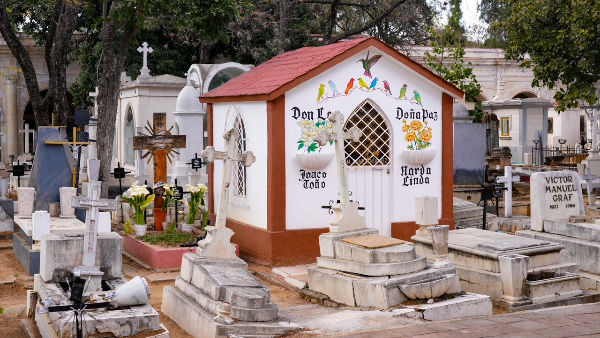
We spent about twenty minutes wandering around this crowded area, a somewhat gaudy mishmash of religious stones and relics. Some graves are completely over the top, and one, resembling a garden shed, wouldn’t have looked out of place in someone’s back garden.
There’s a bus stop a block away from the cemetery that takes us all the way back to the stop near our Airbnb. We’re tired and hot, so we’re grateful to let the bus take the strain and carry us home.
———————————————-
Dear readers, over the last four weeks we have reported hier so much about our adventures that the blog post can’t take any more text and photos. We will open a part 2 travel blog and will continue there with reporting about our last week in Oaxaca.
Please check it out.
2. Puebla 28.12.2025 - 4.1.2026
Informative and interesting facts
Puebla, officially Heroica Puebla de Zaragoza, is a historic city and state in central Mexico, located approximately 130 kilometres (80 miles) southeast of Mexico City. It is among the country’s most culturally and architecturally significant regions, renowned for its colonial heritage, distinctive cuisine, and pivotal role in Mexican history.
Puebla is the 5th largest city in Mexico with around 1.7 million inhabitants. The state of Puebla has a population of 6.7 million people. Although Puebla is still quite big, but it has a relaxed atmosphere, different from the bustling capital.
Founded in 1531, Puebla grew into an important Spanish colonial city thanks to its location on the route between Veracruz and Mexico City. It’s best known for the Battle of Puebla in 1862, celebrated each year as Cinco de Mayo. The historic city centre, a UNESCO World Heritage Site, is famous for its well-preserved colonial buildings, including the richly decorated Capilla del Rosario and colourful Talavera-tiled architecture that mixes Spanish and indigenous styles.
Puebla has played a major role in Mexico’s cultural and intellectual history and still has strong traditions of crafts, religious life, and public festivals. It’s also considered one of Mexico’s food capitals, known for dishes like mole poblano, chiles en nogada, and cemitas. Surrounded by valleys and volcanoes, the region has a diverse economy that includes manufacturing, agriculture, tourism, and creative industries. Today, Puebla is a lively university city that blends deep history with modern development.
Lisa:
29th December 2025
Puebla is certainly worth visiting. Most tourists stay one or two days, wither as an organised day trip from Mexico City or a stop over on the way to Oaxaca. We decided to take a week to explore the area in more detail and soak in the atmosphere.
On Sunday, after a 2 1/2 hour bus ride we arrived safely in Puebla. Our instructions by our Air BnB host Esmeralda were to make our way to the Cafe Me Barrio in the city centre (which she and her sister ran) and pick up the key for our rented studio which was right next door to the cafe where the studio was located.
We entered the building through a big wooden entrance door into a very old big house with staircases and several floors. It looked a bit neglected, the upper part of the building was deserted and cordoned off for security reason, we were told.
We passed the patio and at the end passed through a passage that was horribly smelling of cat piss and shit, which could not be overcome by the burning incense sticks. We were told an old lady was living there with many (no one knows exactly how many) cats. Finally at the end of the passage there it was: our studio. It lovely, friendly, but tiny.
Esmeralda explained, that three years ago she found out that this tiny flat had become available. (Apartments to rent are very scarce.) It was in a desolate state but convenient as right beside the Cafe. She and her father renovated it for a long time and we must say they did a great job. Now she rented it out as an AirBnB studio.
The apartment is 1.90m broad and 8.62m long, inclusive bathroom. (Dave measured it with the digital measuring tool on his smart phone). Small, but all is there what you need. Sleeping area, sitting room with a desk and a bench, a fully equipped kitchen with a dining table, stove, microwave and fridge and the bathroom. What more do you want for £26 a night? But even for us, being used to living in a small flat in London, it takes some time and tolerance to get used to two people moving about in this confined place. The windows go out to the dark patio.


Esmeralda also pointed out that it hasn’t rained for a long time, therefore there was a water shortage and could we please be considerate in our water usage. No problem. The light in the kitchen is linked to an Alexa, who apparently understands Spanish and English commands, but is still learning. So it takes patience to make her understand that we want her to switch the light on or off. But we are getting there.
Puebla is still at 2,200m and the nights are cold, especially in the winter months of December and January. There is no heater in our place, as is in most houses in Mexico. Only in a fancy restaurant we have seen fancy patio heaters between the tables to keep the guests warm. In other places people just have to put an extra sweater on and go to bed early to keep warm. I am writing this diary early in the morning in bed, because it is very cold in the apartment. Later today, when the sun comes out it will be hot in the mid 20s C. However, these big old houses take a long time to warm up.
Puebla is famous for its traditional cuisine. There are many cafes, restaurants and a variety of eating places in town. Our host, Esmeralda, gave us many tips where to eat in town. In her cafe we get a 10% discount, which is very nice. We had breakfast there one morning and it was typical Pueblan food, Huevos Santos (fried eggs, tortillas with green and red chilli sauce and some exotic fruit and veges); the other was Chilaquiles Barrocos (fried tortilla with egg and the traditional Pueblan mole, a chocolate with chilli sauce, again with fruit and veges).

Big portions, very yummy and certainly a treat, but for everyday in the long run it will get too expensive. When we have the opportunity to cook our own breakfast we will do so.
When walking the streets we passed by many restaurants and other eating places. Street food is very popular with locals and tourists. At almost every corner there is someone with a coal stove offering food like churros, tacos, enchiladas, chalupas, molotes, but also hamburgers and saucy sandwiches and many more. Considering the long queues, one wonders if anyone ever cooks at home, if there is so much cheap food available on the street. We were also wondering about the quality of food people are eating, as the supermarkets in town don’t offer any fresh food, such as vegetables, cheese or fruit. However, you can buy such food in many of the markets.
We went yesterday to a local farmers market. Mercado El Parral, and were impressed with the quality of food on display. It makes clearly a difference if you stroll through a market to simply look or, like we now, to select and buy your own food. We stocked up on eggs, tortillas, cheese, vegetables and fruit, got chatting with the vendors and got advice what to look out for when buying avocados or papaya, which are ripe enough to eat. We queued at the butcher’s stall and watched the vendor how she skilfully sliced a number of huge chicken breasts into very thin layers for a customer who either had a very big family or a restaurant. Animated, we also bought chicken breast (enough for three days) and when I cooked it in the evening, it was very tasty. The eggs for breakfast, the guacamole made from the avocados and tomatoes and the cheese filled tortillas also tasted very yummy.
At the Mercado de Sabores (the market of the great tastes) we walked through the lines of stalls offering mouthwatering delicious freshly cooked food. In between were seats and tables for customers and families who were tucking into their food with great appetite. We decided against it, as we just had bought our chickens and veges, but I bought a bowl of cooked black beans to take away as an addition to our evening meal.
We continued walking the streets, and it was fascinating as some streets are dedicated to opticians (even so one cannot see many people wearing glasses), others to sweets, fashion, baby things, stationary; several streets were lined up with shops selling fancy wedding dresses and evening gowns. Other streets were full with plumbing merchants, others with electric parts, computers and mobile phones, next to streets with car repair shops.


The old and once famous Victoria Market had been renovated recently and behind the beautiful historic facade developed into a modern rather boring shopping centre. Here finally, we could stop for a much needed cappuccino and a herbal tea (hierba buena) a delicious peppermint-like tea for me.
The place was full, but quickly two little stools emerged and an old man made space for us on his little table. Soon we got chatting, and he showed us many photos on his mobile phone on what we urgently had to see in Puebla.
At first, I thought, these fabulous pictures were from the internet, but it turned out that they were his and he was a photographer. He also showed me a picture of him with Rigoberta Menchu, the famous Guatemaltecan human rights activist whom I had met personally, and interviewed in the 80s at a human rights conference in Germany. In 1981, she had been exiled and escaped to Mexico and from where she continued to organise resistance to oppression in Guatemala and the struggle for Indigenous rights.
The cafe played traditional Mexican songs, some of which I also knew and we were singing along together. Even Dave joined in too. We had a good time, but had to move on. We thanked our new found friend and said goodbye.
It is amazing, how friendly Mexican people are, especially once they know we are English and not Americans. Many are ever so helpful, when we seemed to be lost. For example, in Mexico City when buying the Metro card, a woman showed us how to do it and even changed our big bills into more suitable smaller ones.
In Puebla, whenever we looked at our map, someone wanted to help to show us the way. It was not always the right direction, but at least they wanted to help. We met one guy, Ricardo, a scientist, who had studied in the UK. He told us at length what we had to see and why it was important. We could not get away from him, but finally we escaped on friendly terms, with his phone number in our pockets, just in case we needed some more help.
Dave:
28th December 2025
We left our hotel in Mexico City at noon for the TAPO bus station with an Uber taxi for MX$150 and arrived at 1225. Taxis are not allowed inside the bus station complex, but our drop-off point was only a short walk and with our roller suitcases. At 1300 our bus left. The roads leading out of Mexico City were congested but once outside the only holdups were at the motorway pay booths. The roads were good but bumpy in many places.
We arrived at the Puebla bus station at 1530. The taxi fare to our Airbnb, in the very centre of Puebla, was MX$113. As in most big cities in Mexico they operate a grid system of one way streets. The ride into town was good until we reached the centre, then we ground to a halt as the road were gridlocked. With just two blocks to go we got out and rolled our suitcases along the busy uneven pavements to our Airbnb meeting point, the renters sister’s cafe next door. We had a coffee whilst we waited for the owner. 15 minutes later we were given a guided tour.
She unlocked the huge wooden door that lead into a long courtyard. At the far were 3 flats. One on the right and a little further our on the left and opposite ours a flight of stairs leading to to another Airbnb. Our flat is 1.9m x 8.62m long, inclusive bathroom. It was a little cramped for us and our 2 suitcases and rucksacks. Nevertheless, we were right in the centre of town and our flat had all the essentials, including a huge flatscreen TV fixed to the wall above the bed.
Puebla hadn’t seen rain since October, so water was at precious. She took us back to the courtyard and showed us the water tank and if our water supply ran low then we should switch on the water pump for 15 minutes.
She must’ve seen us looking at the wet floor and the incense stick burning from a wooden cabinet on the right. She explained that on the left of the courtyard lived a cat woman. She had several cats and we’re told that we’d never see them, or the cat lady herself. These maybe, but there was no getting around the stench of cat shit and cat piss we had to get pass through to get from the courtyard to our flat. We made a note to wipe our shoes before entering.
Formalities over, we went out to explore and find a supermarket for supplies.
The centre was very crowded and the roads still gridlocked.
Puebla’s Zocola (main square) is the centre of town and beside it is Puebla’s Cathedral. There were a long queue of people snaking out of the main entrance into the Cathedral, out of the main gate and out across the park. A conservative estimate of the length of the queue with be 500 metres. We were told they were were queueing because of the celebrations of its 38th anniversary of World Heritage inscription. We continued through the crowds into the park and it was like a fairground, with performers entertaining the masses.

The Zocola is surrounded by colonial style buildings on whose ground floors were restaurants and shops. We continued around 3 sides, and made our way back via an OXXO supermarket for basic supplies. We dropped of our supplies and set off to a highly recommended typical Mexican restaurant, Antojitos Tomy, which was just around the corner. The place was full and we managed to get a table at the back. The restaurant did not cater for tourists and all the others were locals. The food wasn’t fancy, nor the tables and chairs, but there was plentiful of it, with very spicy sauces. They closed at 2100 and were the last to leave.

29th December 2025
I got up at 5 o’clock this morning and sat down to write my diary and to catch up on the news and emails. At 1000 we left to have breakfast at the Me Barrio café, the cafe next door. The breakfast was rather fancy and cost mx$320, but we did get a 10% discount. At 1145 we left, together with our rucksacks, to go to a nearby farmers market, the Mercado El Parral. The enclosed market was excellent and sold absolutely everything. We came away with chicken breast, avocado, spring onions, tomatoes, potatoes, courgette and eggs, which should keep us going over the next few days.

We returned to our compact palace, unloaded our supplies and set off to find the bus station to Cholula, as we want to visit the famous Great Pyramid of Cholula during the next few days.
We had wall to wall sunshine and the temperature had risen to 23C. I’d checked the forecast earlier, took a chance, and for the first time since leaving the UK wore my shorts and sandals. Yes, I also wore my t-shirt, but had my fleece in my rucksack - just in case.
We stopped often to check our bearings, on our phones and tourist office map, and during one stop were approached by someone who wanted to help. He was an academic, was very friendly and spoke good English, and for the next 40 minutes offered advice and gave us tips of where to go in Puebla and the surrounding environs. We managed to escape, but our ears were still bleeding as we walked off.
We found the bus station to Cholula and the surrounding area had other bus stations to other places and towns. From there we walked across the main road to Mercado de Sabores to find a cafe. This was a huge indoor ‘U’ shaped area dedicated to eating, but not for a coffee stop. Lisa bought a small takeaway polystyrene pot of black beans for a starter for tonight’s meal.
We walked back towards the Zocalo and at an OXXO supermarket we bought 2 bottles of special offer red wine. Wine shops are difficult to find in Puebla, but the residents must have very bad eyesight as every other shop seemed to be an optician.
We came to the Victoria Market, a huge towering imposing structure, and entered. I was surprised as once inside the area was open, the imposing outer was just a facade. I was fascinated by drainpipes for the roof/parapet as they were placed approximately every 2 metres along the entire inner facade.
There was a very pleasant small cafe to our left. A mature gentleman was sat on his own at a table and he beckoned us over to share his table. It wasn’t long before he struck up a conversation. Once again we’d met a very friendly person who showed us photos on his phone of the places we must visit whilst we were in Puebla. The photos were good and he bashfully told us he was a photographer. We stayed longer than we’d intended, but, as we’d come to expect, the locals were so friendly and they loved to talk about their country, Mexico, with so much pride. We bade our new friend goodbye, took a quick tour of the market and left to walk back to our Airbnb, via the front of the Cathedral.
The Zocola was teeming with people and stalls selling all sorts of goods and the roads were filled with queuing traffic. Almost opposite our Airbnb was a very fancy hotel called Quinta Real. The door was open so we went inside to have a look around. It was impressive as the hotel was built around a courtyard. The entire courtyard was covered and could be opened up electronically. In the centre of the courtyard was a huge Christmas tree, entirely lit by tiny white led lamps. Red and white bunting was strung from the top of the Christmas tree around the entire courtyard.

We crossed the road and opened the wooden door to our Airbnb, crossed our perfumed courtyard and entered our flat.
We spent some time catching up with the news and reading our email over a beer. Whilst I was writing up my diary Lisa fried chicken in a pan with spring onions and courgettes, tortillas filled with cheese and we started off with those delicious black beans that we’d bought in Mercado de Sabores.
———————————————————-
Lisa:
30th December 2025
There is so much to do and see in Puebla with its rich history, many churches, famous architecture and culture that we are spoilt for choice. It is cloudy and cold, so it’s best to have a day of museums and church visits. The first museum we visited was the Museo de Automovil Puebla, the Car Museum. Dave’s choice obviously and he, I am sure, will write about it. Afterwards, after a much needed rest for coffee/tea we made our way towards the Zócalo (the main dietary) and started with our tour of the most famous churches. By the way, there are many churches here. The town of Cholula, where we will go tomorrow has 365 churches, one for every day, and amongst Cholula and Puebla they have about 3,000 churches! The Spanish built numerous churches as part of their mission to convert the native population after the conquest.
First we visited the Basilica Cathedral of Puebla, right by the Zócalo (the main square). It is one of the most important buildings in the historic centre of Puebla and declared a World Heritage Site by UNESCO. It was built over a long time but congregated in 1649. It has a stunning architecture, many altars, and rich goldsmithing. What amazed me too, was it had 10 confessionals with open sections for the confessors so there is no privacy when sinners confess their sins. Two were in action at the time of our visit and there was a queue for confession whilst the tourists walked about the church.

Next we visited the Chapel of the Rosary, St. Dominique’s temple, the 8th Wonder of the world. This chapel is covered almost entirely by 24-carat sheets of gold and is seen as a master piece of new Spanish Baroque. It was erected in the 17th century at the time of Viceroyalty with the purpose of showing the magnificence, wealth and abundance of Mexico to Spain and the rest of the world. It was also built with the purpose of teaching the rosary to the indigenous population in the region. The chapel was built using indigenous labour, reflecting colonial power dynamics where native people were compelled to construct grand religious structures for the Spanish under harsh forms of forced labour.

Several busloads of tourists marched through the chapel admiring the golden walls and ornaments. We had enough of visiting churches. Despite the Chapel of the Rosary being considered a masterpiece, we felt it was way over the top. The Catholic Church pompously displaying so much gold and richness while many of its worshippers suffer.
31st December 2025
————-
Cholula Pyramid
Here some background information
The Cholula pyramid is in Cholula, Mexico, about 6 km west of the city of Puebla. It was built over many centuries from around 300 BC by different ancient cultures who amended and added layers on top of the other ones, making it the largest pyramid in the world. The pyramid was an important religious centre, mainly dedicated to the Mesoamerican God of Quetzalcoatl. At the time when the Spanish arrived, the pyramids were long abandoned and covered by earth and grass, looking like a natural hill. The Spanish built their own church (Nuestra Seniora de los Remedios) on top of it without realising there was pyramid beneath it.
In the 20th century, archaeologists discovered the pyramid by digging tunnels inside it. Today, the Cholula Pyramid is a mix of ancient indigenous history and cultural history flying how different cultures shaped the same place over time.
Source for background information: Chat Gpt and Wikipedia.
——————-
Today we went by bus to Cholula to visit the famous pyramids and the church built on top of it. Before we entered the site we had a cup of coffee and a pot of white tea in a nearby pleasant cafe. We had a table on the front window and watched the world go by on the street. The cafe was full with mostly local tourists, many were sitting on tables out on the patio, where gas heaters made sure the customers were kept warm.
After that short refreshment we made our way to the sights. We passed by a handicraft market that sold woolly jumpers and ponchos. I was very tempted to buy one and wrap myself in it as it was very cold, 10 degrees at 11 am. But, that’s a no-go as I don’t have any space in my luggage and from the weather forecast I knew it would warm up later up to 23C. I just had to stand the cold a little longer.
Many of the tourists visited the church on top of the pyramid. We wanted to see the site of the pyramids first. We marched a long walk towards the site. On the way we saw a path up the hill toward the church and decided to walk up. We had seen a picture of the church on the internet with the Vulcan Popocatepetl in the background and we wanted to replicate that picture ourselves.
After a steep climb, and after we got our breath back, we went around the church trying to find the exact place from where the photo was taken. Impossible! We had a view of the Vulkan Malinche to one site, and of the Vulkans Popocatepetl and Itzaccihuatl on the other. But the church could not be matched with any of the Vulkans in the background. The photo must have been taken by drone and two different shots merged together. Such a cheat! We were also disappointed that despite the sky being clear, The tops of all three Vulkans were covered by mist and clouds.

There is a nice legend with a love story similar to Romeo and Julia:
Iztaccíhuatl was a princess who fell in love with one of her father's warriors, Popocatepetl. The emperor sent Popocatépetl to war in Oaxac, promising him Iztaccíhuatl as his wife when he returned (which Iztaccíhuatl's father presumed he would not). Iztaccíhuatl was falsely told that Popocatépetl had died in battle, and believing the news, she died of grief. When Popocatépetl returned to find his love dead, he took her body to a spot outside Tenochtitlan and kneeled by her grave. The gods covered them with snow and changed them into mountains.
After this excursion we headed to the archaeological site of the pyramid. The heat was intense, and we trudged across the wide, shadowless grounds. Only part of the site has been uncovered, revealing how different cultures expanded the pyramid over time, with helpful explanatory posters along the way. We had hoped to visit the exploration tunnels, but they had been closed for five years. After nearly three hours, we were exhausted and left. At the handicraft market, we paused to watch indigenous performers in traditional dress who climbed a 20-meter pole and spiralled down headfirst to the sound of drums and flutes—an unforgettable sight.

It was time to catch a bus back to Puebla, which turned out to be harder than expected. With Google Maps and advice from a café waitress, we walked out of town to where the bus station should have been—only to learn there is no station in Cholula. Instead, you stand by the road and wave a bus down. We tried this for a while without success until a local woman told us we were about 20 meters too far along. At the correct spot, a minibus stopped immediately. I took the last seat while Dave squeezed in awkwardly beside an older woman who made a little space for him, sitting on one cheek only and holding on for dear life, until, at the next stop, somebody got off the bus and a seat finally freed up for him.
Today is New Year’s Eve and we wanted to celebrate by going for a meal in a nice restaurant. Finding a nice restaurant was not easy. The ones that I had chosen from the internet, were either closed, had private parties or had a long waiting list. The others were not inviting. Finally we found a restaurant near the theatre district. It was an beautiful colonial building with balconies, though a bit neglected. Beside being a restaurant, it also was a Karaoke Bar. It had a good atmosphere, but there were hardly any customers. We sat on one of the balconies (despite the cold) and ordered food and beers. We enjoyed our stay and hoped that were would be more business for them later on celebrating the New Year.
Yet, we could not wait so long. We were extremely tired, went home and went to bed at 9.30pm and slept peacefully into the New Year.
01st January 2026
We woke up refreshed and started to write our diaries. Our colonial house is dark and cold. So when we went out at midday, we were blinded by the sunshine and sat on a bench in the 23C sun to warm up. Heaven! We were happy soaking up the warmth and sun. Later we strolled around the historic centre, taking photographs, sitting on benches in the sunshine, watching the world go by. In search of a cafe that was open on New Year’s Day, we went into the theatre district.
We found a golden statue of a painter and a group of Mexicans posing around it for photos. The theatre cafe was closed, so were many others. We admired the beautiful colourful Colonial houses with little balconies and shops with antiques, handicraft, all but cafes. Dave took a photo of me at a display of angel wings. This will probably be the only time when I will be wearing angel wings, so I wanted to make the best of it.

Finally, around the corner was a little restaurant with a lovely patio. The owner said he had the best selection of Mexican coffee. And he was right, the coffee was excellent and so was the tea. We got chatting and he told us that on Weekend evenings there was Latino life music in the patio of his restaurant. So we will spend our last evening in Pueblo in his restaurant, Rehilete. The owner then brought us samples of Mezcal to taste. Very nice, but strong, and they went straight into my head. We bade our good byes and continued our stroll and came across a flea market.

It had many interesting things on display: Discs of all the famous rock or Latino music bands, jewellery, precious stones, cameras and lenses, handicraft, tools, and many more, something for everyone. I bought a blue agate stone that, so I as told, is traditionally considered a stone of tranquillity, communication and harmony, which reduces stress and promotes inner peace. That’s exactly what I need!
It was getting late and some started packing up already. So we moved on, bought some supplies from a supermarket and went home,
02nd January 2026
I was sitting in bed wrapped up warmly and red the news and my emails on my iPad when Dave’s watch alarm went off at 7.58 am. The warning of a seismic emergency. An earthquake. I quickly jumped to of bed. I could feel the floor move below my feet and I when walking i was swerving around like being drunk. It only lasted about 20 seconds. We went out into the patio where we met our landlady and together we went to the street to meet others and hear what was happening. Most possibly it was already all over. After a while as nothing happened, we went back into our flat to make breakfast.
Apparently, a 6.5 magnitude earthquake struck Southern Mexico, near this Pacific coast in the Guerrero state, about 400 km from us, near Acapulco. There were no immediate reports of injuries and damages. - Lucky we!
Today, we went to viewing platform in the park Los Fuertes de Loreto. We walked a long way up a hill (our only exercise at the moment) in the burning sun. We stopped at a pharmacy to buy some sun creme. The viewing platform is part of an amusement park and also includes a stadium that was once used as part of the 1968 Olympics. We were mightily disappointed as there was no view, as the surrounding trees had grown into large mighty trees that restricted all views. We could see part of the huge city of Puebla, but no sight of Popocatepetle. There was also a Teleferico, a cable car running between two high towers, advertised that promised great views, but this cable car had been discontinued three years ago until repairs have been completed. We were deeply disappointed and wanted to walk back. I grumpily enquired with one of the drivers of the open hop and hop off tourist busses, he told me he would go higher with his bus to the mirador of Fuertes de Guadalupe. There was a better view. We jumped on the bus and indeed there was a better view of Puebla but still no sight of Popocatepetl. Never mind! We enjoyed our free ride down into town and being driven past by many of the sights that we had passed of foot - now from a different perspective.
After that we visited the Museum de la Revolución. The Revolution Museum in Puebla is basically the family house of the Serdan family. It is a big colonial house with a ground floor, upper floor and a huge patio in the middle. The rooms on the ground floor still have original furniture of the family at the time of the event on display, for example, the living room, the bed rooms, the kitchen and the bathrooms. The other rooms show on posters the events leading up to the attack in which the two Serdan brothers were killed and their sister Carmen injured and more information about the political situation of Mexico that lead to the uprising and the beginning of the revolution in 1910.

It was super interesting to get a bit more insight into the political situation, in particular based on the stories of this individual family who were supporters of the opposition leader Madero who was cheated out of winning the elections. They are still considered heroes by the Mexico population today and in Puebla important roads are named after them and monuments keep their memories alive. We were impressed with the exhibition.
Dave’s account has more information on the political and historical background of the events.
03rd January 2026
Today’s plan was to go to Atlixco, one of the magic towns of Mexico, about on hour from Puebla by bus. Indeed Atlixco is a lovely town with colourful houses. The painting on the side of the house below is to entice customers into a bar/restaurant.

This time, we decided not to walk the town but to take a ride on one of the open deck tour buses to see the most interesting sites and for 150 Mex pesos per person we enjoyed the 90 minute ride. We put our huts and sun cream on as the sun was fierce and off we went. Riding on the upper deck is nice as you see more and from a different perspective than on foot. However, it is also dangerous as many electric cables are hanging deep and we are taller than most Mexicans on the bus. One had to be attentive all the time and we quickly learnt to avoid being decapitated by the cables and trees and bushes by ducking on time.
Atlixco is famous for its huge flower display at festivities. Apart from the Christmas lights there were not much flower arrangements to see in town, but the first stop of our tour was to go to one of the many nurseries where they grow and sell plants. Many of our Mexican co-travellers bought plants to take home. The next stop was to a place where they made jewellery from avocado stones. The jewellery was not really my taste but i took time to watch one of the young girls who polished avocado stone pieces in preparation for being made into jewellery. At that place they also sold Mezcal and we were given a taster of it. It was good and strong and the bottle had a scorpion at the bottle, that is said to give strength through its protein.

Afterwards we went to a place where a range of huge Christmas decorations for events was on display. It was not really our thing, but quite funny and we posed for photos and enjoyed the ride on the open bus through the streets of Atlixco.

After that we went for a coffee/tea with a piece of freshly made pan de elote (a cake made of real corn, not corn flour). Yummy! Something new to look out for. Then it was time to take the bus home to Puebla.
If we wanted to get away from all the Christmas frenzy this year, we did not succeed. I should have known better, as Mexico, as the other Latin American countries too, are deeply religious and Christmas celebrations are huge. Sparkling Christmas decorations were everywhere. In some shops one could buy man sized Mary and Joseph and a donkey. One shop displayed little baby Jesuses in all sizes and colours.

Something for everyone. Even now, at the beginning of January, men dressed up as wise men (three holy kings) were standing on many plazas, not bringing gifts, but willing to be photographed with kids or anyone who wanted, of course against a little fee. I wondered what Micky Mouse and Elephants had to do with Bethlehem, but who knows.


Apparently, the feast of the Holy Three Kings is very important. It marks the end of the Christmas season. Children receive presents, parades with lots of sparkling lights and people with sparkling crowns move through the streets of the centre. This will still go on until the 6th January. Personally, I will be pleased when the Christmas frenzy is all over and peace and quiet returns.
It was our last evening in Puebla and we went back to the Rehilite Restaurant to have dinner in its lovely patio. The owner recommended as a starter guacamole with chapulines (these are fried grasshoppers) apparently a local delicacy. They were good, so was the rest of the food. In the mean time the band, consisting of two guitar players, had started to play and sing well known Latino music.

The two played very well together, the atmosphere in the patio was good, we enjoyed ourselves. It was a perfect end to our stay in Puebla.
Tomorrow we leave for Oaxaca, a 5 hours bus ride.
———-
Dave
30th December 2025
As it was cold and cloudy outside we spent the morning researching and working on our blog. It was cold indoors too and we worked wearing our fleeces.
In the afternoon we walked the short distance to the Automobile Museum Puebla (Museo del Automóvil Puebla) a museum dedicated to the history and evolution of the automobile, with a focus on classic and vintage cars as well as the social and technological development of automotive culture.
The lady at the entrance was surly and not very friendly. When I asked about the discount for seniors I’d found on the internet I received a curt reply. No. The advertised admission price, MX$70, had more that doubled. The special deals for students and children were no more. Also advertised, included in the price of admission, were the wonderful vistas from the rooftop over Puebla and of the distant volcanoes. In reality, if you wanted to go onto the roof, then you needed to buy and extra ticket. Also if you wanted to take photos, even just with your phone, that would cost an extra MX$100 too. We opted for just the basic package.
Founded in 1996, the museum came about from decades of local automotive enthusiasm, going back to the 1960s. Its mission is to showcase the past, present, and future of motoring, highlighting Puebla’s role in Mexico’s automotive development. The museum works with local collectors and clubs to maintain a rotating exhibition of historic vehicles. The museum houses 66 vehicles, ranging from a 19th-century horse-drawn carriage to contemporary cars. Notable pieces include a well-preserved Ford Model T and a rare Opel Kapitän 1939—an Art Deco-style model believed to be unique, as its production plant was destroyed during the Second World War.

We entered and followed the yellow line through the exhibition. All the vehicles were crammed together and were roped off, so you couldn’t walk around them, there was no space between anyway. There were many old American cars, and many brought back memories, having seen them in the American films from the 1940s and 1950s. What was of particular interest was an old MG TF, and next to it two old Austin Cooper S’s. There was also a racing Ford Ka, which was of particular interest to Lisa, as she had owned the basic model. As we neared the end of our tour there was a lady with a duster, dusting off some exhibits. She’d have quite a task dusting off all these vehicles.
We left the museum to explore other sites in the centre of town. We came across a library on our left that was also a cafe, and sat for a coffee in their open courtyard. We didn’t linger as it was rather cold and drafty.
Then we went to visit the most famous of the churches in the city. The first was to visit to the Cathedral of Puebla.
Puebla Cathedral (Catedral de la Inmaculada Concepción) was built from 1575 and consecrated in 1649. Located on the Zócalo, it is a Renaissance-style cathedral with Baroque elements, notable for its sober grey stone, twin 69-meter bell towers, and neoclassical main altar by Manuel Tolsá. It is the architectural and spiritual centre of Puebla’s historic, UNESCO-listed city centre.
An imposing cathedral, and a very popular one, judging by the number of visitors. Puebla must be a town of sinners as we counted 10 confessional boxes. There were also large yellow footprints leading from the main entrance into the centre of the Cathedral, presumably to form an orderly queue for the confessors.
A few blocks away was The Chapel of the Rosary (Capilla del Rosario) is located inside the Church of Santo Domingo in Puebla, Mexico, and is considered one of the greatest masterpieces of Mexican Baroque art and is often called “the Eighth Wonder of the World.”

It was built from 1650–1690; consecrated in 1690 and dedicated to The Virgin Mary of the Rosary, reflecting Dominican devotion. They made lavish use of 24-carat gold leaf, onyx, marble, and polychrome stucco on the interior.
Why it’s famous? The interior is completely covered in intricate gilded decoration with columns, angels, floral motifs, and symbolic imagery all tied to the Rosary.
The ceiling represents the heavens, with light and gold creating an overwhelming sense of radiance and movement.
It marked a turning point in colonial art, showcasing New Spain’s wealth and artistic ambition.
I am not a religious person but this chapel is way over the top. It was built by the indigenous people, who put so much effort into the carving and moulding of such intricate symbols and religious artefacts, and then to smother them with 24-carat gold leaf, beggars believe. The Aztec’s believed that gold was the excrement of the sun, and silver the excrement of the moon, just a worthless by-product. Why did the church place so much emphasis on gold? Throughout central and southern America the Catholic Church is everywhere. The poor indigenous are initiated into the church and give generously, but in doing so are bled dry. It seems hypocritical of the Catholic Church to ask for so much, and yet the Vatican, serving as the spiritual and administrative headquarters for the Roman Catholic Church, own so much wealth.
From there we took a leisurely stroll around the Zocalo on our way back home where we cooked dinner. The days are warm, but the nights are cool. Our flat would be great for keeping us cool in the summer months, but at this time of the year it is cold, very cold.
31st December 2025
It’s New Year’s Eve and we’re on our way to Cholula. We have wall to wall sunshine, 11C, and now at 1045 we’re travelling from Puebla’s bus station, on a rather bumpy old bus. The bus journey costs MX$10 Mexican each, about 41p, to travel a distance of about 30 minutes. We got off the bus and had a 15 minute walk to reach the pyramid complex. Before we entered the complex, we went for a coffee in a very nice café. From there we walked around the base of the pyramid to the entrance. We continued around the base until we came to a stone staircase leading up to the church built on top of the pyramid, Nuestra Señora de los Remedios, the Church of Our Lady of Remedies. There were many stone steps leading to the top and in the sunshine it was hot, and the hottest we’d been since arriving in Mexico.
We had downloaded a photo from the internet of the church in the foreground and in the background a volcano. We searched for the location from where the photo had been taken. We couldn’t find it. The photo must’ve been a fake and a combination of two photos, one of the church, and one of the volcano!
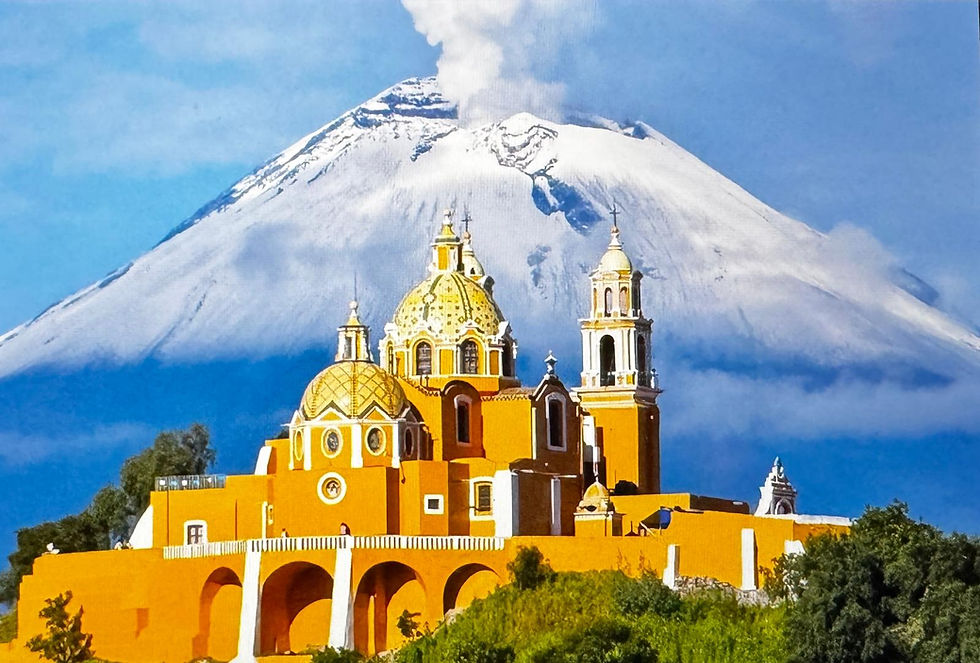
After admiring the views of the surrounding volcanos, now shrouded in cloud, and of Puebla in the distance, we walked back down the steps, to the entrance to the archaeological site. It was hot and the sun strong, so we had to wear hats. These sites in Mexico are amazing, but after a while your eyes glaze over and you can’t take in any more.
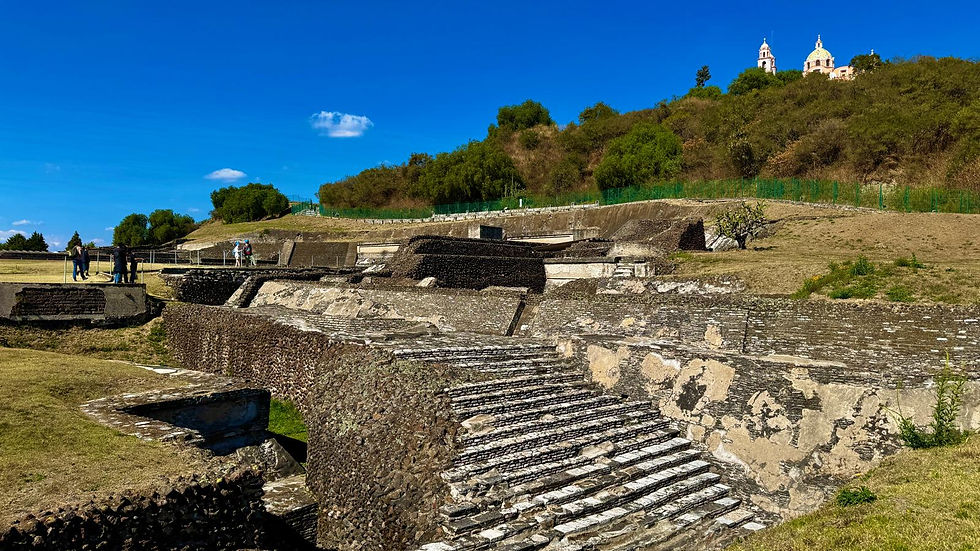
We reached the end and left the archaeological site and walked the short distance to the craft market, where we had a chat to a photographer and his wife. He was a retired pilot and his wife an AeroMexico attendant. We stayed longer than we wanted, because we photographed a group of traditionally dressed indigenous. There was a 20 metre pole with a wooden frame on the top and four ropes hanging down. Six of the indigenous, one wearing a birds beak and a framework of feathers on each arm, kissed the base of the pole, then climbed the pole, via metal rungs and sat on the wooden frame. Birdman stood on the very top of the pole, between the other five who were sat on the frame, and danced.

Birdman climbed off the top of the pole, then he and three others fastened ropes to their ankles, and hung upside down from the wooden frame. The frame started to slowly turn, and as it did, the rope started to lower, and as the rope got longer, the indigenous radiated outwards until they reached the ground, and when they did the two remaining slid down the ropes.

The others of the group, that didn’t go up the pole, milled around the crowd holding out hats for money. We gave: it was an amazing spectacle. After that, we retraced our steps to find a bus that would take us back to Puebla.
Later we went out to celebrate New Year’s Eve Mexican style. It was 19:00 when we left to find somewhere to eat. It was cold and we had to wear our fleece jackets. All the restaurants we wanted to go to were full, were closed or had queues of people who’d been told the waiting times were from 30 minutes, which could be up to an hour. We mooched around, but the places we came across didn’t appeal, such as Chinese or Korean restaurants, after all, we were in Mexico, or the many street food and fast food joints. We finally found somewhere, with few customers, but it did have a certain ambiance to it. We went in and were seated on the first floor, with our own balcony overlooking the square below. The beer was good, the food so-so, but edible. After we’d finished we wandered around the streets but the wind had risen and it got even colder, so we went home.
01st January 2026
We left our Airbnb about 12:30, because we spent the morning working on our computers. It was freezing cold inside and when we got outside, we were amazed how warm the sun felt on our bodies, and we spent around 15 minutes sat on a bench warming ourselves up in the 23C heat. We continued with our mooch around the Zocalo, simply taking in the vibes, and retracing our steps over where we’d been over the last few days. It was such a joy walking around in the warm sunshine, finding interesting places to photograph and soaking up the atmosphere.

It’s tiring mooching around, so we took a coffee and break we decided to have a coffee break and we found a wonderful coffee shop/restaurant called Rehilete. We talked to the owner, who told us they had music in the evenings at the weekend. Our last night in Puebla is Saturday, so we booked a table in the restaurant for 7:30pm. Rehilete may have been small, but it also had a great ambiance and felt right. The owner gave us small glasses Mescal to taste. Even though the glasses were small, the afternoon heat had made us feel a little giddy. We then we wandered around exploring the side streets before we went home.
02nd January 2026
I was up at 0600 and sat at my iPad, catching up with the news and emails then writing my diary. My phone started screeching when it received a seismic alarm call. It was an earthquake warning. Taken from a news site India Today: At 07:58 a 6.3-magnitude earthquake struck Mexico’s Guerrero state on Friday, sending residents rushing out of buildings in panic. Officials said no major damage was reported in Guerrero or the capital Mexico City. We went out on the patio and the owner of our flat advised us to leave our room and go into the street until it was safe to return again. 5 minutes later we got the all clear and we all returned.
We left our cold Airbnb at 11.15 and walked to the Zócalo to warm up, sitting on a bench for about 20 minutes. We then walked roughly two miles to the viewing point, the Mirador de los Fuertes. It was very hot on the way and we walked up a steep hill and reached the mirador de los Fuertes, but it was disappointing as the view of the two volcanoes was mostly blocked by trees, and where was the third volcano? Lisa asked one of the many tourist bus drivers where the best place was to take photos of the volcanoes. He told us the bus would still go a bit higher and there was a better view. So we got on his bus, sat on top of the open topped double decker, the bus took us back into town, stopping at various attractions to allow people to take photos. The bus stopped beside the Zocola and we mingled with the others getting off. Something for nothing!

Museo de la Revolucion of Puebla. Museum of Evolution, Puebla. The house is situated a few blocks away from Puebla’s Zocalo.
The Mexican Revolution began on November 18, 1910, at the Puebla home of the Serdán family. Aquiles and Máximo Serdán, their sister Carmen, and a small group of supporters rose up against the dictatorship of Porfirio Díaz, days before the planned national uprising. Discovered after an accidental gunshot alerted authorities, they were surrounded by police. Máximo was killed in the fighting; Aquiles was wounded, hid beneath the house, and was later found, and shot dead. Carmen fought from the balcony, calling on neighbours to join them.
Though the revolt failed, it marked the opening of the Revolution. The Serdáns’ motivation lay not only in political ideals (Aquiles was a follower of the opposition leader Madero) but in lived experience. Once prosperous, their family had been ruined by fraud (embezzled by their accountant) and reduced to poverty, shaping Aquiles’s sympathy for the poor.
Under Díaz, Mexico’s poor—especially workers and Indigenous peoples—endured extreme exploitation, including forced labour, land seizures, and deadly repression of strikes. In this context, the Serdáns’ sacrifice reflected a broader revolt against injustice in a society where, for many, liberty truly seemed worth more than life.
Thanks to: Los Serdán, a booklet by Donato Cordero Vázquez,


03rd January 2026
Today our destination is Atlixco. We left at 1000 and were glad to get out of our cold flat into the warm sunshine so we could take off our fleece jackets. Last night at the tourist office the friendly staff gave us a map and marked the crossroad junction to wave down minibus 25 that would take us to Atlixco Autobus terminal. We walked there and waited and stopped three minibus 25’s, but each driver said they didn’t go there. 15 minutes later I tried calling an Uber, and as I was at the point of booking, a taxi was passing, and I flagged him down. It cost MX$100. At the bus stop we bought two single tickets for MX$90. Most Mexicans travel by bus, and their bus termini are modern and run efficiently. Within five minutes our bus arrived. No seat allocations, just an orderly queue, and now at 1030 we’re on our way.
We got out at the bus terminal and took a stroll around the streets of this busy town. Streets decked out in flowers and colourful Christmas bunting. We took photos, had the worst coffee I’ve ever tasted in a cafe, then walked back to the Zocalo.

We take a tourist bus around some of the tourist destinations, MX$150 per person. We’re sat on the top deck of an open topped old timer tourist bus. The tour is a bit cheesy. Even so, it nice to be chauffeured around the town. The views from the top are great, but care is needed, as we have to swat away electric cables, branches and various Christmas decorations tied to the tops of poles that the electric cables are strung between. We stop first at a flower nursery called Xalpatlaco. Next we stop again for 15 minutes to visit a producer of cosmetics and jewellery, made from avocado stones. We listen to the inevitable spiel about the wonders of their products and are served thimble sized glasses from a bottle Mezcal that had a scorpion in the bottom of the bottle. We continue, once again pushing branches and cables out of the way, and we get off at what I think is a Christmas Market. However, it’s not a Christmas market as such, but a celebration of Christmas, and it’s geared toward children. It’s also a promotion for the company that supplies the town with their Christmas decorations. Inside are all sorts of Christmas characters, and animals. In one area there’s a theme based on the Mexican’s day of the dead, but with a Christmas twist. We’re inside for about 30 minutes and there was a queue to get in too.
From there it’s a short drive back to where we began, the Zócalo. We’re sat in the back seats of the bus and I’m fascinated watching the people sat in front of us duck down and then sit up again, rather like a Mexican wave, to avoid being decapitated by the electric cables and strings of lightbulbs strung across the narrow roads.

After our tour we go for a coffee on the Zócalo and are frequently serenaded by ‘guitarists’ and ‘singers’, who you would gladly pay to go away. I checked the temperature at 3pm as we drank our tea and a coffee in the sunshine. The temperature was 27C, and it felt warmer than Puebla, maybe because Atlixco is 400m lower than Puebla’s 2200m. We finished our coffee and had a leisurely stroll through the busy streets to the bus station and took the 1600 bus back to Pueblo.
We thought the bus would drop us off at the coach station where we started off from, but it dropped us off at the bus terminus where we arrived from Mexico City, so we had to get a taxi back. Unfortunately there was a long queue, and we a had a 30 minute wait. This was the end of the Christmas holiday period, and there were processions taking place in the centre of Puebla and taxis were at a premium. When our taxi driver was given our destination he refused to take us at first, because he said the centre would be grid-locked. However, Lisa managed to persuade him to take us as far as he could, near to the Centre. We got out of the taxi at the Mercado de Sabores, which we knew well, it was the place where Lisa bought the black beans, but it meant a long walk back to our flat along crowded pavements and grip-locked streets. The Zocalo is absolutely jam-packed with people, out celebrating the end of the holidays and waiting for the processions to begin.
Later in the evening we went to the Rehilete Restaurant and ordered beers. The name of the beer was Rivadavia. The music duo arrived and started playing. We sat outside beneath large umbrellas and ordered typical Mexican food and guacamole, with baby grasshoppers. We were told the young ones were the tastiest. The food was good so was the music. A good end of our stay in Puebla.
1. Mexico City 25.-28.12.2025
Lisa:
25th December 2025
After a bumpy but otherwise uneventful flight, we arrived safely at Mexico City International Airport at 3 a.m. on Christmas Day—90 minutes ahead of schedule. Immigration went smoothly, and while we were waiting for our luggage, a female border official passed through with a sniffer dog doing his rounds.
The dog stopped in front of a mother feeding her baby a banana. Fixing his gaze on the fruit, the dog sat with quiet optimism, licking his lips and clearly hoping for a bite. For a brief moment, it seemed his professional instincts were at odds with a personal interest. But no banana was offered. He was calmly but firmly led away, reminded of the job he was supposed to be doing.
The Uber taxi Took us quickly to our hotel, and while we were waiting for our room to be prepared, we went for a walk at 5 am through the dark, deserted streets of the Roma District. It felt good to move about after being stuck in “Grasshopper class” on the plane for hours. We found a 7/Eleven supermarket open 24 hours and treated ourselves to a much needed cup of coffee and tea.
It seems we can no longer outsmart jet lag the way we once did. Tired but stoical, we dragged ourselves for the next few days through Mexico City, determined to absorb the atmosphere of this enormous metropolis whether our bodies agreed or not. It felt good to be back though. The last time we were here was nine years ago, which turned out to be just long enough to forget almost everything. The next few days we spent relearning how this city actually works.
We travelled by Metro, Metrobus, and on foot—wandering through the historic centre with its many museums, galleries and photo galleries, getting trapped by the crowds in the busy street markets behind the National Palace, and strolling through the attractive neighbourhoods of Roma and Condesa. We even made a visit to the TAPO bus station to buy tickets to Puebla for Sunday and carried out a full rehearsal run, just to make sure that on the day of our travels both we and our luggage would have a smooth journey and arrive on time.
Along the way, we noticed families wearing warm, brightly coloured Christmas jumpers. Of course—it was Christmas, and after all, it is winter here. Night-time temperatures drop to around five degrees, while daytime warmth creep up to 15 at midday and to twenty mid afternoon. To be dressed dressed appropriately is a challenge and requires preparing for something close to all four seasons on the same day.
There is no need for us to race around now to take in as many sights as possible as in the next few months we will come back to Mexico City several times - with more time and more relaxed.
27.12.2025:
Today was a day when nothing works. First we went to the Café/Library Liberia El Pendulo to listen to their Saturday morning music band, only to hear that today they will play from 11. We could not wait so long and went to the Palacio Nacional to see and photograph Diego Rivera’s murales paintings, only to hear that the tickets for today were sold out. That happened the second time, yesterday was also sold out. The Nacional Palace opens from 10 am, and at 10.30 am there are no more tickets for the day? Ridiculous! There is no online pre booking of tickets. People queue from as early as 7 or 8 am to get tickets. After I calmed down, I spoke again with the ticket lady. Apparently during time of Xmas it is full, from mid January it gets better, but she recommended to come during the week Tuesday until Thursday, as weekends is full again.
As the historic centre was crowded, we decided to visit the Museum of Memory and Tolerance. We expected that nowadays not many people would be interested in visiting such a museum, but were proven wrong. Lots of people had the same idea. The exhibition and its content were interesting and thought-provoking.
The section on genocides showed in detail the atrocities committed by Nazi Germany against people who were considered to be “different”, in one way or another: Jews and other minorities, physically or mentally disabled people, homosexuals and others. The exhibition clearly demonstrated that those atrocities could only happen because many people either actively participated, remained indifferent, or did not do anything against it.

The exhibition also included more recent crimes against humanity and examples of religious, ethnic and other forms of intolerance, including in Armenia, Guatemala, Cambodia, Ex-Yugoslavia, Darfour, Myanmar. It would have been very interesting to learn more about these more recent events, but the information was brief and at this stage our minds were already overwhelmed. Still the exhibition continued. The final section was dedicated to tolerance and diversity. It covered various forms of discrimination, the power of the media and hate speech, and the benefits of diversity. We spent almost four hours in this museum. It was a sobering yet deeply moving exhibition, and we were glad we took the time to visit.
On the way home, although our heads were spinning, we visited an interesting photo exhibition in the Centro de Imagen, and learned about “100 years of Leica and its connection with Latin America”.
After that we were knackered and went in search of some typical Mexican food and drink to recover from the hours spent plodding around.

Dave:
25th December 2025
Our flying time was 12 hours and our scheduled landing time at Mexico City’s T2 was 04:30. The flight was full, the food left a lot to be desired and we landed at 03:00, 90 minutes early. There was a problem with disembarking, which took 30 minutes to fix. They were renovation the airport, so it was a rather messy long walk to immigration. Maybe it was the early hour, but we we’re quickly through. Our suitcases took a little longer.
I ordered an Uber cab for 215 pesos (about £9) and 20 minutes later we were dropped off outside our hotel, the Galeria Plaza Reforma. We checked in, and gladly accepted their offer of a room upgrade, which included room access at 07:00 rather than at 15:00, for $US80, about £59. We had just under 2 hours to wait, so we went for a walk around the empty streets to find somewhere to sit down and have a cuppa. The temperature was 10C. There were no cafes open at this time apart from a 24 hour 7/11 shop. They had a coffee machine and hot water, so we took our takeaway cups of tea and coffee back to our nearby hotel, and drank them in the lobby, and waited for our room to be available.
The room was cold. I turned up the temperature to no avail, the room got even colder, and I went down to reception to complain. The problem was this was winter in Mexico and the air conditioning of the entire hotel was set to keep the rooms cool not warm. They took pity on us and brought us a large fan heater.
Later we left the hotel to take the Metro into town to explore the Zocalo and its surrounding area. We stopped first at a small bakery for a snack and a cuppa. The weather was pleasant with a temperature around 14C, with a forecasted high of 21C later. We continued to the Insurgentes Metro station. We bought our rechargeable Integrated Mobility Cards from an automatic ticket machine. We paid 60 Pesos, of which 15 Pesos go towards the physical card, the rest towards the fare. Each ride costs 5 Pesos and can be used on most of the transport system. These Metro stations are huge, their direction instructions confusing, so it took us a while to understand the system.
Among many places we went to the Plaza de la Constitucion, or Zocalo, which was originally built by the conquistadors over the original Aztec city of Tenochtitlan. Today it houses the Metropolitan Cathedral, the National palace, Mexico’s governmental hub, and the surrounding streets are filled with museums and shops.

I remember the last time we were in Mexico City, almost 9 years ago, we had a coffee over looking the National Palace, in the restaurant at the top of the Best Western Hotel. We decided to return. We took the ornate lift to the top and ordered coffee and tea. Whilst we were waiting I took a photo of Lisa from the same place I took her photo all those years ago. Afterward we walked down the very old and very elegant balustraded staircase, down each floor, into the reception area.

27th December 2025
We walked to the nearby music bar where a band was supposed to be playing from 10 o’clock. When we got there they said the band would be starting at 11 o’clock. So we went instead by Metro to the Palace National to buy tickets. We got there at 10:45 and they’d sold out of today’s tickets, so we went to the Museum of Memory and Tolerance. Discounted tickets cost MX$230 for two seniors. Headsets in English were included in the cost of the tickets. The exhibition was informative and visually stimulating, but far too much emphasis placed on Hitler and the Nazis. Other countries’ atrocities were represented, but to a lesser extent.
The memory section ends in a room which features an artistic installation of inverted gallows that move every time crimes against humanity occur. It reminds us what is happenings today. For example, every hour 1,484 girls and young people are raped around the world, and at the same time, 1,369 children are enslaved. The gallows move because of our indifference.

We were tired and our feet hurt, and we needed the loo, so we broke off and took the lift to the cafeteria. We waited 40 minutes for a coffee and a cup of tea, and when it came, I had to send my cappuccino back as the frothy milk on top was a hard lumpy congealed mess. 5 minutes later my replacement cappuccino arrived, together with a jug of milk for Lisa’s tea. It appears their milk machine was throwing a wobbler. We completed our tour, handed back our headsets, collected our rucksacks and left.
Time was running, we were tired of wandering around the Centre and it was now after 4pm, so we decided to give part of the Metro a miss and walk it down to the Balderas Metro station, along the main highway. We came across a free photo exhibition along the main highway, which was called the Centre de Imagen. Parts of it were good, especially the photos taken by Leica camera’s over the years, the rest not so. From there we walked it down to the Metro station and got out at Sevilla, from where it is a nice walk to our hotel.
We pondered where to eat, and wandered around the area looking for somewhere that appealed. We came across a crowd of people waiting outside a restaurant, La Casa de Tono. We thought it must be good for so many people where queuing, so we went to have a looksee. The menu looked good and the people we spoke to in the queue said it was worthy of a visit. There was a lady giving out tickets, rather like in the Royal Free when you went to have a blood test, and were given ticket 91. 20 minutes later we were sat at our table. We ordered two beers and a selection of typical Mexican dishes, enchiladas and quesadillas. They were right, the food was excellent, the tables clean and the service good. Afterwards we returned to our hotel.
28th December 2025
I got up just before 5am and started to write my diary. Then chaos ensued. I must’ve hit the wrong button, and I lost the entire contents of my diary. Both of us tried for hours to get back the latest version I was working on from yesterday. We could get an older version and by copying and pasting notes and remembering what I’d written we managed to cobble together an updated version.
We must remember in future to save our documents and upload them to iCloud each time we finish - and to be on the safe side to email them to each other.

