
Vamos Amigos! Come with us to Mexico! Part 3 of our Travel Blog.
Updated: Mar 17

As in previous travels we want to share our experiences and adventures with you.
Two monhts into our travels, we have already written extensively and there is no more space on the blog post for text or photos. As a result we’ve opened up a new post and continue from here onwards with part 3 of our travel blog. Enjoy.

Baja California, 15th February until 8th March 2026
Dear readers,
unfortunately, the blog is full again, and for the remaining reports and photos we have set up a new blog (part 4). There, under 7b, you will be able to read about Loreto and our remaining days in Baja California as well as about our last days in Mexico City. Enjoy! See link below:
7a. Baja California: 15th until 28th February 2026

Lisa:
15th to 17th February 2026
On Sunday, 15 February, we picked up the van at Vanbaja in San José del Cabo. We received a helpful introduction from Julian, our contact at Vanbaja with whom we had been corresponding from London. He showed us how everything in the van worked and pointed out some of the most interesting places to visit in Baja.


We set off straight away—first to a nearby supermarket to stock up, then on to our first overnight stop in Los Barriles, about two hours north of Los Cabos. It’s a large campsite with clean showers and toilets. The first thing we noticed was how relaxed everyone seemed—and that the campsite was firmly in North American hands, whether American or Canadian. Many have been coming here for years. They know one another, know all the best spots and restaurants, and seem to know everything. Some are friendly and chat with us; most keep to themselves. They arrive in large trucks with trailers and cruise around the beach and town in rented beach buggies or quad bikes.
We decided to stay here for a few days to get used to the campervan and to Baja, and to finish the last chapter of our blog about northern Mexico. The Wi-Fi signal is unreliable, so I spend hours in the “library,” a small building with a few desks and shelves of books. The connection is strongest there, and I regularly see other people working on their laptops—presumably working remotely.

Our van has taken some getting used to. It’s a RAM 2500 with a powerful engine. It doesn’t have four-wheel drive, but as long as we’re careful, it should be fine. We chose it because it’s short and narrow—ideal for winding roads. Inside, it’s tiny. There’s just one seat and a small table, but the driver’s seat swivels around so we can both sit there.
The bed is fixed in place, unlike in Australia, where we had to go through a complicated routine each evening to set it up. Here, it’s always ready—but it’s high up, so we have to climb in and out using a small stool. It’s comfortable, though. We sleep sideways, and even though I’m not tall, I often bump my feet—or my head—against the wooden walls.
Beneath the bed there’s a small fridge and storage space for food and drinks. Next to it is the kitchen area, with a sink and cupboards below, and opposite are shelves and drawers for utensils and supplies. We have a rather fancy Coleman kitchen set with pots, pans, plates and bowls. The stove is a portable two-burner gas cooker with three small gas bottles. Each bottle is supposed to last at least a week, but the first one ran out after just two days—we suspect it wasn’t full to begin with. The cooker takes up a lot of space, so we mostly cook outside when the weather allows and it’s not too windy. We usually eat outside too, as it’s very cramped indoors. If it’s cold and windy, we simply put on several sweaters and anoraks.
Electricity isn’t an issue—at least as long as the sun is shining and we’re not parked under cover—because we have solar panels on the roof. That means we don’t need an expensive campsite hook-up. We are (almost) self-sufficient.
There’s also a shower—but it’s simply a shower head at the back of the van. To use it, you open the rear doors and shower in the open air. For a bit of privacy, we can hang up a small shower curtain. The water comes from an 80-litre tank.
And we even have a loo: a portable toilet stored under the seat by the table. To use it, you slide it out, open it, do your business, flush, and slide it back underneath. It’s ingenious—but it does require a certain level of comfort with the idea of using the toilet in your living room/kitchen/bedroom without much privacy. We’ve decided to use it only at night, and only for number ones.


In Los Barriles, we walked into town to do some shopping. One disadvantage of staying on campsites is that they’re often located outside towns, and without bicycles or a car to tow behind the camper—like many of our North American neighbours—it can be quite a trek. We walked about two miles each way in the midday heat. There are some pleasant cafés and restaurants, but we didn’t really connect with the town or its people. We hardly heard any Spanish being spoken. It’s a feeling that will accompany us throughout our journey in Baja—but more about that later.


18th February 2026
After a few days in Los Barriles, we moved on and drove north to go whale watching. We set off early, just before sunrise, and stopped for breakfast somewhere along the way. Our destination was Magdalena Bay, the first of three places where we hoped to see whales.
It was a long drive from La Paz, particularly after Ciudad Constitución. We passed very few villages and drove endlessly through a barren, desolate landscape of desert scrub and cacti. The road deteriorated steadily: narrow, riddled with large potholes, with sections of tarmac crumbling away at the edges. You had to be especially wary of the white line on the right-hand side—particularly when there wasn’t one and the road had simply fallen away. The many roadside crosses told their own story about how dangerous these roads can be.

We finally arrived at Magdalena Bay at 3.30 p.m., and were deeply disappointed by the town. It looked dirty, neglected and forlorn. We had no mobile signal and no real sense of where we were. Eventually, we found the tourist agency. As we stepped out of the van, a fierce, icy wind nearly blew us off our feet and it looked as though it might rain.
The next whale-watching tour was at 6.30 the following morning—so early because the wind tends to strengthen later in the day. It would be a six-hour boat trip. No toilets—sorry. The cost was $120 per person, or $560 for a private tour for the two of us. No, thank you. With high waves, the threat of rain, six hours at sea and no toilet, we decided against it. We went back to the van, looked at each other and said, “Let’s get the hell out of here.” By then it was 4 p.m., and we still had another two hours and fifteen minutes of daylight.
Without a proper paper map—and with no Google Maps, but our TomTom SatNav—we headed back to Ciudad Constitución and then crossed the mountains towards the east coast and the Sea of Cortez, which lies between mainland Mexico and the peninsula of Baja California.


As always on our travels, we had prepared carefully for the trip—but we were not prepared to be completely disconnected: no Wi-Fi, no mobile reception, no signal, no maps, not even in towns. Nothing. In mainland Mexico we had often relied on public Wi-Fi in town centres or a mobile signal, but here there was absolutely nothing. Like in the old days, you might say—except that we didn’t even have a paper map. To make matters worse, signposting was extremely poor—virtually non-existent. You had to rely on asking people, yet there were very few people about.
Baja California is remote, apart from a few select tourist enclaves where hotels, restaurants and smart RV campsites offer Wi-Fi. Where we were heading, there was nothing. It was a poor area, truly the back of beyond—though at the time we didn’t fully realise that. We had expected remote stretches, but we had travelled a thousand miles and for 999 of them there had been no internet. If we had been in mortal danger, there would have been no way to contact the outside world. One could, in theory, use Starlink, but there had been none available to rent when we collected our campervan.
Back to that day’s journey: if we made good time, we might reach the town of Loreto before darkness. If not, we were confident we would find somewhere in a mountain village to park for the night. It was a long drive, and it dragged. The roads were dreadful, with tarmac frequently broken away at the sides. I panicked every time a large lorry thundered past, but the drivers behaved sensibly, miraculously keeping within their lanes.
It was getting dark and we began scanning the road for somewhere to stop. We passed no villages or towns, not even a petrol station along the long stretch of road. The verges were lined with stones or dense bushes, making it impossible to pull off safely. We had no choice but to continue.
We had never driven this van at night before and didn’t even know where the headlight switch was. I tried to decipher the vehicle manual, but my Spanish does not stretch to complicated technical instructions. Eventually Dave found the switch, but the headlights were weak and barely adequate for navigating the winding, treacherous mountain roads. In any case, it is generally advised not to drive at night in Mexico.
What were we to do?
Then, as we drove around yet another bend, we saw a small parking area beside a roadside café—a little shack—with a house opposite. Dave quickly turned in and stopped. It seemed a safe enough place to spend the night. The café was closed and looked as though it had been for some time. We were the only ones there.
I prepared some food and, exhausted and with nothing else to do—no internet, no distractions—we went to bed early. Apart from the lorries roaring past throughout the night, we slept reasonably well.
We set off again at dawn. In the daylight we could see just how dangerous the road had been, and we were immensely relieved to have found our overnight stop when we did.
19th February 2026
We continued our journey. In Loreto we filled up the van with petrol. There are very few petrol stations along the road—as we had discovered the previous night—so it seemed sensible to top up whenever we saw one and the tank was down to half full.
By 10 am we were hungry and pulled into one of the few lay-bys in the middle of nowhere to make breakfast. We still had a long drive ahead of us and did not reach Guerrero Negro until 3 p.m. This was another well-known spot for whale watching.

Our TomTom satnav took us to the address I had pinned, but we ended up in the middle of nowhere: a vast, dry expanse of land stretching towards the sea. The tide was out, revealing enormous mudflats that seemed to reach all the way to the horizon.
We turned around and asked some locals for directions, but were sent off in various directions. Once again, it seemed that rather than admit they did not know, people preferred to point us somewhere—anywhere—just to be helpful. Eventually, one set of directions proved correct and we arrived at a hotel with an RV park behind it and a small tourist agency on site.
We booked a boat tour for the following day and secured a pitch in the RV park behind the hotel and restaurant. The hot shower was absolute bliss after two days on the road—we were hot, dusty and sticky—and we greatly appreciated the facilities, which cost just 200 pesos per night.
Afterwards, we quickly went to a supermarket to buy some chicken—no fish available, despite being at the seaside—and cooked ourselves a delicious meal. We ate indoors, as a strong wind had picked up and it had turned decidedly cold.
20th February 2026
It was a cold night. We got up early and postponed our showers until after the tour, as we had been warned to expect plenty of spray during the trip. We paid 1,030 Mexican pesos per person (£44) for a four-hour excursion, departing at 8 am.
Wearing our life jackets, we set off on time. Together with thirteen other people, we were taken by minibus to the departure point, where our boat would head out to the Ojo de Liebre Lagoon. There are three main lagoons along the north-western Pacific coast of Baja Sur: Magdalena Bay, which we had visited the previous day; Ojo de Liebre in Guerrero Negro; and Laguna San Ignacio, which we planned to visit the following day.
We climbed into our boats and sped off through wind and rain, crashing over high waves on our way to the lagoon. Even once inside, the wind remained strong and it was bitterly cold. I was grateful for the two jumpers beneath my anorak and for my hood pulled tightly over my head. The boat rose and fell heavily; by then, at least, the rain had stopped.
Before long we were surrounded by whales, swimming beneath the boat and occasionally surfacing to reveal a face or a tail. A few came close but quickly disappeared again before anyone could touch them. We had been told that grey whales are famously friendly—that they approach boats, interact with people, enjoy being stroked, and sometimes even nudge their calves towards the tourists, as if introducing them to the world. None of that happened on our trip.


We learned that the mothers give birth after a gestation of around twenty months and then remain in the calm waters of the lagoons to nurse and protect their young. Once the calves are strong enough, they must swim through the powerful currents out of the lagoons. This usually happens around mid-March, in time for the migration north towards the Arctic ice, which begins in early April.
We were also told that at one point as many as 6,000 whales gathered in Ojo de Liebre Lagoon. Today, the numbers are significantly lower, as many do not survive due to diminishing food supplies linked to melting Arctic ice. The effects of climate change feel starkly visible here.
After the boat trip, we thoroughly enjoyed the hot showers at the campsite. At 1 pm we set off again, heading for San Ignacio, our next stop. Once more, it was a long and rather monotonous drive, retracing some of the previous day’s route.
We arrived in San Ignacio at 4 pm and strolled around the charming plaza beside the church, which was once part of a mission—as were many churches in Mexico until the mid-19th century. We chatted with a couple from South Carolina who warmly recommended the nearby RV park, just around the corner and within walking distance of the town centre.
We drove there, set up camp and booked a whale-watching tour through the owner of the RV park. Afterwards, we went in search of a supermarket selling chicken or fish, but without success. In the end, I prepared a meal of vegetables with tinned herrings in tomato sauce and sweetcorn. Surprisingly delicious.
We celebrated our safe arrival with a beer and later joined a small group of people playing guitar and harmonica and singing together. It was a lovely atmosphere, lit only by a few torches. Gradually the campsite fell quiet. Even the children, who had been running around a campfire earlier, had settled down. On campsites, people tend to retire early—usually shortly after 8 p.m., or at least that’s when they disappear into their campervans or tents.
21st February 2026
We rose early the next morning, as a long drive lay ahead. The distance from San Ignacio to Laguna San Ignacio is about 59 kilometres (37 miles). The journey usually takes between one and a half and two hours, as it involves roughly 40 kilometres of paved road followed by 15–20 kilometres of dirt track, depending on where you are heading within the lagoon area.
We made our way to Antonio’s Eco Tours, the last of the whale-watching operators along the lagoon. We hurried, as we had been told the tour would begin at 10 am. On arrival, however, we were informed that the boat would leave at 11. In fact, we did not set off until 11.30.

Laguna San Ignacio is a biosphere reserve and impressively well organised. The various tour operators work together to protect the whales. Boats are allowed into the lagoon only for limited periods, and only a fixed number may be inside at any one time. The journey from the shore to the whale-watching area takes about fifteen minutes. Before entering, the boat’s capitán must report to an official overseeing access to the lagoon. Each boat may remain for only one and a half hours before leaving to make way for another. At any one time, a maximum of fifteen boats are permitted.

The lagoon itself is vast and divided into zones: breeding areas, areas reserved for mothers and calves (which expand as the calves grow), and a designated zone where authorised whale-watching tours may operate. That was where we were. If you are lucky, the whales approach the boats, play and display themselves.
That day there was no wind and no swell; it was hot as we waited for signs of movement. Unfortunately, we were not lucky. Apparently, the whales are more active in wind and choppier water. We saw very little close up. In the distance we occasionally spotted a spout of water or the curve of a body breaking the surface, but never near enough for a proper photograph.


One young big American woman became wildly excited whenever she glimpsed a whale. She leapt from seat to seat, trampling over Dave’s rucksack, which he had placed at his feet. She was always first to thrust her camera forward, and many of my photos feature her back blocking the view. Afterwards, she even had the audacity to ask whether we could send her our pictures.
Somewhat disappointed, we returned to shore, where we consoled ourselves with an excellent meal of fish and prawn tacos before setting off again.
We still had a long way to go. Our aim was to reach Mulegé on the east coast. That meant retracing the dreadful dirt road back to San Ignacio and then continuing along Carretera 1 through the mountains towards the sea. We were pressed for time, having been delayed by almost two hours, and hoped to reach our RV campsite before sunset.
It was a long drive through stark desert mountains and then along the coast, where breathtaking views unfolded—though the driver could scarcely enjoy them, given the many sharp bends on the narrow road. We passed through Santa Rosalía, once a mission settlement, now a rather forlorn and windswept town with rubbish blowing through the streets. It felt marked by poverty and neglect.
We kept an eye out for a supermarket or fishmonger to buy something fresh for supper, but without success. The small shops we found sold drinks, crisps tins and tortillas—no fresh vegetables, fruit or fish. We were hoping for something more substantial.
Just before 6 p.m. we reached Mulegé. The TomTom worked well enough but directed us along a short cut down an alarmingly steep hill, where I was convinced we might tip over at any moment. The van, however, remained reassuringly steady.
On the way to the RV park we spotted a larger supermarket. Dave parked while I dashed inside in search of butter and fish. There was no fresh fish—only frozen chicken, which would not do for that evening. By then Dave had joined me to remind me to buy a bottle of rum to celebrate the long drive.
As I was paying, a local man rushed in to say that the police were outside removing number plates from a wrongly parked van. Dave ran out to check whether it was ours. It was.
I hurried after him. A policewoman was standing in front of our campervan, writing out a ticket; our number plates had already been removed. Without them, of course, we could not continue our journey. Apparently, we had parked on a red line. Only then did I notice the faint trace of red paint along the kerb—so worn it was barely visible. You would have needed to know it was there in the first place.
We had been inside the supermarket for less than five minutes. I tried to explain that we had been driving all day and were simply buying food for supper. Nothing softened her stance. If we wanted our number plates back, she said, we would have to go immediately to the police station and pay the fine.
She indicated the way to the station, though ironically there was another red line in front of it. We hesitated to park there for fear of another fine, but she assured us it was permitted for police business.
Inside the station, we paid 700 pesos (£30) and were handed back our plates. Dave asked whether we might borrow a screwdriver to reattach them, but none was forthcoming, and no one spoke English. It seemed their tools worked perfectly well for removing plates—less so for putting them back on.

By now it was almost dark and we still had to find our campsite. We drove out of town and, after about two kilometres—just as it became dark—found it beside the river. Fortunately, there was a pitch available, complete with a small covered kitchen area, a sink, a table and benches. Perfect.
We parked, opened a well-earned beer and celebrated our safe arrival against the odds. I cooked a simple but satisfying meal of vegetables with the last tin of sardines. Gradually, we calmed down and the frustrations of the day began to fade.
22nd February 2026
The following day we explored the town of Mulegé and went to the supermarket to buy provisions—this time on foot, so as not to risk another parking incident. Once again, we were unable to find any fresh fish, though we did manage to buy some frozen chicken breasts and legs, which would defrost by the evening.

In fact, we have not been able to buy fish in a supermarket since our first day in Los Cabos, when we purchased frozen octopus. Since then, we have found fish only in restaurants or taco stalls. Most locals we asked said they did not know where to buy fish. Do they not eat it? As far as I understand, fish—particularly in the form of fish tacos, ceviche and other local seafood dishes—is a cornerstone of the region’s cuisine. Living on a peninsula surrounded by sea, one would expect fish to be readily available. Yet people seem to eat more chicken than fish. I am sure there must be sound economic reasons for this.
A little research suggests several factors affecting affordable local access to fish. Much of the catch—especially high-value species such as lobster and certain prized fish—is increasingly reserved for export or for restaurants catering to tourists. This makes it expensive or less accessible for everyday local consumption. So while seafood remains culturally important, traditional diets are shaped by economic realities. Locally caught fish can become a luxury item, prompting residents to rely on other sources of protein. In addition, demand for popular species sometimes exceeds supply, leading to substitution with alternative fish. One study in Baja California Sur found that around 42 per cent of fish served in restaurants is substituted with other species—meaning diners may pay for premium fish such as marlin but receive a cheaper local alternative instead. Something to bear in mind the next time we order fish in a restaurant.
That said, the following day, while travelling and stopping for petrol, we came across a roadside stall selling a variety of freshly caught—though frozen—fish. The woman who sold us octopus explained that she is there every day from 10 a.m. to 3 p.m., and that on Wednesdays she also offers fresh (not frozen) fish.
Later in the week, a local fisherman regularly visited our campsite selling fish, lobster and prawns—but at distinctly high prices, almost as high as in the UK.
Back to Sunday afternoon in Mulegé: we found a delightful restaurant with a shady patio garden, where we had soft drinks and wrote up our diaries. Afterwards, we strolled back to the campsite along the river, feeling rather more at ease with the world.

That evening we read reports of a major police operation in the state of Jalisco, in Puerto Vallarta, where we had been only four weeks earlier. One of the world’s most wanted drug traffickers—the Mexican cartel leader known as “El Mencho”—had reportedly been killed by security forces, according to Mexico’s defence ministry. The operation triggered a wave of violence: vehicles were set alight, gunmen blocked highways in more than half a dozen states, and even supermarkets were attacked. Authorities in several affected regions urged residents to remain indoors; schools were closed and people advised to keep a low profile and stay at home until order was restored.
Baja California, where we are currently travelling, was also affected, though mainly in the north near the US border, around Tijuana and Mexicali.
The current Mexican president, Claudia Sheinbaum, has been under pressure from the United States government to intensify action against the drug cartels. Reports suggest she had been cautious about provoking a violent backlash ahead of the forthcoming World Cup, concerned about Mexico’s stability and reputation as a host nation. However, she was overrolled by the US authorities who wanted it to happen now. The situation is ongoing.
—————-
More information:
Here a link to an article by The Guardian as of 22 Feb 2026:
Here a link to an article ZDF Heute:
Wie "El Mencho" der mächtigste Drogenboss Mexikos wurde https://www.zdfheute.de/panorama/kriminalitaet/el-mencho-portrait-aufstieg-drogenboss-mexiko-100.html?at_medium=Social%20Media&at_campaign=ZDFheuteApp&at_specific=ZDFheute&at_content=iOS
Und in der Tagesschau:
—————-
In our earlier post about our travels in the North in Chihuahua and Sinaloa, I referred to the impact of the violence of the Sinaloa drug cartels on the local population. We were glad that we had not any running-ins with them.
Here is an interesting link to background information from Wikipedia on the Sinaloa drug cartels.
—————
23rd to 25th February 2026
This morning we left our campsite and Mulegé and continued south. After only about half an hour on a beautiful mountain road overlooking the deep blue sea, we arrived at Santispac RV Park. We’re planning to stay here for two or three days to unwind, before slowly heading further south towards Loreto.
The campsite stretches around an entire bay and is packed with campers and trailers. Some people stay just a few days; others—like our neighbour—remain for three months or more. We also see cars arriving for the day so people can swim or kayak, then heading off again in the late afternoon.
It’s a simple site. We chose a pitch with a palapa—a little shelter with a palm-leaf roof next to our van that gives us some shade from the fierce sun. There are no showers. Two toilet blocks are dotted around the campsite; the toilets are basic and a bit rough, but clean. There’s no running water—you flush using a bucket filled from a large drum. The only drawback is that it’s quite a walk to get there.
There are two restaurants serving breakfast, lunch and dinner. We’re sticking to cooking for ourselves, but we occasionally stop by for a soft drink to make use of the only available Wi-Fi. At least, that’s the plan—the Wi-Fi is currently “down”. Allegedly. Perhaps it will magically reappear tomorrow.
As mentioned before, much of Baja has no mobile signal, which makes it tricky to stay in touch, work on our blog or follow the news—especially the recent developments after the killing of the drug lord. Still, we can manage without for a few days. We came here for these beautiful bays and beaches, so we’ll adapt.
Water is another thing we have to manage carefully. There’s no mains water on site. We have a 10-litre canister of drinking water, plus supplies in our kitchen tank, toilet tank and even enough in the shower tank for two very short showers each. So we’re being economical, especially when washing up. Luckily, we filled an extra container at our last campsite, which helps. The next place with proper showers will be in Loreto in about five days’ time. Good thing I bought a pack of wet wipes.
We’ve since learned that a pick-up truck comes by daily selling water. I wouldn’t necessarily drink it, but it’s fine for washing up. Another truck regularly appears selling freshly caught (though frozen) fish and prawns. There’s also a tiny shop behind the restaurant with basic supplies. We’re slowly getting used to how things work here.


I counted around 50–60 campers, trailers and caravans. Ours is among the smallest. A group of friends from Florida are here with four fabulous silver Airstream caravans. We chatted with one of them while he was playing with his dog in the water. He’s ex-military, now retired. He sold his house, put everything into storage and has been travelling in his Airstream since May last year. He’s currently touring Mexico with friends, but next week he’s heading back to Florida and then with other friends on to Canada and Alaska for the summer. Not a bad life.
On our left side are two friendly men camping in a tent. We first met them at the restaurant when they were served chicken instead of prawns—but they just laughed and enjoyed it anyway. We were there only for drinks (and Wi-Fi). We’ve come to suspect the Wi-Fi works better for diners than for those just ordering drinks—but never mind, the two kind men shared the password with us. One of them is also ex-military and was stationed near Heidelberg in the 1990s. They’re both from Los Angeles and often travel to Baja. Soon they’ll head back home—a two-day journey.
Our neighbour on the other side has an enormous trailer with pull-out sides and even a fold-out balcony at the back, towed by a huge Ford Motor Company pick-up truck. He and his wife have been here for three months, they sold their house and bought this trailer and travel the continent. During Covid they were caught in Europe, rented a caravan and travelled Europe, in particular the Balkans until Covid was over and it was safe to go home. He’s also ex-military and now works as a mechanic for motorcycle racing teams. He works around 60 days a year; when he’s needed, he flies out for three or four days, then returns to wherever they’ve parked their trailer. They travel widely and seem to have found a good balance.
The campsite is also popular with motorcyclists. Just now, about fourteen of them roared past our van on their way to the far side of the bay, where they’re camping in tents.
At the edge of the bay are what look like long-term residents, complete with little gardens, flowers and outdoor carpets arranged around their trailers. On Tuesday afternoons there’s apparently a happy hour and disco at the restaurant, when everyone gathers to chat, drink and dance.
Today a military patrol drove slowly through the campsite, heavily armed and watchful, but they soon moved on. Otherwise, it’s peaceful. The residents we’ve spoken to aren’t too worried about the unrest elsewhere. They believe cartel violence is unlikely to reach southern Baja—there’s only one main road down here, and it’s in poor condition. “Too much effort,” as someone put it. So we should be safe.
Best of all, our neighbour has kindly shared his Starlink with us. We’re connected to the world again—at least while we’re parked next to him.
A group of 10 motorcycles just arrived at our beach. We got talking: they (the motorcyclists and their wives) come from all over Central America and Argentina and are on a two-week tour of Baja California. We talked to someone from Mexico, Guatemala and a very nice couple from Costa Rica. They all rode BMW motorcycles rented from the tour operators. Only the Mexicans had their own bikes with them. It was a lively group. They populated our beach and celebrated one of their friends' birthdays. The music was loud, there was dancing and drinking. Latinos just know how to party. It was a good atmosphere. Finally, we felt like we were in Mexico. Afterwards, the men rode their motorcycles to a nearby hotel where the group was staying. The women were transported in a minibus. We hope the group arrived safely, given the many bends in the road.
So we’re spending a few blissful days here: sunbathing, walking along the beach, working on the blog (thanks to Starlink), cooking octopus or prawns in the evening, enjoying a sundowner beer and gazing at the stars. Life feels wonderfully simple.


Tomorrow we’ll move further south to Requesón Beach Campground—another beautifully located but very basic beach campsite. Let’s hope someone there is willing to share their Starlink too.
26th February 2026
When we got up, our Los Angeles Neighbours packed up to leave. We had a chat and wished them a safe journey. They had been very pleasant neighbours. Tonight they would stay in San Felipe, then the next day drive all the way back to Los Angeles.
After a leisurely breakfast, we also drove off and made our way south. We needed to find a supermarket to stock up on food, but there was none on our way. We turned into what looked like a compound of little holiday houses or a hotel in the hope that people there most certainly needed a shop to buy essential food. To our surprise we found the group of Latin bikers there. That’s where they were staying. They were just packing the bikes and preparing to go for breakfast. They told us they had a good time at the party yesterday. But they also bitterly complained that their hotel had turned off the electricity and water supply at 10 pm and only turned it on again at 9 am, treating them like children, not like paying guests. We all know water is tight, but this is unbelievable.
The restaurant that served them breakfast was also a shop but had not much to sell. We found three avocados and paid an exuberant amount of 70 pesos for them. In Oaxaca the kilo of avocados was 40 pesos. I complaint and the shop owner but he just shrugged his shoulders, take it or leave it. Supply and demand! We had hardly seen any avocados in shops in Baja. We said good bye to our biker friends and continued our drive. At some point, Dave stopped in a lay-by on the road. He wanted to free up the blocked kitchen sink outlet, without success. We need to contact Julian from VanBaja - when we had access to wifi or a phone signal again - to sort something out. Until then we needed to be careful with the amount of water and washing up water pouring into the sink as the waste water does not run away.
Then we continued to drive through the mountains with a wonderful view of the blue Sea of Cortez. Soon, 18 km south of Santispac we arrived an the Requeson Beach, our home for the next two nights. Each slot had a Palapa by its side, a palmroofed shady area. The toilets were clean with running water. What was missing, though, was a sink outside the toilets where to wash your hands. There were no showers and no water. But you can’t have everything. This beach came highly recommended for swimming and we were looking forward to it.
We settled in and had a walkabout the campsite and chatted with our new neighbours. To our left was a young lady with a Chihuahua mixed with something dog. She just came back from a tour with her boat and the little dog had misjudged how far it was to swim to shore and was exhausted and traumatised. She had a colourful camper with an extendable roof for sleeping and a nice stainless steel kitchen in the back of the van, so outside cooking only. She is US American but for the last three years she lived in Baja California, in the north. The couple next to her are Chileans from Valparaiso, living for the last 20 years in Toronto. The man always goes out with his boat for fishing. The neighbours on the other side of us are also Mexicans, a family with 3 adult children. They have a pick up truck, but most of them sleep in a tent. I wondered how their sleeping arrangements were, as all five of them were rather large and the tent was small, with a maximum of three slim people fitting in. On the other side of the bay, are some large vehicles with huge trailers parked. They are mostly US Americans or Canadians.
Suddenly, a large tourist bus made its way down from the main road and stopped right in the middle of the campsite. The passengers come out with lunch boxes and streamed towards the beach and shady palapa areas. One of them is right beside our van. Here about 20 of them gathered trying to stay out of the sun. The bus driver was checking his tires. One of them was flat. I had a chat with a few of the passengers under the palapa next to us. It turns out they are all Mexicans on an organised Baja California tour. They flew from Mexico City to La Paz in the South of Baja California. From there they will explore Baja for one week. This was their first day of the tour. The bus managed to get them to their destination, Requeson Beach. Whilst his passengers enjoyed themselves on the beach, the bus driver arranged for a mechanic to come and change the tires. Perfect timing.
The group consisted of people of all ages. They were in a good holiday mood. Some of them walked along the beach, others went into the water but the water here is flat and calm and one has to walk a long way to get to deeper areas where swimming is possible. Suddenly we notice that two young lads were supporting their friend out of the water. He could hardly walk, blood dripping of one foot, so they carried him out of the water to the shade, where people attend to him. I assumed he has been stung by a stingray. We had seen a dead stingray on the beach of Santipac, picked upon by seagulls. So I wouldn’t be surprised, if this was the case. Someone asked the guy I had spoken to whether he had any tequila. A bit early at 11 am, I thought. I went to see the young lad, how he was getting on. He was obviously in a lot of pain and his foot was bleeding heavily, a woman attended to the wound. Someone handed over a bottle of Tequila, but rather than giving it to the lad, to drink it against his pain, the woman used it to sterilise the wound. Aha, wrong assumption. Three people had to hold down the poor young lad, as he was in so much pain. I still think they should have let him drink a gulp of the Tequila first. I know from experience how painful a stingray sting is. Dave had been stung by a stingray many years ago in Nicaragua. It was very painful, his leg went numb, but after 6 hours the pain was gone and he was able to dance. We left them to it, they seemed to know what they were doing.
An hour later, a pick-up truck came along. Dave, curious as always, checked what they had on offer. Ceviche (a fish salad, a Mexican speciality). Word got out and many of the Mexican bus passengers streamed there to get some of the ceviche, as they preferred them to their packed sandwiches. The seller even let you try some to see whether you liked it. We liked it. It was nice fresh and cool. We shared one portion, which was enough for us both. The price came close to restaurant prices, 300 pesos for one portion of ceviche. But again, supply and demand. Everyone paid without complaining. And the ceviche was very yummy. He promised to come back the next day.
At 4.30 pm, the tire was repaired, and the passengers went back onto the bus. We waved off our newly found friends. The father of the lad assured me that he was already better, but in La Paz they would still bring him to a doctor to check him out. Just in case.
It was getting cooler and the wind had dropped a bit. Dave and I walked along the beach, where we met a nice Mexican couple from Quintín, in California Baja Norte. She was heavily pregnant, due to give birth in two weeks. This was their last chance to undertake a trip to the south of Baja. They had never been in this area and were enthusiastic about the beautiful bays. They went with a pick-up truck from his work and were staying in small hotels along the road. Back home, they were living in a trailer, which was good enough for them both, but now with the little one coming, they had to get something more substantial and bigger. They were a lovely couple, setting up a family together. We wished them all the best. Later before they set off, as they were staying in a small hotel nearby, they came over and brought us five oranges that they had bought in Ciudad Constitution, in the middle of Baja Sur, a region where the oranges are especially sweet. How very kind of them! We cherished these oranges and they were really sweet.
We are often taken by surprise by the kindness of many Mexican people. In Baja we met some who were not friendly, probably fed up with all the tourists, who come in huge trailers, dominate the place and don’t interact with locals, may even don’t notice them, in return some Mexicans treat the tourists as somebody who can be milked, or as cash machines. Then again, we meet so kind people like the shop owner the other day. I had bought eggs, you get them in a small plastic bag, which makes them easy to break. After I had paid, my plastic bag with eggs clicked on the table of the counter and one of the eggs broke. This woman, heard the click too, took the plastic bag with eggs from me, took all the eggs out washed them, tried them, put them in a new plastic bag, put the broken egg aside and replaced it with a fresh one. After that she refused to take payment when I wanted to pay for this additional egg. Her argument- with a smile, nothing is wasted. She will have my broken egg for lunch.
In the evening, Dave and I prepared dinner. We had a feast of shrimps with garlic and lemons, washed down with a nice bottle of Chilean wine. What a life!
27th February 2026
We had the best night’s sleep in a long while. At 6 am we put with our easy chairs nearer to the water to watch the sunrise over the bay. Hardly anybody else was up. It felt magical.


After breakfast we went for a walk following a sandy path through desert bushes to the next bay, carefully watching for scorpions or rattle snakes. We didn’t find any, only dog shit. The bay was completely secluded, no road access. A few stingrays glided through the shallow water, which put us off swimming. A pity. On the way back we passed the Mexican family camped next to us. Their teenage boy hung back to have a phone conversation, presumably with a girlfriend. We could hear her voice and told him to say hello from us. He just giggled.
Later we came across a VW camper from Fulda, Germany. The couple had shipped their van—newer and larger than the classic California model, more like a Mercedes Sprinter—from Hamburg to Baltimore. From there they toured the US over the summer, visiting their son on student exchange in Iowa. They’re now spending a month in Baja California, loving it, before heading north through the States to Canada. In July they’ll catch the ferry from Halifax back to Hamburg. What a wonderful way to take a year out. Their English was limited and they spoke no Spanish at all, which inevitably restricts what they can experience—but there are always other ways to communicate.
Back at our Campervan, I got chatting to our US American neighbour, who water delivered and expertly filled her kitchen- und shower water tanks without spilling a drop. She’d lived for six years on a sailing boat off San Francisco, that’s where she learnt to conserve water. An interesting woman and well travelled. She came to Baja California on a sailing trip, liked it and stayed. She is ex-military and was once stationed at the US American Airforce base of Lakenheath in England.
She is critical of some of the US American people who arrive in their huge camper trailers, take up a lot of space on the campsites for months and months and rarely engage with the locals. They stay here because it is cheap andwarm. Many don’t leave their trailer because they don’t speak or understand Spanish, so they keep amongst themselves. They don’t know how to communicate other than in English, which many Mexicans here in Baja don’t understand. So they stay amongst themselves. Technically, US citizens receive a 180 days visa, but overstaying is very common and largely tolerated.
Our neighbour also said, many of the campsites in Baja are full with Trump supporters. She mentioned, a few years ago, some of the campsites were full with pro Trump 2020 flags, but they have largely disappeared. We wondered why? It’s probably still the same people, but perhaps they are no longer so confident, or are disappointed as nothing has changed for them for the better? We were just contemplating about similarities to BREXIT in the UK, when the fish pickup van arrived and offered ceviche for lunch. Our efforts to putting the world to right had to be postponed as lunch was waiting. I still wanted to know how she was earning a living, but certain things are not being asked when not forthcoming.
In the afternoon, three enormous RV coaches rolled in, each towing a big pickup truck. They parked in a circle to create their own compound, set out cones to mark their territory; and effectively blocked access to that side of the beach. Tables and chairs appeared, along with large brown bottles and they settled in. It reminded me of old Western films, where settlers would circle their wagons for protection against the Indians.
We went for a walk, hoping the wind would drop so we could have a shower. However, with this wind, our outdoor shower would have drenched our bed. We could not risk that. At that point we were dreaming of the next manifest in Loreto - with a hot shower and even wifi.
As we prepared dinner, sitting in front wind shade of the van, our Chilean neighbour, Antonio, walked past. I ask him whether he had caught any fish today. Yes, he did, a big one, but he threw it back as they had still to eat the three fish he’d caught yesterday.
We reminisced about Chile and the fabulous New Year’s Eve fireworks in Valparaiso that Dave and I had seen. Antonio was brought up in the coastal village Algarrobo where I used to go with friends for a day-trip on Sundays from Santiago by bus. After Pinochet’s cop, his activist uncle fled to Spain, while his own family endured police harassment until they moved away to Valparaiso.
Twenty years ago Antonio and his wife emigrated to Toronto. He’s a carpenter; at first it was hard to win trust as a Latin American tradesman, but now he runs a successful contracting team and can afford two months off each year. We talked about immigration—about working hard, building a life abroad, like him in Canada or me in England, and the benefits migrants bring. Soon he hurried off to his wife, only to return moments later with hot Chilean cheese empanadas he’d made earlier. We offered red wine in return and carried on talking. Dinner was late, but good company matters more.
Afterwards we watched the Mexican family light their wood fire with petrol. One of the boys misjudged the fumes and a dramatic flame shot up - luckily no one was hurt. We joined them by the fire. They are from Tijuana, the Mexican boarder town with the US, and have holidayed in Baja Sur every year for sex years. The father loves whale watching and proudly showed us photos of himself stroking a grey whale, which lingered by their boat to be tickled again. A true whale whisperer. Tomorrow they head north, stopping in San Felipe before reaching home. We wished them a safe journey and finally retreated into our van after a long, full and memorable day.
—————

Dave:
15 February 2026
The alarm went off at 07:00, and we had a busy day ahead. Lisa worked on the blog while I finally managed to download the map of Baja California Sur onto our TomTom. Breakfast at 08:00 was included in our room rate, and was excellent.
After repacking, we handed in our key and I booked an Uber to the company we’d rented our campervan from; VanBaja. Ten minutes later we arrived to find it gleaming in the driveway, freshly washed and polished. We met our host Julian, who was originally from Buenos Aires, completed the paperwork, paid the balance in cash, MX$45,000 (£1,925.55) and left a deposit for the campervan on my Wise card.
The van is built on a six-year-old Ram 2500 chassis. The original engine had been replaced with a smaller 2.5-litre petrol version, slower uphill, but far more economical. I was pleased. Inside, it had an efficient fridge and a portable two-ring Coleman gas cooker with a three-sided windbreak, perfect for outdoor cooking. We’d also hired a portable toilet that slid neatly out from a cupboard. Great in the middle of the night, once you got over the fact you’re going to the loo in your living room!
Our first stop was a nearby supermarket to stock up. Dinner for the next two nights would be pan-fried pulpo with vegetables, accompanied by beer and wine. With supplies stowed (eventually), we set off for our first campsite: Playa Norte RV Park near Los Barriles, about 75 km away.
We were struck by how mountainous Baja California Sur is, stark desert terrain, twisting narrow roads, sheer drops and no barriers. Once off the highway, it’s sand. Full concentration required at all times.
The RV park sprawls across sandy ground dotted with trees and toilet blocks. There’s a small library, launderette, lively beach bar for sundowners, and localised Wi-Fi zones that are somewhat hit-and-miss. It’s clearly a place for longer stays for Americans and Canadians; many of the RV trailers were fenced n and shaded with roof structures.
The manager was nowhere to be found, and a garbled phone message told us to pick a spot in Row F and to check in tomorrow. So we did.
We spent the afternoon unpacking, working out storage solutions, and organising our clothes, thankfully packed in zippered nylon bags. Our suitcases now live in the space below under the bed, accessed from the read doors. Later we caught up on emails, photos and our blog.
At sunset (18:18) we walked down to the beach and looked out over the Gulf of California, returning via DoDo’s Beach Club, where the music was pumping and short shorts were in full swing.

______________________________
Background information:
The Gulf of California, also known as the Sea of Cortez, is a 750-mile-long (1,200 km) marginal sea of the Pacific Ocean separating the Baja California Peninsula from mainland Mexico. Covering roughly 160,000 km², it is one of the most biologically rich marine environments on Earth. Often described by Jacques Cousteau as “the world’s aquarium,” it is recognised by UNESCO as a World Heritage Site. Its waters are home to more than 900 species of fish and around 39% of the world’s marine mammal species, including whales, dolphins and sea lions. A remarkable number of species are endemic, found nowhere else on the planet. The combination of desert landscapes, and isolated islands creates an ecosystem of extraordinary diversity — a rare meeting point of stark arid land and intensely productive sea.
Courtesy of Wikipedia.
_________________________________
Back in our campervan, we cracked open a beer and began cooking. Lisa prepped the vegetables while I tackled the pulpo. Disaster struck when the frying-pan handle collapsed, dumping onions, garlic and oil into the sand. After some choice words and a repair job, we started again, lesson learned: begin earlier, and have decent pots and pans. Everything takes twice as long the first time.
The camper is fully solar-powered, so we’re entirely self-sufficient, no electrical hookup required. Water is topped up from hoses around the site, and as long as we limit the portable toilet to night-time visits (and avoid “number twos”), it should only need emptying every few days.
By 21:00 we were locked up. The wind that had blown through the afternoon had completely dropped. The campsite was silent, the stars brilliantly clear. Best of all, we could stream ‘The Lincoln Lawyer’, so we watched another episode before switching off the bedside lamp and settling into our first night of campervan life.
16th February 2026
We spent the day exploring our huge RV campsite and trying to locate the manager of the site. A most elusive character. We managed to track him down eventually in his office and pay our camp dues. We also got the WiFi passwords. There were two, one near the laundry and another in the library. Yes, the site had a library too. Lisa spent most of her time in the cool library contacting Tania and uploading photos and diary entries for our blog. Day turned into night and we had a beer before preparing dinner.
17th February 2026
We wanted to find a supermarket to buy some essentials, so after breakfast we walked into the nearest town, Los Barriles. We were told it wasn’t that far, but in this heat it must’ve been twice as far as the manager of our RV campsite said it would be.
Th first thing that struck me was the unfriendliness of the people, these were Americans on vacation and each and everyone we came across failed to offer a greeting. The mini markets we came across didn’t have any fresh fruit, vegetables, fish or meat. We walked to the far end of town to an alleged large supermarket and that was just the same. Dusty tinned fish, out of date vegetables and no fresh meat. So disappointing. We walked it back thorough the heat, stopping for a cold tin of coke in a shack at the side of the road, before a shortcut back along the dried riverbed to the beach, and from there back to the beach entrance to our camp.
We took a leisurely hot shower, and afterwards had a cold beer sat outside our campervan, before starting dinner. A lesiurely end to a leisurely day.
18th February 2026
We left Los Barilles campsite at 07:25 and drove north via La Paz towards Magdalena Bay for whale watching. On the way we stopped at a scruffy hypermarket on the edge of an equally scruffy town, stocked up on a few basic vegetables and a case of beer, and failed to find anywhere decent for coffee. An hour later we were relieved to come across a pleasant roadside restaurant, where I had a croissant and coffee, and Lisa a tea.
It was a long haul to Magdalena Bay. When we finally arrived, we were disappointed. We stopped beside what looked like a row of holiday cottages. The tide was out, the bay just a stretch of mud, and a fierce, icy wind nearly knocked us over as we stepped from the van, fleece jackets immediately required.
We drove into the town, which looked like it had seen better days, to enquire about whale-watching tours. Because of the wind and rough sea, tomorrow’s trip had been brought forward to avoid worsening weather. The tour would cost US$120 (£89) per person. There would be a 06:30 start before dawn, then six hours on a cold, very bouncy boat, full wet-weather gear essential, and cameras not advised due to the sea spray. We looked at each other, shook our heads, and drove on.
Our goal was Loreto before sunset. The mountain road was narrow and twisting, with heavy wagons thundering towards us and no barriers at the edge, definitely not somewhere to be after dark. About 60 km short of Loreto, at 18:25 with sunset upon us, we pulled into a lay-by beside a closed roadside café and called it a day.
It had been a long tiring drive. Lisa made guacamole while I opened a cold beer, both of us relieved to have found a safe spot in the mountains. We’d filled up earlier with 50 litres for MX$1,062 (£46). Even though the gauge still showed half full, we’ll refuel again when we reach Loreto. In Baja California Sur, petrol stations can be few and far between, and it pays not to gamble.
19th February 2026
We got up at first light, 06:45, and we weren’t the only ones who’d chosen the lay-by for the night. A weary wagon driver had parked his rig opposite us. The greasy spoon café beside us showed no sign of life, and with no facilities open we resorted to some discreet wild camping etiquette before getting back on the road. (A shared dump beside the side of our campervan).
It was a long, winding drive through the mountains before we finally reached the coast of the Sea of Cortez. From there we headed north through Loreto and Mulegé, climbed back into the mountains, then crossed to the Pacific side. At 16:30 we rolled into the town of Guerrero Negro, on the border between California Baja Sur and Norte.
We drove around town checking out whale-watching options before settling on a small, secure RV spot behind a hotel. It had clean toilets, hot showers, and, luxury of luxuries, internet! Next door was a whale tour booking office, so we reserved a tour with them for tomorrow, Malarrimo Eco Tours for MX$1,020 (£43.70) per person. Transport would collect us at 08:00 from outside the hotel car park.
With plans made, we cooked dinner, opened a cold beer, and relaxed after another long Baja driving day, even managing to stream the final episode of The Lincoln Lawyer. Such luxury indeed!
20th February 2026
We’d booked an organised whale-watching tour with Malarrimo Eco Tours for MX$1,020 per person (£43.62). Up at 06:45, we were warned to prepare for everything: warm layers against the cold, boots, and waterproofs for the spray, both from the sea and from the whales’ mighty spouts.
By 07:45, thirty of us were divided between two boats and driven out to the lagoon. A stiff breeze whipped up a choppy sea, and our boat bounced energetically over the swell. We were thankful for our waterproof jackets as spray drenched us repeatedly. At one point we sped through a brief rain shower, rewarded moments later with a vivid rainbow arcing across the grey sky.
Out on the water, several boats criss-crossed the whale area. There were plenty about, and we managed some decent shots on our phones, though the constant spray made it far too risky to have brought our expensive Sony cameras.
Whales are extraordinary creatures. When they surfaced near the boat, people splashed the water with their hands and, astonishingly, the whales responded, gliding right up alongside us, playful and curious, as if it were all part of a game.


We spent over two hours among them before heading back. On the return journey we passed a group of sea lions sprawled across a large metal pontoon. Our skipper gently nudged it with the bow, waking a particularly large sea lion who promptly slid into the sea with a splash.
We were back by 12:30. After showers, packing, and topping up our water tank, we left at 13:00 for San Ignacio, about two hours away. We needed fuel and groceries en route. One supermarket looked promising from the outside, but proved disappointing within, so we pressed on.
San Ignacio turned out to be a charming little town centred around its beautiful old mission church, Misión San Ignacio Kadakaamán, but frustratingly, no decent supermarket. An American lady we met recommended an RV campsite, Paraiso Misional RV Park, within walking distance of the square. It was friendly and welcoming, with clean toilets, hot showers and reliable internet. At MX$300 (£12.91) for the night, it felt like a bargain, though the number of campers suggested it might not be the quietest evening.
We also booked another whale watching tour for the following day, with Antonio’s Ecotours Whale Watching, paying Antonio US$170 (£125.98) for a two-hour trip when we arrived in the morning. To reach their base beside San Ignacio’s lagoon by 10:00, we’ll need to leave at 08:30 and tackle a 90-minute dirt road drive. Afterward, we’ll return through the town of San Ignacio, and continue on to Mulegé, on the shores of the Sea of Cortez, where we planned to stay at Huerta Don Chano RV Park, which was beside the river.
That evening we settled in, and Lisa produced a delicious meal of sardines and vegetables. We wandered around the campsite, listening to music drifting over from a cheerful group from Kansas. Not bad at all. Later, we turned in and watched something on Netflix before sleep.
21st February 2026
We were up at 05:45, loo first, then blissfully hot showers, before setting off at 08:30 for Antonio’s Ecotours. The first hour of road was manageable if you avoided the crumbling edges; the final thirty minutes was a slow rattle along washboard dirt road. We saw no other vehicles heading in. After the tour we’d retrace it all the way back to San Ignacio town, then join Highway 1 heading south toward Mulegé, hoping for space at Huerta Don Chano RV Park.


By the time we reached Antonio’s at 10:00 it was 16C with a biting wind, beneath a cloudless blue sky. We paid for our tour in US dollars, drank tea and coffee, and waited for the previous boat tour to return, which it did 45 minutes later.
Seven of us climbed aboard. The lagoon was mirror-calm, and warm inside our life vests and almost no spray because of the calm waters. We saw whales up close, though fewer than on our previous trip. Our guide suggested the reason was the the calm conditions, as grey whales seem to prefer choppy waters and a breeze.

It was fascinating listening to our knowledgeable guide explaining the strict rules that must be followed, to keep within the designated area of lagoon, in order to be able to operate his whale watching tours.
______________________________________
Background Information:
From the sand dunes across the lagoon to the distant headland, an imaginary line marks the start of the whale-watching zone. There’s a 15-minute run at full speed to reach the imaginary line. Once inside, the captain of the boat radios the ‘sheriff,’ who logs each boat’s arrival and departure. Only sixteen boats are allowed in the whale-watching zone at any one time, each given ninety minutes before making way for the next boat. In total, just over two hours on the water.
It’s still early in the season, and there are around 120 grey whales in the lagoon, including a handful of mothers with calves. These mothers and calves remain in the calmer upper reaches of the lagoon, as the calves are born with very little fat. The tides are strong, especially around the new moon, and the narrow channel in the lagoon can run like a river. Later in March the mothers will edge south to strengthen their calves, before starting the long migration north to the Arctic feeding grounds in the Bering Sea.
These grey whales travel thousands of miles each year. Most females arrive already pregnant, giving birth in the relative warmth and shelter of Baja’s lagoons. Grey whales start to give birth between the ages of eight and twelve years old, and are capable of having one calf every two years, but they don’t get pregnant every time. They have calves, one every two years, until they die. Nobody really knows, but they’re guessing they live between eighty and one hundred years. There are other species of whales, like the bowhead, that can reach a grand old age of 250 years.
However, The grey whale population has fallen sharply, from about 27,000 a decade ago to nearer 13,000 today. The cause lies far to the north. Grey whales feed on tiny, fatty amphipods that depend on algae that grows beneath the Arctic sea ice. With less ice forming, there is less food. Even a small rise in ocean temperature can ripple through the ecosystem. Climate change is to blame.
Orcas are the grey whales enemy and they’re waiting just outside of the lagoon ready to attack. A few did enter the lagoon once, and killed a calf and a dolphin, but they haven’t been seen since.
For now, the whales are here, so enjoy them whilst we can.

When we stepped off the boat, the meal we’d prepaid was waiting. We were hot and hungry after sweating inside our life vests, and a cold Coca-Cola restored our spirits before our 90 minute drive back to San Ignacio town. We should have left just after midday. In reality it was nearly 14:00 because of the late departure of our tour, and meal. I drove the awful washboard dirt road, and we swapped when we reached the asphalt road and changed again an hour later in town.

Highway 1 climbed through mountains and across the backbone of Baja California Sur, then dropped down towards the Sea of Cortez. We passed through an awful dust bowl of a town called Santa Rosalia. By 17:22 the sun was going down and we still had many kilometres to go, and we were unable to keep the speed on the rougher stretches of road. At 17:55 we finally rolled beneath the stone arch and entered Mulege.
We hadn’t found a decent supermarket en route, and I pulled over at the first supermarket we came to. A few seconds after we’d entered a customer hollered out ‘whose is the white van, as there’s a policewoman standing in front of it’. We rushed out, but she’d already removed the front numberplate and was writing out a ticket. It seems it was illegal to park next to a kerb that had faded red paint on it. No amount of bargaining would change her mind. I had to follow her in her police pickup truck back to the police station. She wanted me to park next to another kerb with red paint on it. I said that was illegal, as we were just about to been fined for parking next to one. Don’t worry, this is police business. You can’t win with the Mexican police! We were fined MX$700 (£30), and only then was our number plate returned. My request for a screwdriver to screw back the number plate was met with no-comprehendo. We were not happy bunnies, and certainly not one of our finest travel moments.
Thankfully Huerta Don Chano RV Park, beside the river, was less than five minutes away, and when we got there they had space. Plot 16 came with excellent wifi, water, sink, and a trestle table. Lisa cooked a simple meal of potatoes, courgette, onions, black beans and sardines, and a couple of cold beers certainly improved our mood. We fitted the thermal screens against the chill, as the last few nights had been particularly cold, and we ended the day by watching a film on Netflix.
22nd February 2026
We had another poor night’s sleep. I was up at 05:30, a quick trip to the loo before settling down with my diary, while Lisa carried on writing hers in bed. It had been a very cold night, and stayed that way until the sun finally cleared the surrounding hills and warmed our pitch. Breakfast was simple but satisfying: fried eggs, refried beans, bread and cheese, washed down with mugs of tea.
The fish man never appeared, despite being told he’d call between 10:00 and midday. By early afternoon we’d given up waiting, showered, and walked into town in search of the recommended supermarket near the stone arch at the entrance into town. The road from camp into town was narrow, with two bends and no pavements, so we had to be careful as Mexican cars are big and unforgiving. The supermarket was another disappointment, with very little fresh produce. There was no chicken on display either; we had to ask, and an assistant produced a bag of frozen pieces, two thighs and a lump of breast. They did, however, stock Chilean wine, so we left with four bottles of red.
On the way back we stopped at Histórico Las Casitas, right on the main square, Parque Miguel Hidalgo. It was a charming, traditional Mexican-style hotel with a rustic, old-world feel, a little dated perhaps, but full of character. We found a table in the shade of an ancient tree in the garden and ordered drinks. I had a tin of Coca-Cola while Lisa bravely ordered tea. As usual in Mexico, it arrived lukewarm. I took it back, dipped a finger in to demonstrate the point, and asked for a hot one.
We spent a very pleasant ninety minutes there, enjoying the shade and catching up on the news and emails. A very nice spot indeed.
Afterwards we wandered back through the sleepy town to our RV camp and settled into a lazy afternoon, making another cup of tea whilst we read the news and answered messages until the sun slipped behind the hills. Later we cooked a relaxed dinner, then climbed into bed and continued the film we’d been watching on Netflix.
23rd February 2026
It was another cold night in the campervan, though once the sun climbed above the surrounding hills the chill quickly lifted. We were up at 06:00, quietly catching up on our diaries before a relaxed breakfast of fried eggs, cheese and bread. After hot showers, we prepared the van to leave Mulegé and head south to Playa Santispac, just 22km away, a mere 24-minute drive. After our recent long hauls, it felt wonderfully easy. We stopped to refuel and at a small shop beside the road that offered fish from an ice box. We bought 2kg pack of frozen octopus for MX$250 (£10.68), which I’ll cook over two nights.
Playa Santispac sits on Bahia Concepcion, along the shores of the Sea of Cortez. It’s a beautiful, secluded sweep of sand framed by desert mountains and calm, turquoise water. Popular with RV travellers, it’s known for safe swimming, kayaking and snorkelling, and offers a handful of palapas (shaded huts) for shade. It’s classic ‘boondocking’ dry camping with minimal facilities and all for MX$200 (£8.54) per night. Vendors pass through selling fresh bread and fish, but otherwise you’re reliant on your own supplies. We paid MX$600 for three nights, including palapa, and reversed into our pitch, just metres from the water.


Campervans lined the shore, all facing the tranquil bay. Ours was among the smallest. Our neighbour’s motorhome was enormous, with slide-outs, a rear platform and awning, perfect for sundowners overlooking the sea. He and his wife had been there for three months, and planned to stay until Easter. This was their home. We got on well with him and one of his two chihuahua's. He must’ve liked us, for he was kind enough to share his Starlink WiFi password. Not only could we access the news and our emails, but we could also get Netflix too. He worked as a motorcycle mechanic for a top American racing team, and when the season began his wife would drive him down to Loreto airport so he could to fly out to whichever circuit beckoned.
Water bowsers trundled around the site offering refills for the larger rigs, we used one to top up our two 10 litre plastic water bottles. There are dump stations on site, for a fee, though manoeuvring some of these motorhomes wouldn’t be simple. With no electricity hookups, everyone relied on solar power; panels were everywhere, all angled toward the sun. Our neighbour towed his motorhome with a large Ford pickup, itself carrying a big lockable container.
Inside the container, I found out later, was a pump and a dump station. He’d connect a pump to his motorhome waste outlet, suck the waste into the dump station on his pickup, and when full, drive his pickup to the site dump station, and empty it into it. Was all this fiff-faffing about worth it? There again he had been on site for over 3 months.
He also brought with him what looked like a Zodiac rubber boat, a motorcycle and two high-end bicycles. Quite the travelling setup.

The beach shelves gently, so you have to wade out some distance before you can properly swim. The main drawback for us was the toilet situation. A small restaurant on site had reasonable facilities, but they’re only available if you eat or drink there. The don’t open until around 11:00 and close between 19:00 and 20:00. There are three campsite toilet blocks on site, but they’re basic: no doors, lights, seats, or flush. A torch is essential after dark, and a cautious stamp of the feet before entering is wise - just in case. Once you’ve done your business, you fill a plastic bucket from one of the water barrels outside and pour it down the loo. Simple enough, though not exactly luxurious.
Still, as the sun set over the bay and the water turned a deeper shade of blue, it felt a small price to pay for such a peaceful, beautiful spot.

It was mid afternoon before we’d settled in, and after catching up with our diaries we went for a long walk along both sides of our beach. We’re in the desert mountains and when the sun goes down behind them it casts long shadows, and then there’s a noticeable drop in temperature.
I prepared the whole 2kg pack of octopus. Mid afternoon we bought a kilo of frozen king prawns from a guy going around the camp selling fish, and defrosted a few to have as a starter with our octopus. Preparing the octopus wasn’t an easy task, in fact it was rather messy, and I needed to be careful with our precious water, so I washed them in the sea. There was a lot of octopus and I cut them up into small pieces, and divided them into two. The other half we’ll save for tomorrow night’s dinner.
We prepared for the evening and set up our camp table and chairs behind our campervan overlooking the bay. A cold beer at 18:00started off our evening.
It gets dark quickly here surrounded by mountains, and we started with king prawns, fried in the pan. Delicious! Next was our octopus. Some were a little hard, which was my fault, because I hadn’t beaten them when I’d initially prepared them. Even so the majority of them were perfect. We ate from our laps, sipping our wine, beside our table, placed behind our campervan, gazing out across the bay, now lit by a quarter moon.
Afterward we washed up and watched, thanks to our neighbour, something on Netflix in bed and by 21:00 we were fast asleep.

24th February 2026
It was a wonderfully lazy day. We did little more than enjoy the peace and quiet, lounging beneath our palapa with our chairs planted firmly in the sand. Long, unhurried walks along the shoreline filled the hours, the calm waters of Bahía Concepción shimmering beside us.
In the evening I turned my attention to the remaining octopus. Determined not to repeat the previous night’s mistake, I placed it in our metal pan and gave it a thorough beating with a large stone I’d collected from the beach earlier in the day. Some of the thicker tentacles were cut into smaller pieces before being pan-fried with sliced onion and tomato.
The result was delicious, tender, flavourful, and all the better for being shared over a bottle of wine as the light faded over Playa Santispac. Lesson learned: never again will I forget to bash the octopus before cooking.
As we’ve come to notice here, most people turn in early and rise early. No matter how promptly we set our alarm to catch the sunrise, there is always someone already up, quietly watching the first light touch rise above the distant desert hills.
25th February 2026
We were running low on water and needed supplies, ideally fish, otherwise chicken. Knowing the petrol station on the road back towards Mulegé stocked water, we drove out after breakfast from Playa Santispac.
We bought two 5 litre plastic bottles of water, though there was no frozen fish, chicken or vegetables in sight. Across the road were two small shops, an OXXO and a local mini-market. We picked up juice in OXXO, already aware they rarely stock frozen food or fresh produce, then tried the smaller shop. There we bought six eggs and a frozen lump of chicken. One egg cracked as Lisa put them in a small plastic bag, but the owner kindly replaced it, washed the others, and refused payment for the broken one, smiling and saying she’d have it for her lunch.
Back at camp we headed out for another long walk along both sides of the bay at Bahía Concepción, enjoying the heat stillness of the afternoon.
Later, a group of motorcyclists arrived and gathered at the restaurant. We struck up a conversation and quickly realised how misleading stereotypes can be. Far from the clichéd image of leather-clad outlaws, they were a friendly, educated group of friends from Central and South America touring Baja California together, accompanied by wives and girlfriends. They spoke excellent English and were full of stories. We took photos for them with their cameras whilst the women spent time swimming and relaxing on the beach.
Travelling with them was a large support van carrying luggage and, if necessary, a broken-down bike. As afternoon slipped into evening, another party at the restaurant began celebrating a birthday. Drinks flowed, music played, and before long the two groups had merged into one cheerful gathering, as day turned into night well. Sensibly, the riders abstained from alcohol, though the support van proved useful when the restaurant closed, ferrying the merrier non-riders, wives, and girlfriends back to their hotel, still singing as they disappeared into the darkness.
We retreated to our campervan, the neighbour’s WiFi too weak for Netflix, so instead we watched a music video before turning in.

26th February 2026
We had a leisurely start and were sitting behind the campervan by 06:30, watching the sun rise over Bahía Concepción. Our friends a couple of bays along were already up, breaking camp and preparing to head north, slowly making their way back home to Los Angeles.
We too were moving on, south for us, to Playa El Requesón, just 18km away. Like Playa Santispac, it’s a popular dry-camping beach within the bay. After breakfast of bread, cheese and fried eggs, we left at 10:00, hoping to find fresh vegetables, especially avocados, along the way.
About 10km down the road we turned off towards a small village. There was a modest hotel, where our motorcycling friends from the previous day were staying, and we greeted them again as they checked out, continuing their Baja adventure. Attached to the hotel was a tiny restaurant/shop where, somewhat reluctantly, we bought three avocados for MX$70 (£3.50). In Oaxaca we’d paid MX$40 per kilo, but needs must.
By late morning we arrived at Playa El Requesón and paid MX$500 (£21.20) for two nights, palapa included. We reversed into position, with the turquoise water’s of the Bahia in front of us, and desert mountains beyond. A stiff breeze, however, had other ideas, as it promptly blew our chairs over, so I folded them flat and turned the table upside down until things settled. At 34C, with heat reflecting off both sand and water, the wind was at least a cooling blessing.


A coach soon arrived carrying a tour group from Mexico City on a scheduled beach stop. Their afternoon took a dramatic turn when the coach suffered a puncture, and they had to wait for a tyre repair. Spirits remained high, and they were enjoying the shallow waters, until one of the party stepped on a stingray. He was carried back to shore, foot bleeding, while a passing pickup selling ceviche did roaring trade. We bought a tray for MX$300 (£13+) and it was excellent.
Though the beach is famed for swimming and snorkelling, you have to wade more than 100 metres to reach deeper water. Later we heard that stingrays were common here, and that three people had been stung the day before, which put us right off from venturing in. The coach finally departed around 16:30 once the wheel was fixed.
By 17:15 the sun had slipped behind the mountains. It was still hot and windy, so we opened a cold beer before preparing dinner, the last of our king prawns. I washed them in seawater, whilst Lisa chopped garlic. Using the campervan as a windbreak, I rigged our outside lamp to bonnet of our vehicle and cooked the king prawns in two batches. As daylight faded into near-full moonlight, it felt magical sitting beside waters gazing out across the Bahia beneath the starry sky, finishing off our delicious king prawns, and our bottle of wine.
After we’d cleaned up, no easy task dry camping, we went to bed, and watched part if a film ‘Yesterday’, a Beatles comedy, which I had saved on my iPad. At 21:15 we switched off the light and slept. The rest of the RV campsite was deathly quiet, as they were already fast asleep.
27th February 2026
We were up at 06:15 and carried our chairs down to the water’s edge to watch the sunrise. The stiff breeze had eased and the fiery orb of the rising sun rose slowly behind the desert mountains, warming us as it climbed.


Afterwards we made tea and had our usual breakfast of fried eggs, toast today, with Oaxaca string cheese.
We followed a stony track beside our beach that led to the next sandy bay, accessible only on foot. The water was beautifully clear, though who knows what swam beneath. We walked back and along the sand on the other side of our pitch, and met a German couple from Fulda, Germany. They’d shipped their campervan from Hamburg to Baltimore, and were spending a year touring North America and California Baja. They were heading to Loreto, our destination tomorrow, so we may see them again.
Back at camp an irritating family had arrived for the day and parked too close, using their car as a windbreak and partially blocking our view. By mid-afternoon the heat and dust defeated them and they left, to everyone’s relief. Our other neighbours were far more companionable: a Mexican family from Tijuana camping neatly under a palapa, and on the other side a Chilean carpenter from Toronto, and his wife sleeping in his works van escaping the Canadian winter.
The breeze kept temperatures out of the 30C+ bracket, but ruled out us having a shower, as we needed to keep the rear doors open, and the wind would have blown the water straight onto our bed.
We set up our cooker in front of our campervan to use as a windbreak and cooked half of the chicken we’d bought previously. The Chilean guy from Toronto came over for a natter and stayed 30 minutes and asked if we’d like a couple of warm cheese-and-cream empanada’s that his wife had just made. Yes please! When he returned he gladly accepting a cup of wine in return. (We don’t have glasses.)
Later in the evening the Mexican family lit one of the beach fire pits with a dramatic whoosh, after a splash of petrol. We joined them and the dad showed us photos of one of their whale-watching trips. It was hard for us to finally make our escape.
Earlier, three enormous American motorhomes had rolled in, sides extended and cones placed around them. They dominated the campsite, a stark contrast to our modest setups and the easy generosity of our New Mexican and Chilean friends.
Another day in Baja: desert dawns, shifting breezes, and the full spectrum of campervan life.
After thoughts. Mid afternoon we walked past these huge motorhomes on one of our walks along the beach. They’d set up tables between two motorhomes, and they and several of their friends were drinking heavily. It was like the old Wild West films with a modern twist. Motorhomes instead of horses and wagons circling at the end of the day.
What a difference to our new-found friends. The bigger the motorhome and the bigger and more powerful pickup truck, the bigger your status. It’s as though they were showing off their wealth. These motorhomes are huge and the roads the length of mountainous California Baja north and south so narrow. I fail to understand why two people and the inevitable dog, (they all seem to have dogs) would want to drive around for 1000’s of miles in such huge motor homes? Talking of dogs. They exercise these dogs on site and many of them don’t clear up after their dogs, so you have to be careful where you step. We were reliably informed, that Americans virtually live inside their motor homes because they can’t speak, or understand, Spanish.
More from us later here on the last eight days in Baja California.
——————————————
28th February until 8th March 2026 Loreto and the rest of our Baja California Sur Trip
Dear readers, unfortunately our blog is full and we can no longer upload text and photos. Therefore, we have seet up Part 4 of our Mexico Travelblog. You can there under 7b. read our reports and see the photos of our last week in Baja California, including Loreto and the South of Baja, as well as our adventures of the last days in Mexico City (8.). It is worthwhile checking this out.
See link:
The North, 7th until 14th February 2026
Chihuahua and Copper Canyon 7th until 10th Februar 2026
Los Mochis 10th to 14th February 2026
Lisa:
7th February 2026
When we arrived in Chihuahua at the airport, there was an eery atmosphere. The sky was covered by black clouds, threatening to burst any moment. We just made it to the hotel by taxi before it began to drizzle. It was very cold.
We checked in with a grumpy receptionist. We didn’t know what had got into him, possibly he was bored of his life. It was also very quiet - nobody in the restaurant, nobody speaking, only the television blasting away. We had stayed in this hotel before, and remembered it fondly. In that occasion, we only stayed a few hours, as we had arrived on the El Chepe train from Los Mochis lat at night and left early in the morning for the airport. This time we wanted to do the tour the other way round: start off in Chihuahua and get to know more of the City, which we had liked, before travelling by bus to Creel to explore the Copper Canyon and eventually take the El Chepe train to Los Mochis. This was the plan.
It was freezing cold when we ventured out on Saturday night in search of a restaurant. Three was not much Saturday night life going on in the area where our hotel was and we could not be bothered to travel far in the cold. We went back to the Hotel and had a delicious chicken soup in the restaurant - just the right thing to warm us up. We were tired and went back to our room.
8th February 2026
The next morning we woke up early and worked on the blog. Overnight it had rained and the roads were wet with puddles everywhere. The sky was grey and day light did not seem to want to appear.
At 10 am we went out to get some breakfast. The hotel breakfast did not look inviting. We also had no success finding breakfast in our area. There were a few stalls, where women were selling food, but that did not look particularly inviting either. A few men were huddled around the woman’s fire, to warm up, eating and getting a hot drink. They looked as though they had slept on the street, or at least somewhere not comfortable or warm. No wonder they felt cold, the temperature at 10 am was about 10 degrees, at night it had dropped to no more than 2 degrees.
The City has grown in recent years, with more inhabitants, but to us it felt neglected and run down. At least in the areas we had seen, many businesses were closed and boarded up, houses were abandoned, and the streets and pavements were dirty and full of rubbish. At 11 am on a Sunday morning, the streets were empty; hardly anybody was out and about. Only a few older cars drove along the roads.
Eventually, we found a nice cafe. A young lady was just about o clean the floor. She made us ham and cheese paninis for breakfast with cappuccino and she even had Twinings green tea (no black tea), We enjoyed our breakfast and took in the atmosphere of the cafe. There were shelves with books that customers could read, and board games to play. In the corner was a piano ready for someone to play. It was a very tasteful setting. We were happy to have found it. We were the only customers. I chatted with the nice young lady and she told us, we might even be the only customers that day. She had opened the cafe about 3 months ago but so far business had been very low. We.wished her well for her business and many future customers; then we continued our walk through Chihuahua.
A few blocks away was the El Chepe railway station and we were keen to take photographs of the famous train. Unfortunately, the train station and its museum are closed on Sundays. We could see the train through the bars of a huge fence. We continued our exploration and passed the local prison, the Penitenciaria del Estado. The prison is overcrowded and full of gang members, which often get involved in violent fights. Throughout 2024 and 2025, following violent incidents, many high risk inmates and gang members were transferred to high security prisons to reduce overcrowding and violence.

A few houses further down from the prison is the famous Sacred Heart of Jesus Church. By now it was 1 pm and when I walked in, the Sunday mass was about to start. Some people in blue t-shirts were distributing plastic bags to worshippers; as far as I could see they contained food. I was told, it was not a special event but simply a community looking our for others. Outside on the street it suddenly became livelier as cars rolled up with people attending church; while other drove families to restaurants for Sunday lunch. Older cars were replaced by newer and bigger cars. So clearly, not all of Chihuahua was poor and run down. We also passed nice houses.
Dave needed to visit the toilet so we went to a Happy Chicken restaurant (Feliz Pollo) and had a soft drink. Apart from us, only one other woman was sitting there having lunch. Business was slow there too. It felt as though there was a stark divide between posh restaurants, frequented by people with expensive cars, nice houses and the rest of the population.
We decided to take the bus back to the hotel because Dave’s foot was hurting. He had injured it in Sayulita when stepping barefoot on a sharp rock on the beach, and his shoes were rubbing against the wound. In a pharmacy around the corner we bought some large plasters to cover it.

We then took the bus, which took us past the historic centre with the Plaza de Armas, which we had been looking for, and groped us just around the corner from our hotel. At midday, the sun had come out and it warmed up a bit, but by 4 pm the sky was covered with heavy rain clouds and it had turned cold again. We spent the rest of the afternoon working on the blog. In the evening we went out in search of a restaurant, but once again could not find one within walking distance, so we returned to the chicken soup an the hotel.
9th February 2026
It had rained all night and dark clouds obscured the sky on Monday morning. We got up early, worked on the blog, then packed and at 8 am we went out in search of breakfast. On Monday morning, we had hoped, that life would have returned to the city and cafes would be open for workers to grab breakfast before going to work. None of this was the case. The only cafe that was open was a drive-in, not suitable for us, as we don’t have wheels. We also tried to withdraw money from a cash machine at one of the banks nearby, but there were no cash machines available and they did not exchange money either. Frustrated, we returned to the hotel, as I remembered having seen some sandwiches at reception. So we ate sandwiches in our hotel room with a cup of tea from the hot water machine.
By then we had enough of this city and called a taxi to bring us to the Central Bus station as we had bus tickets for a five-hour journey to Creel. In the lift, on the way down to reception, we met a friendly young Canadian man from British Colombia. He was travelling in a Japanese-built compact Toyota mobile home. He had already been on the road for 6 months, travelling on his own, and would also be in Baja from following week. He wanted to show us his mobile home, but the our taxi arrived and we had to leave. We will look out for him in Baja and hope to see him again.
It was very cold at the bus terminal. Even Dave felt the cold and opened his suitcase to get a warm jacket out, but still kept his shorts on.

While we were waiting at the bus station for our bus, one of the elderly porters approached me and asked what music i liked. I thought he wanted to talk about Mexican music. It turns out, he was a fan of heavy metal and rock, in particular music by Judas Priest, and other English bands. He knew them all and had seen them in concerts in El Paso, Texas. El Paso is about 380 km from Chihuahua, and the bus journey takes about seven hours. I was genuinely surprised, as I had not expected a luggage porter to be so knowledgable about rock music and bands. But why not? Once again, I had made assumptions based on their appearance - and shouldn’t have. What do we really know about other people?
Then our bus arrived and we boarded. I had booked seats 3 and 4 in the first row, but they were occupied by the bus driver’s bags. I went back outside to ask, and was told there was no seat allocation but to sit anywhere. However, by the time I returned, the best seats had already been taken and we had to move towards the back. The bus had clearly seen better days. The seat cushions were slipping, the seats wobbled, the fabric was torn, but at least there was a toilet on board. That was something I had specifically checked for when booking online, as five and a half hours is a long time to spend on a bus. So I was able to look forward to the bus ride quite calmly. Only after four and a half hours, when Dave went to use the toilet did he discover that the door had been screwed shut. So no loo after all! Just as well I hadn’t known earlier - I might have panicked. We only had another hour to go.
We were glad to leave Chihuahua behind. We felt as though the city had a desolate atmosphere. I couldn’t quite understand why, so I looked online for information about recent developments in the city and the region. This is what I found:
———-
Back ground information:
One of the explanations I found was that drug cartels operate in the Chihuahua region, as they do also in other parts of the North of Mexico, such as Sinaloa, Jalisco, Michoacan and Guerrero. The high number of abandoned houses in Chihuahua City and the surrounding state is primarily the result of a combination of extreme violence, poor urban planning and economic factors. Many people have fled their homes, because intense ongoing violence, driven by conflicts between rival drug cartels, has turned neighbourhoods and entire communities in Chihuahua into ghost towns. Residents often abandon their homes due to kidnapping, extortion and threats.
Many of the deserted houses were part of large-housing developments, built on the outskirts of the city, far away from employment centres, schools and public transport. These areas often lack basic services, making it difficult for residents to earn a living, and many of them move away. Once a few homes in a development are abandoned, they are frequently looted and vandalised, triggering a chain reaction that makes the surrounding area increasingly unsafe and prompts even more people to leave.
————-
A few hours into our bus journey, it started to rain and became very cold. People standing outside on the street were wearing thick jackets, some with gloves and woolly hats. Those boarding the bus were shivering with cold. It was quite concerning, but inside the bus it was warm and comfortable, as the driver had switched on the heating. However, the full impact hit us when we got off the bus in Creel. It was absolutely freezing.
There was no internet and no GPS signal, and we had no idea where we were or how to find our hotel. A kind lady in a sweet shop showed us the way to the Valle Hotel. When we arrived at the address, however, we could not see a hotel — only a large handicrafts shop. So I went inside to ask where the hotel was. The shelves were crammed with a mixture of traditional clothes, scarves, gloves, hats, souvenirs and all sorts of things one does not really need — rather tatty items. Behind the counter sat a few women, wearing gloves, scarves and woolly hats because it was so cold indoors.
It turned out that this was our hotel. Heavy rain had started to fall. A young, strong woman took our suitcases outside and dragged them through the rain and mud along the street, then up to the first floor balcony platform with a row of rooms. She showed us our room. It was freezing cold. An icy wind blew in through a gap beneath the door and through the ill-fitting windows. We looked at each other in horror. The room had two double beds and a bathroom — also cold — but no wardrobe. We had booked it through booking.com and it had received glowing reviews. The room looked nothing like the photos on the website.
It was Monday, and we had booked the room for four nights as a base for tours to different parts of the Copper Canyon, before taking the El Chepe train to Los Mochis on Thursday. Furthermore, the weather forecast predicted more rain throughout the week. We needed to find a way to deal with the situation.
Dave fiddled with the air conditioning in the hope that it might be able to blow warm air. And — he managed it: warm air began to flow and we huddled around the unit to warm up. That made it slightly more bearable. After a while, the rain eased and we decided to go out for a walk to explore the area and find a restaurant and a shop. We also needed to go to the railway ticket office to buy tickets for Thursday. The office was open until 6 pm, so we had better hurry.
Before our departure, I had researched the El Chepe timetable and we had planned our trip around taking the Thursday train to Los Mochis. Nine years earlier, we had simply gone to the ticket office in the morning, bought our tickets and boarded the train ten minutes later. Now everything was far more complicated. There is the El Chepe Express, aimed at tourists; it offers tourist, first and business class, has a bar and a viewing platform, and is often sold out. We wanted to take the regional train, as we had done before, and travel with the local population. It was cheaper and, although the view might not be quite as spectacular, it suited us better. The Thursday service had been listed as the regional train.
In the last few days, when I checked online, I found conflicting information about travel days and times. So it seemed wise to sort this out and choose our tickets for Thursday in advance. We walked through puddles of muddy water — the rain had flooded the streets — and within minutes our shoes and trousers were soaked.
When we arrived at the railway station, the ticket office was closed. I approached a man in a yellow vest who looked authoritative. He told me the ticket office would open the following morning at 7 am. He also said, there was no train at all on Thursday, nor on Wednesday. There was one train the next day, Tuesday, at 11.47 am, and another on Friday — but that was the El Chepe Express, which was often sold out, and he did not know whether any seats were still available.
Bother! That was not what I had expected to hear, nor what my research had indicated. The timetable had changed since I last checked in December, before we started our trip, and I had not been aware of it. What were we to do now? We would have to wait until the ticket office opened the next morning and then decide.
Frustrated, we left the railway station in the rain and went in search of a supermarket to buy a few tins of beer. However, none of the supermarkets sold alcohol. Later, we discovered that many restaurants did not serve alcohol either. According to my research, this is due to strict licensing regulations that restrict sales to specialised liquor shops and require special permits. These restrictions are generally intended to control availability and address alcohol-related public health concerns. Such regulations vary between states and municipalities in Mexico.
Eventually, we found a liquor shop on the outskirts of town. It felt rather strange going into a liquor shop, as though we were buying forbidden goods. However, when we entered, a very friendly young woman served us. She spoke good English and we began chatting. We asked her to recommend a good restaurant, and she even wrote down the name of the place and her favourite dish, which contained a mixture of chopped meat. We thanked her and set off in search of the restaurant, Ice-Creel.
It took us some time, and we had to ask several people before we finally found it. When we went in, it looked like an ice cream parlour. I showed the little note and asked whether we were in the right place. Yes, we were. So we ordered the recommended dish and looked forward to having a nice beer. Sorry — no alcohol. All right then, Fanta instead.
Soon the highly recommended dish arrived. It was a tortilla filled with small pieces of chopped meat and some beans. It was tasty, but not what we had expected. We briefly considered ordering another one, but on reflection realised that even a second tortilla would probably still leave us hungry. So we paid and left in search of another restaurant serving proper food — and beer.
Again, out in the rain, we soon found a restaurant called La Cabaña. It looked like a ski hut with its wooden walls. In fact, come to think of it, the whole town had the architecture and atmosphere of a ski resort, mixed with that of a Western town.
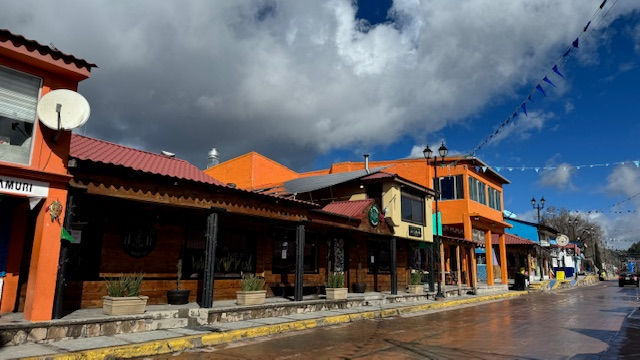
The restaurant was full with people eating and drinking beer, and we chose a table well away from the draughty door. We ordered chicken soup to warm up. Despite wearing two pullovers and my rain jacket, I was so cold that my hands were shaking and I spilt some of the soup while lifting the spoon to my mouth.
Afterwards, we walked the short distance back to our hotel. By then our shoes were soaked and muddy, our trousers and jackets wet; I could wring out my sodden socks. Dave switched the air-conditioning unit to heating mode and we hung up our shoes and clothes to dry overnight before slipping into bed to keep warm. It was not even 8 pm.
The large television did not work properly — the picture was blurry and hurt our eyes. However, we had Wi-Fi and were able to watch another episode of The Lincoln Lawyer on Netflix on Dave’s iPad, gradually warming up. We left the heater on throughout the night, as an icy draught came in through the gap beneath the door.
10th February 2026
Early in the morning I got up and worked on the blog. Then, at 7.30, we made our way through the waterlogged streets to the railway station. We had made a snap decision to get out of the town as quickly as possible rather than wait and hope that a train might be available on Friday. We wanted to leave immediately and did not worry about the two hotel nights we had already paid for.
It was still dark, freezing cold and thoroughly miserable. Although the rain had stopped, black clouds gathered on the horizon, threatening more rain throughout the day. Parts of the road and pavement that were not flooded were covered in ice. As we approached the railway station, masses of people with luggage were moving towards a waiting train. There was a train leaving at 8 am — yet only the previous day we had been told that there was just one train at 11.47. What was going on?
We pushed our way through the crowds of tourists and I asked someone where the train was going. “I don’t know,” came the reply. They asked others, “Where are we going?” — “I don’t know.” Finally, someone was able to tell us that it was the 8 o’clock train to Los Mochis.
There was no way we could return to the hotel, pack, and make it back in time. In any case, hundreds of people were trying to board, and there was no guarantee that seats were still available. We made our way to the ticket office instead. A very friendly lady informed us that the train was full, but sold us tickets for the 11.47 regional service. Phew — at least we were safe.
The El Chepe Express, the tourist train, carries between 340 and 540 passengers, depending on the configuration. It has six passenger carriages, a bar, a restaurant and a terrace with a viewing platform. There are three classes — tourist, executive and first class — and ticket prices range from 1,200 to 5,400 Mexican pesos (£51 to £230). We paid 1,030 pesos (£43) for our seats on the regional train. The regional service takes longer, as it stops at many more places along the route.
Calmly, we watched the tourists fighting to board the train and walked alongside the El Chepe to take some photographs. We were constantly followed by a few dogs that ran between our legs and nearly made us trip over. We simply could not shake them off. They did not bother the locals at all. Presumably, they had seen too many soppy films in which poor little stray dogs are taken home by tourists and live happily ever after. Sorry, mate — not with us. Off you go.


While we were waiting for the train to depart, many of the cars arriving in town — possibly from the surrounding hills — were covered in snow.

Eventually, the enormous El Chepe rolled past us and we took our photos. Afterwards, we went to the restaurant Las Cabañas for breakfast. I was delighted to see a large box with a selection of tea bags. There was no black tea, but I settled for the last bag of Earl Grey, which was the closest option. I had a mushroom omelette and Dave chose fried eggs.

Back at the hotel, we packed and worked a little more on the blog before leaving and returning the key to the owners, who were once again sitting in gloves and hats in their souvenir shop. We were relieved to be leaving what had felt like a rather inhospitable town.
We arrived at the railway station early. An icy wind swept across the platform, although it was slightly warmer inside the ticket office. Suddenly, I realised that in all the morning’s commotion we had forgotten to book a hotel in Los Mochis. We were due to arrive there at around 9.30 pm with nowhere to stay. Panic. I tried searching online on my phone, but there was no signal. What were we to do? We could not even telephone a hotel, as we did not know any in Los Mochis.
I approached the kind ticket clerk and, miraculously, she gave me access to her private internet connection. How incredibly generous of her. We had only a few minutes before the train arrived. I searched quickly and found a hotel with good reviews, booked it for the next four nights, and informed them that we would be arriving late on the El Chepe regional train. Phew — that was close, but at least we had somewhere to stay.
We will always remember what happened the last time we were in Los Mochis. Our plane was delayed and, although I had telephoned from Mexico City airport to inform the hotel that we would be late, they gave our room away and the hotel was closed when we arrived. That triggered a rather interesting chain of events, which I later wrote up as a story. See here…
En: https://www.rememberrelatereflect.com/en/post/on-the-way-to-the-copper-canyon-in-northern-mexico
The train arrived. I thanked the very kind ticket clerk and we boarded. Everything was very well organised. The train had left Chihuahua at 6 am and already had passengers on board. Several conductors were on hand, directing people to allocated seats. There was an economy class as well as a social economy class, with cheaper fares. A large group of mostly Indigenous passengers who had gathered at the far end of the platform with substantial luggage boarded those carriages.
We entered the economy-class carriage. Dave struggled with our luggage because one woman tried to squeeze past — very pushy, even though we all had assigned seats. Once we reached ours, Dave tried to position our hand luggage safely on the floor by our feet. The same woman was sitting in the seat in front of him and abruptly pushed her seat back. As there was resistance — Dave’s knee and hip were in the way — she pushed even harder. I had to tell her to stop. She then turned round and told us to put our hand luggage on the overhead rack so that she would have more space. That was precisely what we did not want to do, as it contained our expensive camera equipment (though I did not mention that). I asked one of the conductors who allocated seats, whether we could change to other seats as ours had restricted view. No problem - and we were far away from this very pushy lady. Eventually, we all settled down and the train departed, half an hour late.

There was plenty of space in our carriage, and many seats were empty at first, though they gradually filled up along the route. The Chepe Express had started its journey in rain and fog, but now, four hours later, the rain had stopped and, to our surprise, the sun even came out. We were lucky and enjoyed good views. Unfortunately, the windows were cracked and not ideal for photography, but at the end of the carriage there was a small platform where passengers could stand to admire the scenery and take pictures. Many did so, despite the big sign saying it was prohibited to stand on this platform as it was not safe. We spent some time there.
The journey was magnificent. The scenery was breathtaking. A man offered to take a photo of me leaning out of the window with my phone, from one window to the next, but I declined. He might have dropped it while leaning out — or worse, run off with it. Who knows? Better safe than sorry.

At the stop in Divisadero, we were allowed off the train for fifteen minutes. We remembered the location from our previous trip and hurried to the viewpoint from which there is a spectacular panorama of the Copper Canyon mountains, so that we could take some photographs.
Then we returned to the train and continued our journey through mountains and forests, and over bridges.


It was a long trip — eleven hours in total — though we managed to make up some of the delay. We were relieved when we finally arrived in Los Mochis at around 9 pm.
We looked for a taxi, but no one wanted to take us — possibly because the town centre was not far enough to make the fare worthwhile. Eventually, one driver, Ernesto, agreed to take us, but to compensate for the short distance he also picked up another couple along the way. Within ten minutes we arrived at the Hotel Central Americano in the centre of town.
We were shown to our room and were shocked. There was a tiny window set so high that you could not see out of it. The fridge was filthy. The air conditioning had cables hanging down, secured with tape. The bathroom light above the sink was loose, with just the bare bulb exposed — touch it with wet fingers and you could electrocute yourself. There was no wardrobe, nowhere to put our clothes, and nowhere to place toiletries in the bathroom. And this was a hotel with a review score of 9.0? There was no resemblance to the photos on booking.com. We simply could not believe it.
We went down to reception and asked for another room, but there were none available. The hotel was fully booked — perhaps something might become free the following day. Most likely, they had let out all the better rooms and kept this one in reserve in case we failed to turn up.
We were furious and did not sleep well that night, even though we were absolutely exhausted.
Los Mochis 11th until 14th February 2026
11th February 2026
The next morning I spoke to one of the cleaning ladies, who kindly showed us several rooms that had already been vacated. They were much nicer — not perfect, but certainly better than ours. We arranged to change rooms and then went down for a very tasty breakfast. We were far happier with the new room. It was cleaner, better organised, and the light fittings were secure. It even had a small desk and chair. That was perfectly adequate for us.
After spending some time working on the blog, we went out, changed some money, explored the town and found a launderette. Life was beginning to look up. We stopped at a café for a Coca-Cola, but the owner did not sell fizzy drinks. She specialised in healthy beverages and persuaded us to try protein shakes instead. Dave’s was a vivid pink.

We chatted for a while and eventually she asked how old we were. She seemed very surprised and said we looked so young and fit. Thank you very much. She herself was 64 and looked considerably older (despite the protein shakes). Over the past few weeks, several people had asked our age and seemed astonished that we were still fit enough to travel. In Mexico, people are often considered old at 60, partly because of the harsher living conditions. The average life expectancy is around 75 — 72 for men and 77 for women. Dave is already well beyond that and still strong and in excellent shape.
We carried on, dropped off our laundry at a launderette, and then looked for a restaurant for dinner. We could not find any. When we asked, we were told that there were no standalone restaurants and that most dining options were located inside hotels. We eventually found a restaurant in Hotel Fénix and studied the menu. Dave discovered they served pozole — a hearty soup with beans and generous portions of pork knuckle. That suited us perfectly. No alcohol, though. Never mind.
We returned to our hotel, worked on the blog for a while, and then went back to the Fénix for dinner.

The soup was delicious. The meat fell off the bone. It was rather too much meat for me, but still extremely tasty. With full stomachs, we walked back to our hotel, where a beer was waiting for us in the fridge. We watched another episode of The Lincoln Lawyer on Netflix and then fell into a deep sleep.
12th February 2026
Los Mochis is not a tourist destination in the traditional sense, and there is little to see or do for visitors. It does not have a Plaza de Armas where people gather. The city functions more as a business centre and transport hub. It is relatively young, founded in 1903, and has grown to become the third largest city in the state of Sinaloa. It is the western terminus of the Chihuahua-Pacific Railway (El Chepe), which passes through the scenic Copper Canyon. The railway concession was authorised and promoted by President Porfirio Díaz between 1897 and 1902 as a trade route linking the cattle markets in Kansas City with the nearest Pacific port, Topolobampo.
Today, the North Pacific region of Mexico (Sinaloa and Sonora) is Sinaloa’s principal agricultural area, producing sugar cane, cotton, rice, flowers, and a wide variety of vegetables. Transport connections are provided by air via Los Mochis Airport or by sea from the nearby port of Topolobampo. From Topolobampo, an overnight ferry carries cars and passengers across the narrow stretch of water to Baja California.
On this day, we wanted to explore the port and beach area of Topolobampo. We packed our swimming costumes and took a local bus on the 40-minute journey to Topo, as the locals call it. Taxi drivers in Los Mochis offer trips to the Marviri Islands in Topolobampo Bay, which are said to be very beautiful. It is a long and expensive journey, which we did not want to undertake today, as we will soon be in Baja California and will have plenty of time to enjoy the beaches there.
In Topo we wandered along the streets and visited a small local museum that displayed a replica of the first fighter aeroplane that had operated in the area in 1914 — a fascinating story, which I am sure Dave will elaborate on.


We then strolled along the Malecón. It was not quite what we had expected. The water was green and reeked of algae. Pelicans perched on boats or waded in the water, hunting for fish.

A few fishermen waited in the shade, offering tourist trips to the surrounding islands — though there were none to see at that time. A few groups of people sat on benches drinking beer. There was no proper beach, and swimming in the green water was not inviting at all.
We walked towards the port to see the ferry, but it was not there, presumably still out at sea. We had considered taking the ferry across to Baja California, but there was conflicting information online regarding the sailing days and times, and booking proved complicated. We did not want to risk having to wait several days for a ferry with available space, as we had already booked a motorhome in La Paz and were on a tight schedule. In the end, we opted to fly — a rather complicated route via Mexico City to San José del Cabo. Surprisingly, the flight was only slightly more expensive than the eleven-hour ferry.
At the far end of the Malecón, there were a few pleasant restaurants and cafés, likely catering to tourists arriving or leaving by ferry. We stopped for tea and coffee in a lovely café, where the friendly waitress assured us that the area came alive in the evenings before the boats departed.
Soon after, we made our way back by bus. We were tired, and rather than facing another pork-knuckle soup, we stayed in for the evening and settled for a bag of peanuts and a beer for dinner.
13th February 2026
I slept straight through until 5.30 in the morning — I must have been completely exhausted.
Today we faced the tricky task of withdrawing a rather large sum of money from ATMs. Tomorrow we are flying to Baja California, and on Sunday morning we are due to pick up our camper van. As part of the deal with VanBaja, the motorhome hire company, and to save on tax for the second payment, we had agreed to pay this second instalment in cash. Since we did not want to carry such a large amount of cash around Mexico for long, we needed to withdraw it shortly before the payment was due. Given our previous experience with ATMs in Sayulita, we were hoping that a business city like Los Mochis would make the process easier.
Yesterday, we had tested the waters — or rather, the cash machine — at the bank opposite the hotel, and it had worked. So, after breakfast, we went across the road to the same bank. To withdraw 48,000 Mexican pesos (£2,035), we had to take out the daily maximum from each of our cards. Three of the cards worked perfectly, but the last one refused on several machines. Back at the hotel, Dave called our bank in England. They assured us that the card had not been tampered with and should be fine. We tried another bank, and finally — success!
Now we are all set for tomorrow morning. The money is safely hidden away. The taxi driver will arrive at 5 am to take us to the airport, which means packing today and getting up at 4 am. Isn’t travelling fun!
We also booked a hotel in La Paz, Baja California, for tomorrow night, near the airport, as VanBaja, where we collect the camper van, is nearby.
14th February 2026
Today was an exhausting travel day. We got up at 4 am, the taxi picked us up at 5 am. The drive to the airport at this time of the day only took 25 minutes. The airport was still dark, but we saw inside some people and through a sliding door we got inside. Yesterday, I had received an email from the airline Volaris, urging us to be at least 3 hours before departure time at the airport. Departure time was 8am. When we arrived at 5.25 am everything was still closed, including the Starbucks Cafe. The airport slowly came to life just after 6.15. We checked in and had still time to have some breakfast. Then we went through security where I had to hand over my Swiss pocket knife, as I had forgotten to pack it into my suitcase. Shit!
The flight was an hour delayed, but we were not bothered, as we had a long stopover in Mexico City before our flight to Baja. When we landed, the woman next to me received a phone call and suddenly burst into tears. She sobbed loudly, desperately and inconsolable. Two flight attendants tried to consolidate her. In tears she said she immediately had to go back to Los Mochis. Some surrounding female passengers handed her tissues. The flight attendants offered to help her and led her off the plane before everyone else. We other passengers were shocked having experienced her desperation. Some of us probably thinking back to a desperate situation they had faced themselves. I still now think of her, what might have happened, and what she would be doing now.
The airport terminal in Mexico City is still under construction with lots of building work going on in preparation for the Football Cup. Dust and noice and smell of glue everywhere. Never mind. We soon entered our next flight and arrived in Baja California.
We stayed at the Airport Hotel, because Vanbaja, where we will pick-up our camper van tomorrow, is nearby. The hotel was a welcome change to the hotels we had stayed at during the last week: It had a huge room and a bed that was as large as our total bedroom at home. We had dinner in the hotel as there was no other restaurant around, and the fish fillets in garlic were delicious.
Afterwards, I was tired and exhausted and operated on autopilot. That had consequences: When cleaning my teeth I realised that the toothpaste did not foam and tasted horrible. Without my glasses on, I had taken the wrong tube: instead of the new blue Mexican toothpaste, I had taken the (also blue) anti-mosquito cream. Quickly, I rinsed my mouth to get rid of the horrible taste and cleaned my teeth extra long and extra carefully with the right toothpaste. Dave’s commentary: I should be glad as now at least my mouth was a mosquito-free zone!
———————
Dave:
08th February 2026
A solid night’s sleep at last, only interrupted by a few trips to the loo. I was up at 06:00 and working on my diary after a shower, while Lisa began hers at 06:30 from the comfort of the warm bed.
Breakfast at the hotel was a non-starter, the restaurant was full, with just one free table, so we set out in search of alternatives. Finding nothing open nearby, we walked towards the famous El Chepe railway station. En route, in a rather seedy area, we found a small café serving paninis and, more importantly, tea for Lisa.
The walk to the station was long and, frustratingly, it was closed, although still worth seeing. On the way back we stopped for a cold drink opposite the state penitentiary, where I was extremely grateful for a conveniently timed toilet break. Whilst I was otherwise occupied, Lisa went online and booked tomorrow’s bus from Chihuahua to Creel: MX$400 (£16.50) at the seniors discounted rate of 50%.
We stopped at the cathedral, Lisa venturing inside, then we caught the bus back to the hotel for MX$22 (93p). I was knackered and dozed while Lisa pressed on with the German blog translation. Tomorrow’s task: photo updates from 28 January to 7 February.
Dinner was their excellent chicken soup again, albeit with no crackers, and only one spice pot). Standards are certainly slipping! We were the sole diners.
Back in our room we went to bed to began Season 4 of The Lincoln Lawyer, newly released, but ten minutes in Beverley called. They were enjoying their final days in Mexico City, and they too had had an earthquake warning. Terry narrowly avoided losing his wallet to a three-man distraction gang, quick reactions and a chase forced them to drop it. A lucky escape indeed.
09th February 2026
Another restless night, whether from the antibiotics or a touch of flu, I’m not sure. I woke feeling decidedly under par: head tender, eyes like fried eggs, and alternating between hot and cold. At 07:40 it was still dark and just 12°C, sunrise not until 07:48.
During a brief pause in the rain we went in search of breakfast, but everywhere was closed, even approaching 09:00. OXXO yielded nothing but crisps and biscuits, so we retreated to the Ibis and chose the freshest-looking two of the four sandwiches available.
Chihuahua seems larger than when we last visited, but also more rundown. There’s talk of families moving away because of cartel violence, and the place feels neglected and subdued.
We packed, went down, and ordered an Uber to the bus station MX$87 (£3.67). Outside we bumped into the young Canadian with his British Columbia campervan. He was six months into a ten-month adventure, and also heading to Creel. We said our goodbyes and hoped our paths might cross again.
Our 11:00 bus, supposedly a 4½-hour journey, quickly descended into disorganisation. Although our tickets showed seats 3 and 4, the driver declared open seating. Fortunately we secured two together. The coach had seen better days: some seats broken and stuck fully reclined. Some passengers had to stand in the aisle. I go for a pee, but there are 5 screws holding the one toilet door firmly closed. Broken seats, seat allocation nil and the toilet locked more securely than Fort Knox. I’m glad we’re travelling 1st and not 2nd class!
There is no intel from our driver, so we don’t know when he pulls to a stop, whether its just to pick up/drop off passengers, or maybe just that little bit longer so we can get in a quick pee. One things for sure, nobody dares to try as our driver isn’t interested, and would simply drive off with our luggage and leave us behind. So we just sit and suffer, hoping our ordeal will be soon over. We finally reached Creel around 17:00 in cold, soaking conditions. Water flooding the streets.

Hotel Los Valles bore little resemblance to its online photos, and the room was freezing, though I managed to tweak the air-conditioning into producing warm air.
Determined to clarify El Chepe train times before the 18:00 closing, we set out for the train in torrential rain. We’ll before we reached the ticket office Lisa’s shoes and socks were soaked, and when we got there at 17:30 it was closed. An official in a yellow vest told us it reopened again at 07:00, but there remains confusion between the times of the Express and regular El Chepe services.
On the way back into town from the ticket office we’re surrounded by dogs and they’re an absolute nuisance. They’re constantly around your feet tripping you up. These are tagged street dogs, who think tourists are a soft touch, and they only pester them and leave the locals alone. Streetwise dogs indeed.
Hungry, cold and drenched, we eventually found warmth and a good meal at the delightful La Cabaña restaurant diagonally opposite our hotel. We had chicken soup, washed down with bottles of Modelo Negro beer.
Back in our chilly room, socks drying on the air-con, I set the temperature to 26°C, climbed under the thick teddy-bear over blanket, watched another episode of The Lincoln Lawyer, and fell asleep to the relentless drumming of rain on the roof.
10th February 2026
Thanks to the central heating we slept well, though I woke at 02:30 with painful toenails, but a quick trim solved that and I managed a few more hours’ sleep. Just before 07:00 we set out in a clear but freezing 2C morning to the station to book the 11:47 El Chepe Regional train to Los Mochis.
The platform was already chaotic, with the 08:00 El Chepe Express preparing to depart, and passengers scrambling to board. This El Chepe Express was news to us, but it was fully booked anyway. The helpful clerk secured us seats on the regional service for MX$2,068 (£87.87) for both of us (the Express would have been MX$2,364). We walked back carefully over icy sleepers and had breakfast at La Cabaña, passing cars coming into town covered in snow.


Back at our “hotel” we caught up on emails and blog posts, then checked out at 11:00, reclaiming our MX$50 key deposit and forfeiting two remaining nights, no great loss given the mismatch with its online photos. Another complaint for later.
At the station we waited in the chilly sunshine (still only 2C) for the 11:47 train to arrive.

It was a mad scramble boarding, when it did, but after being allocated seats with limited visibility, we charmed our carriage conductor, a football fan, with tales of Liverpool FC, and he moved us to better window seats, cracked glass notwithstanding. The train pulled away with a mournful blast of its klaxon.


We stopped briefly at Divisadero at 13:30 for a 15 minute break to let us stretch our legs and photograph the dramatic canyons. We got out of the train, taking our rucksacks with us, because you don’t know what some of the characters on this train are capable of. The carriage was full when we boarded, it was a good idea to mark our territory with our hats and jackets before we got off.

At Temoris a fellow passenger tipped me off about an upcoming 100-metre-high bridge the train would pass over. Photographers gathered by the open window despite warning signs written in big letters on the wall, ‘Prohibited to stand in this area’. After much jostling for position, and some near-misses with passing foliage, the bridge itself proved underwhelming, and we were over it in 20 seconds.


We noted the one-hour time difference with Los Mochis, Mexico City is an hour in front, important for our onward flight on Saturday, via Mexico City, to Baja California Sur to pickup our campervan.
As dusk fell we passed El Fuerte, where we’d travelled to Creel from nine years ago, and later Sufragio, arriving in warm Los Mochis at 20:45.
It was chaos getting off the train and even more so getting a taxi. A taxi valet grabbed our suitcases and took them to a group of taxi drivers, where we were allocated a driver, together with a young couple. We got in the back, the young couple had to squeeze together onto the passenger seat. We reached our hotel, the rather grandly named Hotel America Centro at 21:30 and paid our driver the set fare of MX$150 (£6.34).
Our allocated room was disappointing but the hotel was full, so no change possible until tomorrow. After showers, and another episode of The Lincoln Lawyer, we turned in, tired but satisfied after a memorable, and eventful day on the rails.
11th February 2026
I was awake at 04:30, thanks to a bus idling on the opposite side of the road. Beside the crossroads, a group of drivers gathered beside it for what looked like a pre-work smoke. They finally drove off at 05:15, but not before making one hell of a racket, another good reason to change rooms.
I worked on my diary until Lisa woke around 06:00 and began hers. By 06:30 I was tired enough to doze for an hour and a half. We showered and had breakfast. The maids kindly showed us a couple of rooms and we chose Room 81, which was an internal room overlooking a courtyard.
We approached reception prepared for a fight about the faults in our original room. We’d made a list: a broken bathroom light without a shade, a missing table, and a damaged air-conditioning surround, a loose taped electrical cable, a dirty fridge and a noisy room overlooking the street. To their credit, the staff agreed immediately and moved us without fuss. Even so, we’ve made notes and will be writing to Booking.com when we’re back in England.

After settling in, we continued working on the blog. Around noon we went out to find a lavadero so we’d have clean clothes for our flight to Baja California Sur on Saturday via Mexico City. We found one a few blocks away. A brief stop on our way back to our hotel at a rather intense health café ended with a polite escape. We dropped off our 3.9kg of dirty washing, which cost MX$160 (£6.78).

We’d already checked the menu at the Hotel Fenix, spotted Pozole, and that had settled our dinner plans. At 19:30we walked the two blocks to the hotel restaurant. Their Pozole was excellent; the service painfully slow. It had turned cool by the time we walked back.
Back in our room we had a rum nightcap, and watched another episode of The Lincoln Lawyer After that we crashed out.
12th February 2026
I was up at 05:45 for another diary session, finally finishing Wednesday’s entry three hours later. After breakfast, just as good as yesterday’s, we checked emails before heading out for a bus to Topolobampo, swimming trunks packed just in case.
The 40-minute ride ended by the malecón, where friendly locals ensured we found our way.
_________________________
We visited the modest but interesting Museo Comunitario Juan Noriega Valdivia.
Background information:
This community museum highlights: The First Naval–Air Battle in History (1914) during the Mexican Revolution, which took place in Topolobampo Bay. Historical photographs and documents. A scale model of an early biplane. Maritime and railway history of the port.
It is a modest museum but historically interesting because of the aviation connection.
________________________________

The waterfront itself was less appealing, with strong-smelling algae, murky water and no chance of a swim. There were many pelicans patrolled the bay, or lounging on the fishing and tourist boats bobbing about in the gentle breeze and 30C heat. We took a break at the far end of the Malecon for drinks at Alma de Mar café. We walked back along the Malecon before catching the minibus back to Los Mochis (MX$120 for both).


After collecting laundry, we retreated to the air-conditioned room for a rest, then worked through photos from Creel and our El Chepe journey. At 18:00 we enjoyed a cold beer while watching a documentary about the making of ‘Rumours’ by Fleetwood Mac.
We never made it out for dinner, peanuts sufficed, and rounded off the evening with two episodes of ‘The Lincoln Lawyer’, before lights out at 22:15.
13th February 2026
I was awake at 06:00 and quickly discovered I’d deleted something I shouldn’t have, which meant rewriting 11th February. Bother!! While I wrestled with that, Lisa worked on the German version of our blog. We finally broke for breakfast at 10:00.
I was also battling with the TomTom, trying to download the Mexico map, but the hotel Wi-Fi stubbornly redirected me to its IP address page. A problem for another day.
We’re getting a special cash deal on the campervan rental, so needed to withdraw MX$48,000 (£2,035.68). In the afternoon we went to the bank opposite. Lisa’s cards worked perfectly, but one of mine was repeatedly rejected. Back in the room I called First Direct; they could see no withdrawal attempts and suggested trying another bank. I did, and it worked immediately. The issue was clearly with the first bank. Crisis averted.
We also booked a hotel for Saturday night near the camper rental office and the airport, the Hotel Aeropuerto Los Cabos, conveniently within walking distance of departures.
Our flight to Los Cabos International Airport goes via Mexico City, departing Los Mochis International Airport at 07:57. We were advised to arrive three hours early, so alarms are set for 04:00 with a taxi booked for 05:00.
We worked until 18:30, then headed out to a local fiesta before dinner at the Hotel Fenix Restaurant. The fiesta was underwhelming, fast-food stalls around the perimeter, clothes and trinkets within, and in the centre a bandstand surrounded by happy parents, smartphones held a loft, taking photos a 7 year old singing very badly, and so off key it made my ears bleed. We left for the Fenix restaurant.
Dinner was quick, Lisa had flautas, I chose tacos, before returning to finish packing. We managed half an episode of The Lincoln Lawyer before an early night, ready for the pre-dawn start.
14th February 2026
Our alarms sounded at 04:00 on Valentine’s Day. (XX). We showered, packed, and met our taxi at 05:00. Twenty-five minutes later we were at Los Mochis International Airport, paying MX$300 (£12.69) for the ride. The airport didn’t officially open until 06:00, though the doors were already ajar and a couple of early travellers were inside.
We sat near Starbucks, where mosquitoes lurking in the pot plants made a meal of us while we had cups of coffee, and tea and shared half a baguette. The terminal soon filled. We checked our luggage through to Los Cabos International Airport and headed for security, where Lisa’s Swiss Army knife was confiscated, she’d forgot to put in the suitcase due to the early start.
Our flight was delayed by 23 minutes, but boarding was swift once the aircraft arrived, and we were seated and ready to go by 08:10. Nothing was complimentary, even a small carton of apple juice came at a price, very much the Mexican equivalent of a EasyJet, or Ryanair.

We landed in Mexico City at 11:10, but were briefly held on the tarmac due to an unspecified emergency. Five minutes later we taxied to the gate. The woman beside Lisa suddenly burst into tears, she had received news of a death and needed to return immediately to Los Mochis. The crew seemed uncertain how best to help her; it was an awkward and emotional scene.
Inside the terminal, preparations for summer football were causing confusion, and creating a lot of dust. We were sent to one end of the airport and then back again, good for the step counter if nothing else.
The onward flight to Baja California Sur took about 1 hour 45 minutes, landing at Aeropuerto de Los Cabos at 15:15 local time (we gained an hour). Disembarking via the rear steps into a warm 29C was a pleasant change after Creel.

Our bags were among the first on the carousel. After passing through security, we phoned for the hotel courtesy shuttle. The signal was poor and the rapid local accent didn’t help, but by luck I spotted the hotel courtesy vehicle outside. There were just the two of us, and a pilot, aboard.
We checked into the Hotel Aeropuerto Los Cabos, room 226, which was a welcome step up from some of our recent ‘hotel’ stays. I finally managed to download the Baja California Sur map onto the TomTom as this hotel had a better wifi, and we spent a good few hours catching up on our blog. Dinner tonight will be in the hotel restaurant.

