
Where do I stand? – My story with Judaism and Israel
(DE) The current debate on anti-Semitism and attitudes towards Israel in the mid-2020s is something that concerns me deeply. I feel unsettled. At what point do certain ways of thinking, certain statements and judgements cross the line into anti-Semitism? Some explanations fill me with fear and dread, because according to this understanding, I could be an anti-Semite.
This horrifies me, because from childhood right through to my adult life, I have engaged with the persecution and extermination of Jews in Germany. I know that for a long time I felt deeply ashamed of belonging to the nation of perpetrators, even though I was born after the war, in 1953. I knew, of course, that I myself had done nothing wrong, but perhaps the people around me had, and certainly many from the nation to which I belonged by birth, whether I wanted to or not.
And although I am actually certain that anti-Semitism has not taken root in my mind, in my heart or in my genes, I want to look back.
What experiences and attitudes towards Jews and the Jewish state of Israel was I confronted with during my childhood and youth, and well into my adult life, and how did I come to terms with them?
Judaism in my socialisation in the 1950s and 1960s
When I look back on my childhood, Jewish people certainly feature in stories and also in person.
My paternal grandmother had been a maid in private households before her marriage in 1930, including in Jewish households. When she told me in the 1950s about her experiences with the so-called ‘ladies and gentlemen’ – her employers – it made no difference which of the commanding, mean or malicious housewives was Jewish.
In the eyes of my socialist-minded grandmother, the ‘ladies and gentlemen’ were all members of a class she viewed with suspicion anyway. It was not a question of religious affiliation, but of social status. I never heard her speak of Jewish stereotypes, but I did hear class stereotypes.
It was also she who told me about the persecution and extermination of the Jews during the Third Reich, thereby stirring my childish sense of injustice. I asked the question many times – the very same question that Rachel Salamander, the German-Jewish scholar of literature, journalist and bookseller born in 1949, posed to her parents in a similar form: “Didn’t anyone help the Jews? Why didn’t anyone help?”
As a child, I couldn’t make sense of the explanation that they would have been arrested themselves. It was simply unbearable that people were allowed to be so cruel to other people for absolutely no reason.
Surely they must have realised that this wasn’t right, I thought.
Someone should have told them, I found.
I demanded that someone appeal to their conscience.
I remember spending days fantasising about how I might have managed, after all, to convince Hitler that you mustn’t just lock other people up, harm them and kill them.
Well, the fantasies of omnipotence of a six- or seven-year-old child!
These stories struck me as real fairy tales, in which evil men did evil things and no good spirit or person ensured a happy ending. My own life, however, was disconnected from these events, even though my grandmother would occasionally claim that this or that acquaintance or neighbour had also been a ‘Hitler’. By that, she meant that these people were Nazis. But there was never any mention of specific Jews she had known, nor of their fate. So whilst former Nazis certainly took on a definite form from time to time, Jews remained shadowy figures without any real individuality.
A huge mystery: Why did people want to persecute and kill Jews?
This injustice perpetrated by the Nazis and their followers weighed heavily on my mind, and my engagement with history – including the persecution of Jews in the Middle Ages – has been a constant companion throughout my life.
My interest in when, where and why Jews were persecuted never waned. I wanted to get to the bottom of what drove people to discriminate against and kill Jews. I read and read and read, yet I was never satisfied with the answers I found.
For example, when medieval landlords, church leaders or other powerful figures sought to rid themselves of their debts to a Jewish moneylender by inciting the town mob against the Jews, leading them to carry out pogroms, that was still not, for me, a sufficient explanation for hatred of Jews, for anti-Semitism.
I asked myself: why did people who didn’t even owe any money to Jews hate them so much that they killed them? How was that possible? It made no sense!
Religious reasons didn’t make sense either. After all, Jesus, Mary and most of the apostles had been Jews. How could people persecute Jews and accuse them of murdering Jesus, when Jesus himself was a Jew who had been tortured to death by the Romans?
Every story led to questions to which I could find no satisfactory answers.
My failure to ask questions within my own family!
Perhaps it would have helped if Jewish adults had explained their view of earlier and, above all, more recent history to me, or if someone close to Jewish fellow citizens had done so. That would have been helpful.
And yet I didn’t ask any further questions when my mother sometimes spoke of her time immediately after the war as a live-in maid with the Jewish Citronenbaum family.
That is why I do not know how it came about that a Jewish household took her in.
Sometimes she spoke of the rules that had to be observed in the kitchen of her Jewish host parents, and she was evidently allowed to go to the synagogue, for she also spoke of these rituals from time to time. But you could sense that the religious customs and traditions were alien to her, though not the people who looked after her. She was very fond of them. She always said she’d had a really good time as a live-in maid.
Because both my grandmothers had been maids in their youth, I thought as a child that my mother had also spent some time as a maid with the Citronenbaums. It was all quite normal. What I found exciting were the stories about mean and unjust, even malicious, employers. That gave me the chance to think about how I would have fought back against them. That wasn’t the case here. That world seemed to have been all right, at least back when my mother was a live-in maid.
My mother hardly ever spoke about what had happened to the individual family members during the Nazi regime.
I seem to recall her mentioning that the Citronenbaum family’s relatives had been killed in a concentration camp. Did she not know more? That’s entirely possible, as my mother was still almost a child when, in the late 1940s, she was taken in as a live-in daughter and later trained as an apprentice at the Citronenbaum & Jagoda textile shop. Neither her ‘host parents’ nor her employers would have shared their traumatic experiences with this young girl.
But I also cannot imagine that the past was never discussed at all, even though my mother never showed any particular interest in history. It simply wasn’t an issue for her. Perhaps the suffering of these people, whom she presumably liked, hit too close to home; it was too real, too harrowing. Or perhaps it was simply taboo in the post-war period to speak of the atrocities that had been inflicted on the Jews. Out of shame, out of helplessness, out of anti-Semitic feelings?
I don’t know, because I never probed any further! Never! Not even when I was older! What stopped me from pestered eyewitnesses like my mother with questions, when I devoured every book on Judaism and the persecution of the Jews that fell into my hands with such keen interest? – I cannot explain it.
So I am unable to say how my mother came to be a live-in daughter for a Jewish family after 1945, what family connections might have existed, what fate these people had endured, why they settled in Germany, what they thought of their German fellow citizens, and how they felt in German society.
A scandal in 1971 completely passed me by!
Nor can I recall our family ever discussing a scandal concerning the treatment of Mr Moses Leib Citronenbaum by the City of Regensburg in 1971. And I must say that at our dinner table at that time, I was 18 years old and enjoyed provoking political debates – politics was constantly being discussed.
When, whilst researching this text, I chanced upon this article in the Der Spiegel archive (see link in the appendix), I was surprised and shocked that, as a teenager, I’d been completely unaware of such blatantly anti-Semitic events.
I want to summarise the story here briefly:
In 1971, the Regensburg administrative authorities suddenly harboured doubts about the German ancestry of Moses Leib Citronenbaum, who had been born into a German-Jewish family in the small Polish town of Zmigoród.
As early as 1961, he had already been issued with a displaced persons’ identity card, to which he was entitled as a ‘former member of the German ethnic group’ under the Federal Displaced Persons Act (BVFG). He had provided all the evidence required under Section 6 of the BVFG for recognition.
In 1971, however, the authorities revoked this certificate based on a 1921 census in Poland, because the statistics showed that no Germans had been recorded in Zmigoród.
At no point, however, neither under Polish rule nor during the Nazi era, would it have been in the Jewish family’s best interests to identify themselves as Germans explicitly. Anyone familiar with history knows why!
What had happened?
The city’s Compensation Office had apparently received Moses L. Citronenbaum’s application for compensation and carried out its own investigations. The data from a 50-year-old census, conducted during difficult times in Poland, was given more credibility than the evidence and witness statements from 1961.
And so he had to produce all the evidence once again before the Bavarian Administrative Court. The court ultimately ruled in favour of the defendant.
However, I could not believe what was written at the end of this Spiegel article:
During the hearing, an associate judge asked the witness O., in all seriousness, whether the Nazi party organ Völkischer Beobachter (link attached) had been on display at the Citronenbaum family’s home in that small Polish town at the time.
Such a hate-mongering piece of propaganda in a Jewish household?! Proof of German ethnicity during the Nazi era?! Demanded in 1971? What on earth was going through that judge’s mind?! Surely no one could have been that clueless at that time!
A revealing question, I think! What sort of era or society were we living in back then? Denying history and, at any cost, denying Jews their German identity? That was Nazi ideology, after all!
Theoretically, of course, I already knew back then that many Nazi lawyers and civil servants had retained their positions and honours in the Federal Republic of Germany. But I’d actually believed that they would at least not dare to come out of hiding, that they feared being exposed and dismissed.
My God, how naive I was in my youthful arrogance!
Perhaps I believed – or hoped – that the old Nazis had gone into hiding because they feared us, the young people searching for the truth.
At the very least, I believed – or hoped – that the perpetrators were ashamed of their actions or their inaction during the Nazi era, just as I was ashamed of my mere affiliation with the perpetrator nation.
As a sign of my solidarity with Jews and Judaism, I crocheted a kippah and walked around town wearing it. Naturally, I attracted strange looks, which could only have been strange because someone recognised the symbol of Judaism on a woman’s head, where it didn’t really belong. To everyone else, it was just a harmless fashion accessory.
Today, people would say I was guilty of cultural appropriation. But back then, nobody knew anything about such offences.
And I looked upon Israel with great interest and through rose-tinted glasses – the well-deserved state of the Jews, as I thought at the time.
My romantic relationship with Israel
I cannot say exactly when I first became aware of the State of Israel. I only know that at some point, probably on the threshold of adolescence, I dreamt of becoming a kibbutznik. Life in a community! A new beginning! Building a new life! A spirit of optimism!
I think we heard at school that the Jews had built – and were still building – a magnificent, flourishing country that the Arabs living there had failed to make the most of. That was why they hated the Israelis and wanted to murder them.
As I knew a great deal about the persecution of the Jews in Germany, this made perfect sense to me straight away.
I admired this country, Israel, which was completely unknown to me.
Although I didn’t see the 1960 film Exodus, starring the charismatic Paul Newman, until later in my teenage years, it reinforced my extremely romantic view of Israel and the Israelis.
My view of Israel is changing!
Over the years, the history of Israel and the Middle East conflict was added to this history of anti-Semitism. And here, over the decades, my naïve perspective changed enormously. It became more realistic.
When I first began to engage with this conflict in the 1960s, I still looked solely to the Arabs and Palestinians for reasons behind their supposed hatred of Jews. I believed this to be the same hatred – that is, anti-Semitism – that had wreaked havoc in Europe for centuries and was still doing so.
Still completely caught up in my romanticised view of Israel, I could not quite understand the Palestinians’ hostility towards Jewish Israelis.
As late as 1983, I fully understood the two Jewish Israeli women who were studying German with me on my adult education course in Munich when they said that they were, after all, all inhabitants of Palestine and that it was downright malicious of the Arabs to be firing down on them from the Golan Heights.
Perhaps the kindness these two Israeli women showed towards me also influenced me, even though I was, after all, German.
Hadas, in particular, who was my age and with whom I became friends, talked to me about my feelings of guilt as a German.
She told me that her family in Israel had been completely baffled, even annoyed, when she and her husband had decided to move to Germany with their two children, where he’d been offered a good job. Although her parents were Holocaust survivors and therefore naturally harboured negative feelings towards Germany and the Germans, she explained, in her eyes, today’s Germany was a different country.
And she didn’t understand my feelings of guilt in the slightest. I must admit that this came as a bit of a relief to me.
These two women, representatives of Israel, fit so well with my image of Jewish Israelis. Self-assured, friendly, strong and human!
Looking back now, my attitude at the time seems almost philosemitic to me. However, it was more of a wishful dream that everything could turn out well, rather than the notion of ‘good Jewish genes’. (To put it briefly!)
I would have loved it so much if Israel had been innocent. But, as I had to admit to myself over time with a heavy heart, it wasn’t.
Not from the very beginning!
Wars, assassinations, the Intifada and reports of discrimination and harassment against Palestinians, as well as stories of expulsion and flight, brought about a shift in my perspective. I read Palestinian and Israeli authors in turn. I even read Theodor Herzl’s The Jewish State from 1896 in the hope of learning more about the idea of Zionism. But the conflict seemed – and still seems – really complicated to me.
A shocking experience
Back in the early 2010s, I came across a leaflet announcing a talk on Israel and the conflict with the Palestinians, followed by a discussion, at the Gasteig in Munich. I believe it was organised by the Jewish Community. I was really looking forward to this event and expected to gain some insight into the conflict in the Middle East.
The Israeli speaker, who spoke German very well, explained that the Palestinians in Gaza should leave things alone and open up their magnificent beaches to Israeli tourists. He claimed that in Israel, Palestinian Israelis had the same rights as Jewish Israelis and were treated equally.
Seated next to me were three young adults – two women and a man – one of whom was growing increasingly restless. When the floor was opened for questions, she spoke up and explained that she was a Jewish Israeli and had to disagree with the speaker’s remarks vehemently. At that, the audience in the front rows turned towards her with truly hate-filled expressions and shouted her down: Propagandist! Propagandist!
Frightened, the three of them and I left the hall.
With whom can I show solidarity? – With everyone? With no one?
I hadn’t expected anything like that. This experience was shocking and deeply unsettling. I never had another opportunity to speak to Jews about Israel until,
years later – in October 2024, to be precise – I went to a demonstration outside Ludwig Maximilian University in Munich.

On one side of Ludwigstraße, on Professor-Huber-Platz, pro-Palestinian demonstrators had gathered; they had set up a pro-Palestinian camp there months earlier.
Opposite them, on Geschwister-Scholl-Platz, a much smaller group of Jewish and pro-Israeli demonstrators had congregated.
The occasion was the massive bombardment of Gaza, which resulted in countless deaths and injuries, carried out by Israel following the attack and massacre perpetrated by Hamas against Israelis on 7 October 2023.
As I had already spoken to participants in the pro-Palestinian camp at Munich University on several occasions, I decided to take this opportunity to speak with the pro-Israeli side to learn how they viewed the situation.

A Jewish student, whom I asked whether he had had any conversations with his pro-Palestinian fellow students, told me that all he ever heard were threats and death wishes. Dialogue, he said, was impossible. An elderly gentleman who joined us began voicing prejudices against Palestinians, but was stopped by the young man. Apart from that, no one else from the pro-Israeli group showed any interest in talking to me.
The pro-Israeli demonstrators began dancing ecstatically to Jewish or Israeli songs. Almost at the same time, the pro-Palestinian protest march formed on Ludwigstraße and headed towards the city centre. They chanted hate-filled slogans such as “Child murderers! Child murderers!” as they marched past the dancing pro-Israeli demonstrators.
I stood shuddering between the two groups.
The defiantly dancing Jewish demonstrators struck me as lacking empathy for the suffering of the Palestinians in Gaza. Yet the hate-filled pro-Palestinian demonstrators also struck me as repulsive in their hatred.
I was unable to feel or show any solidarity that day. Both sides were alien to me, and yet at the same time, I still felt for them. Their respective causes were understandable.
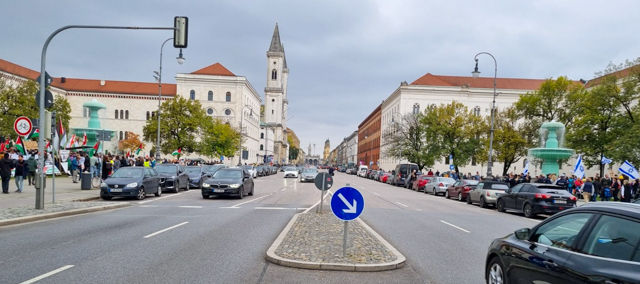
So I stood, pointedly, on a traffic island in the middle of the road. Of course, that didn’t impress anyone, but it reflected my inner stance. Helpless! At a loss! Hopeless!
As a contemporary, as a European, as a German, as someone not directly affected, do I really have no chance of truly grasping and making sense of this conflict? There are the principles of law and humanity, but I suspect that in this case, they do not always help.
Final thoughts
There is one question I will probably never really be able to answer, although I would very much like to know the answer:
Is my positive attitude towards Judaism a product of my feelings of guilt as a German, as a reluctant member of the nation responsible for the atrocities? Do I want to make amends in some way? To steel myself against anti-Semitism? So that I, too, do not become guilty one day?
The German government calls such an attitude ‘reasons of state’ and by this means the security guarantee for Israel! However, this required a new understanding of anti-Semitism – anti-Semitism relating to Israel!
I do not, however, subscribe to this fundamental broadening of the concept, even if it means I must repeatedly defend myself against accusations of anti-Semitism. (TA)
________________________________________________________________________
Background information:
Link to the Der Spiegel archive, which contains the article describing the legal dispute mentioned in the text between the Jewish merchant and the administrative authority.
Information on the Völkischer Beobachter


